On this page
- What are the basics of de-escalating an upset caller?
- What does a well-configured AI receptionist do with an angry caller?
- What should an AI receptionist say to an upset caller?
- Where does an AI receptionist fall short with upset callers?
- How should you review upset calls afterwards?
- How This Guide Was Sourced
- Frequently Asked Questions
- Conclusion
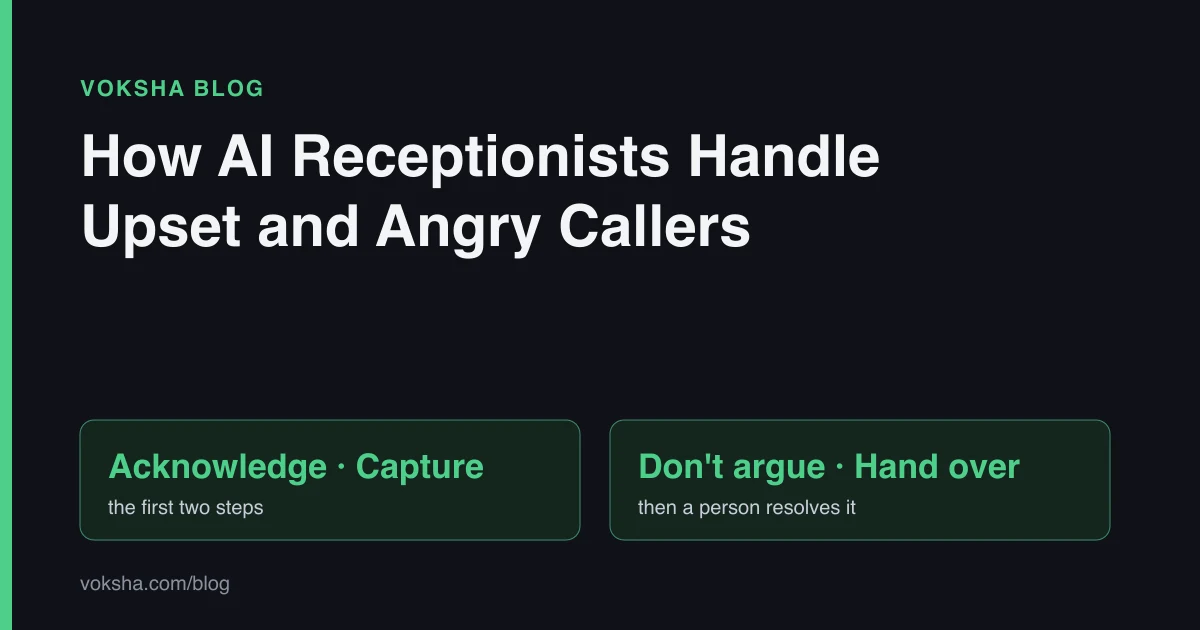
A well-configured AI receptionist handles an upset caller in four steps: acknowledge the problem in plain words, capture the facts, never argue, and hand over to a person with a clear next step. It should not try to fix the complaint, offer refunds or defend your business. Its job is to stop the call getting worse and make sure the right person picks it up fast. That only works if you write the trigger words and the exact lines it should say before an angry caller ever rings.
This guide is for owners and managers who worry about what happens when an annoyed customer reaches an AI instead of a person. It covers de-escalation basics, what a good AI does on the call, script lines you can copy, where AI falls short, and how to review those calls afterwards. If you have not yet written your general handoff rules, start with when an AI receptionist should transfer to a human.
Key Takeaways
- The AI's job is containment, not resolution. Acknowledge, capture, don't argue, hand over. Fixing the problem stays with you. ANALYSIS
- Write triggers as words, not moods. "Refund", "overcharged", "nobody showed up", "cancel my account" are reliable. "Sounds angry" is not.
- Script the awkward lines. Voksha's docs advise giving the agent "the exact words for the awkward moments", including "when the caller is angry", because "left blank, it improvises" (What it says, retrieved 2026-11-03).
- Do not count on the AI to read emotion. Treat any tone detection as a bonus. Build the handoff on what the caller says.
- Read the summaries afterwards. Each upset call shows you a gap in the script or in the business.
What are the basics of de-escalating an upset caller?
De-escalation means lowering the temperature before you try to solve anything. A person who feels heard calms down faster than a person who gets an explanation.
The same basics apply whether a person or an AI answers:
- Let them finish. Interrupting an angry caller restarts the anger.
- Name the problem back to them. "So the technician didn't arrive this morning, and you took the day off for it." This shows you listened.
- Apologize for the experience once. "I'm sorry, that's frustrating." Not five times, and not with excuses.
- Don't argue the facts on the call. Even if the caller is wrong, the phone is not the place to prove it.
- Give a concrete next step. Who will contact them, how, and by when.
- Keep it short. A long explanation sounds like a defense.
None of this needs a specialist. It needs the person, or the AI, to follow the same few rules every time.
What does a well-configured AI receptionist do with an angry caller?
It follows the four steps in order and stops at the handoff. It does not improvise a solution.
Here is what each step looks like in your instructions:
| Step | Put this in the instructions | Avoid |
|---|---|---|
| Acknowledge | "Repeat the problem back in one sentence and apologize once." | Long, repeated apologies that sound scripted |
| Capture | "Take their name, number, the date of the job and what they want us to do." | Asking for details they already gave |
| Don't argue | "Never explain why it happened. Never quote policy. Never offer refunds, discounts or credits." | Letting the AI defend the business |
| Hand over | "Transfer to the owner. If nobody answers, tell them the owner will contact them today." | Vague promises like "someone will be in touch" |
The "never offer refunds" line matters. Only you know what you can afford to give. An AI that offers a credit to calm someone down has made a promise in your name.
Where the call goes next depends on your setup. With Voksha, live call transfer to a person is on Premium only. Every plan, including Starter, sends you a call summary by email and SMS and can post alerts to Slack or Google Chat, so an upset caller reaches your attention within minutes even without a transfer.
What should an AI receptionist say to an upset caller?
Give it exact lines. Short ones. Here are lines you can adapt for your own instructions.
Acknowledging:
- "I'm sorry the technician didn't arrive. That's a wasted morning, and I understand why you're upset."
- "I hear you. Being charged twice is frustrating."
Capturing without making them repeat themselves:
- "So I get this right for the owner: you were booked for Tuesday at 9, nobody came, and you'd like a new time and an explanation. Is that right?"
- "What's the best number for the owner to reach you on?" Then read the number back one digit at a time.
When the caller demands something the AI cannot give:
- "I can't make that decision, but the owner can, and I'm sending this to them now."
- "I don't want to guess and get it wrong for you. I'll pass this straight to the person who can fix it."
Handing over:
- "I'm putting you through to Dana, our manager, now."
- "Dana will contact you before 5pm today. I've sent her everything you told me, so you won't need to start again."
When the caller is abusive:
- "I want to help, and I'll pass your message on. If the language continues, I'll end the call."
Write the business-specific parts yourself. The AI receptionist script guide shows where these lines fit in a full script. The top 5 AI receptionist mistakes covers the most common way this goes wrong: no fast path to a human.
Where does an AI receptionist fall short with upset callers?
An AI is a good first responder for an upset caller and a poor final one. Know the limits before you rely on it.
- It does not reliably read emotion. Some systems try to detect tone, but you should not build your handoff on it. A calm caller with a serious complaint and a loud caller with a small one sound different but may need the same action. Build triggers on words.
- It cannot make it right. Refunds, re-dos, discounts and apologies from the owner are business decisions. The AI can only pass them on.
- Some callers want a person on principle. If a caller asks for a human, hand them over. Don't make them argue for it.
- Grief and crisis calls need people. If your business regularly takes calls from people in distress, use the AI for overflow and put a person first.
- It can misunderstand. Voksha's own terms say the AI "may misunderstand callers, provide incomplete information, or fail to properly route calls", and that "you are responsible for reviewing call summaries, transcripts, and captured information for accuracy" (Voksha Terms of Service, section 10, retrieved 2026-11-03).
The honest comparison:
| AI receptionist | Experienced person | |
|---|---|---|
| Answers instantly, every time | Yes | Not when busy or off shift |
| Follows the same de-escalation rules every call | Yes, if written down | Depends on the day |
| Never gets defensive | Yes | Usually |
| Reads tone and adapts | Limited; don't rely on it | Yes |
| Can offer a refund or fix | No, by design | Yes |
| Owns the relationship afterwards | No | Yes |
The best setup uses both. The AI answers fast, stays calm and captures everything. The person makes the decision.
How should you review upset calls afterwards?
Read every upset call's summary within a day, then fix one thing. That habit improves both the AI and the business.
Each call leaves a recording, a transcript, a written summary and the details you asked the agent to collect (Reading your calls, retrieved 2026-11-03). One limit to know: search in the dashboard matches the caller's phone number only, not words in the call, so narrow by date and read the summaries (Reading your calls).
A five-minute review routine:
- Did the trigger fire? If the caller said "refund" and the AI kept trying to book them, add that word to the trigger.
- Did the AI argue or explain? If it defended the business, tighten the "don't argue" rule.
- Did it promise anything? Any refund, time or outcome you did not approve is a rule to add.
- Did the caller have to repeat themselves? If yes, shorten the capture step.
- What caused the complaint? Often the fix is not the script. It is the late technician or the confusing invoice.
Then make one test call that says the same thing the upset caller said. If the agent now handles it properly, the change worked. For measuring how this improves over time, see customer service KPIs for business phone calls.
How This Guide Was Sourced
Written by the Voksha team. Voksha builds AI receptionists for small businesses. We are not a neutral reviewer.
Sources and retrieval dates:
- Voksha Terms of Service, section 10, AI Service Disclaimer. Retrieved 2026-11-03
- Voksha docs: What it says and Reading your calls. Retrieved 2026-11-03
The de-escalation basics, the four-step flow and the script lines are editorial guidance, not measured results. This guide makes no claim about how well any AI detects emotion, because we found no source in our allowed set that measures it. No Voksha call data is used in this guide.
Frequently Asked Questions
Can an AI receptionist tell when a caller is angry?
Do not rely on it. Some systems try to detect tone, but tone is a weak signal on a phone line. Build your handoff on the words callers use, such as "refund", "complaint" or "cancel", and on any request to speak to a person.
Should an AI receptionist apologize to an angry caller?
Yes, once, for the experience. "I'm sorry, that's frustrating" is enough. Repeated apologies sound scripted, and the AI should never admit fault or explain the cause on your behalf.
What if the caller asks to speak to a real person?
Hand them over. Transfer the call if someone will answer, or capture their details and tell them exactly who will contact them and by when. Never make a caller argue for a human.
Should the AI offer refunds or discounts to calm someone down?
No. Put "never offer refunds, discounts or credits" in the agent's hard rules. Those decisions belong to you, and an AI promise made in your name is hard to take back.
How fast should I follow up after an upset call?
The same day if you can. The AI has already told the caller when to expect you, so meet that time. A fast, personal follow-up often turns a complaint into a loyal customer.
Conclusion
An AI receptionist will not fix an angry customer's problem, and it should not try. Its job is to answer fast, acknowledge, capture the facts, avoid arguing and put the caller in front of the person who can fix it. Write the trigger words, script the awkward lines, ban unapproved offers, and read every upset call's summary the next day.
Ready to set up an agent with your own handoff rules? Get started.