On this page
- Key Takeaways
- Where Do You Find Your Missed-Call Data?
- How Do You Clean the Data Before You Count?
- What Should a One-Week Call Audit Worksheet Look Like?
- How Do You Calculate Your Answer Rate?
- How Do You Put a Dollar Figure on Missed Calls?
- What Should You Do With the Results?
- How This Guide Was Sourced
- Frequently Asked Questions
- Conclusion
To audit your missed calls, collect seven days of call records from every place a call can land: your carrier's call log, your phone system's reports, your voicemail box and your Google Business Profile performance page. Remove spam. Count the calls a person answered and the calls nobody did. Divide answered by total to get your answer rate. Then multiply the missed calls by $12.15, the direct cost per missed call in Voksha's Missed-Revenue Methodology (R-05), for a conservative weekly cost floor.
This guide is for owners and office managers who suspect the phone is leaking but have never measured it. It covers where the data lives, how to clean it, a day-by-day worksheet, and the two numbers that come out of it. It does not repeat the big-picture cost argument, which is in the true cost of missed calls, or the full metric list in 10 customer service KPIs for business phone calls.
Key Takeaways
- One week is enough. Seven consecutive days catch weekday peaks, lunch gaps and the weekend, which is where most small businesses find their misses.
- Your answer rate is answered calls divided by real inbound calls. Strip out spam first, or the number lies in both directions.
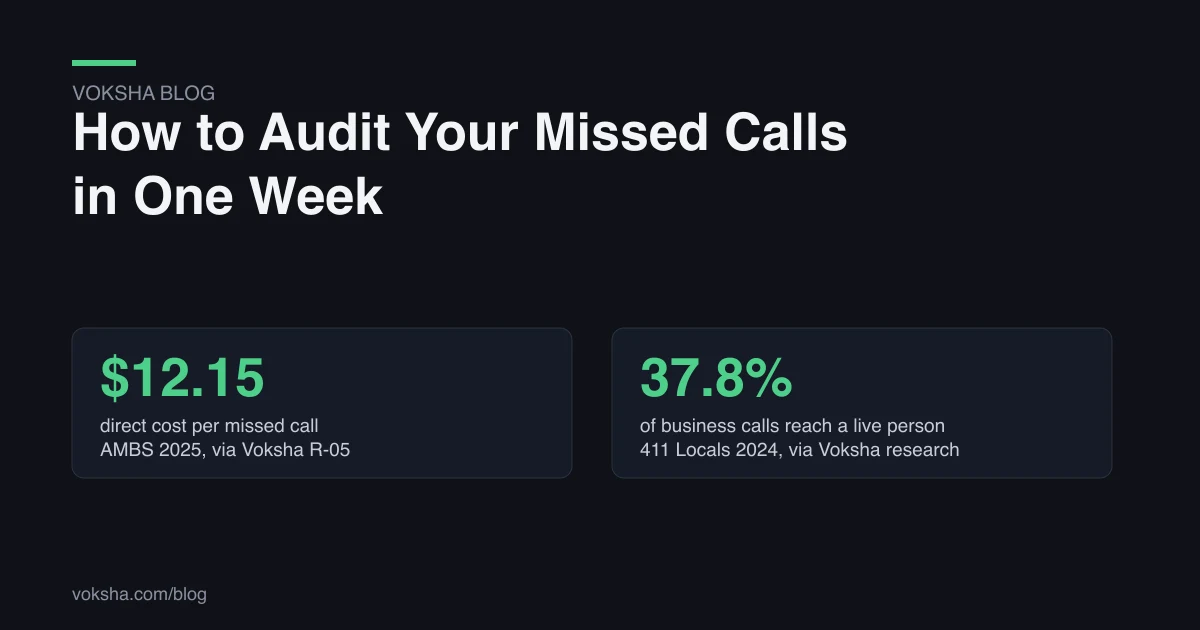
- Use $12.15 per missed call as a floor, not a forecast. That is the direct cost per missed call from AMBS Call Center (August 2025), as analyzed in Voksha's R-05 report. Your real value per call is usually higher.
- The benchmark is low. Businesses answer only 37.8% of inbound calls (411 Locals, 2024, as reported in the After-Hours Economy report).
- Google no longer shows call history. Google Business Profile retired call history on July 31, 2024, so it can only tell you how many people tapped "Call" (Google Business Profile Help, retrieved 2026-11-03).
Where Do You Find Your Missed-Call Data?
Your call data is spread across three or four systems. None of them tells the whole story alone, so pull from each one for the same seven days.
1. Your carrier's call log. If your business number is a mobile line, your carrier's online account or app shows incoming calls with time, number and duration. A call with zero duration, or one that went to voicemail, is a miss. Export or screenshot every day of the audit week.
2. Your phone system's reports. A VoIP or hosted phone system usually has a call history or call detail report in the admin portal. Look for a status column: answered, missed, voicemail, busy or abandoned. This is the cleanest source if you have it. Filter to inbound calls only.
3. Your voicemail box. Count the voicemails left each day. Do not delete them during the audit week. The gap between calls that reached voicemail and voicemails actually left tells you how many callers hung up. Research summarized in the After-Hours Economy report puts that hang-up share at 80-85% of voicemail callers.
4. Your Google Business Profile. The performance page has a "Calls" metric, defined as "the number of times a customer clicked on the call button on your Business Profile" (Google Business Profile Help, retrieved 2026-11-03). It is a click count, not a call log. Since July 31, 2024 you can no longer see customer call history there (Google, retrieved 2026-11-03). Use it to check whether call-button taps roughly match the calls your carrier logged.
If you have none of these, keep a paper tally by the phone for a week. Every time it rings, mark answered or missed. It is crude, but it beats a guess.
How Do You Clean the Data Before You Count?
Clean the list before you calculate anything. Three kinds of calls distort the result.
- Spam and robocalls. Remove them. They inflate your total and, if you ignore them, make your answer rate look worse than it is. If your carrier labels calls "spam likely", use that label.
- Repeat callers. One person who calls three times in ten minutes is one customer and three missed calls. Count calls for the answer rate, but note unique numbers separately. A repeat caller is a warning sign: they really wanted you.
- Internal and outbound calls. Staff calling the main line, or calls you placed, do not belong in an inbound audit.
Write down the time of each missed call. The pattern matters more than the total. Misses that cluster at lunch call for a different fix than misses after 5 pm. Voksha's data shows 32% of calls arrive outside 9-to-5 weekday hours and 23% on weekends (After-Hours Economy), and our post on when customers call breaks the timing down further.
What Should a One-Week Call Audit Worksheet Look Like?
Use one row per day. Fill it in each evening from your sources, not at the end of the week from memory.
| Day | Real inbound calls | Answered by a person | Reached voicemail | Voicemails left | Missed (no person) | Busiest miss window |
|---|---|---|---|---|---|---|
| Mon | ||||||
| Tue | ||||||
| Wed | ||||||
| Thu | ||||||
| Fri | ||||||
| Sat | ||||||
| Sun | ||||||
| Week total |
How to fill each column:
- Real inbound calls: every inbound call after spam and internal calls are removed.
- Answered by a person: someone at your business picked up and spoke to the caller.
- Reached voicemail: the call rolled to voicemail, whether or not a message was left.
- Voicemails left: messages actually recorded.
- Missed (no person): real inbound minus answered. This includes voicemails, hang-ups and busy signals.
- Busiest miss window: the two-hour block with the most misses that day.
Add a notes line under the table for anything unusual: a staff absence, a promotion, a storm. One odd week can skew the result, so flag it.
How Do You Calculate Your Answer Rate?
Your answer rate is calls answered by a person divided by real inbound calls, times 100.
Answer rate = answered ÷ real inbound calls × 100
Worked example, ANALYSIS: a salon logs 120 real inbound calls in the week. Staff answered 84. The answer rate is 84 ÷ 120 = 70%. The other 36 calls were missed.
Compare that to the 37.8% figure from 411 Locals (2024), reported in the After-Hours Economy report. Beating a low benchmark is not the goal. Every missed caller is a person who wanted to give you money or needed help. The useful comparison is your own answer rate by day and by hour, because it shows where the gaps are.
Two more numbers fall out of the worksheet for free:
- Voicemail message rate = voicemails left ÷ calls that reached voicemail. If it is low, voicemail is not catching your misses.
- Weekend share of misses = Saturday and Sunday misses ÷ total misses. If it is high, your problem is coverage hours, not staff speed.
How Do You Put a Dollar Figure on Missed Calls?
Multiply your weekly missed calls by $12.15 for a conservative floor. Then, if you know your average value per call, run the fuller model from R-05.
Floor estimate (direct cost only):
Weekly cost = missed calls × $12.15
Using the salon example, ANALYSIS: 36 missed calls × $12.15 = $437.40 for the week. Over 52 weeks that is about $22,745 a year, if the week was typical.
The $12.15 figure is AMBS Call Center's direct cost per missed call (August 2025), which AMBS puts at about $26,000 a year for a business missing six calls a day (R-05). It is a floor because it ignores what the job was worth.
Fuller estimate (your own value per call): R-05 uses this formula: missed calls per month × value per call × 12 × the share of missed callers who never come back. R-05 uses about 85% for that last input, from industry data. Plug in your own average sale, not someone else's.
What Should You Do With the Results?
Match the fix to the pattern you found. The audit is only useful if it changes something.
| What the audit shows | Likely cause | First fix to try |
|---|---|---|
| Misses cluster at lunch or shift changes | Nobody assigned to the phone | Stagger breaks; name a phone owner per hour |
| Misses cluster while staff are with customers | Line busy or hands full | Overflow forwarding on busy or no answer |
| Misses cluster evenings and weekends | Coverage hours end before demand does | After-hours answering: staff rota, answering service or AI |
| Many hang-ups at voicemail, few messages | Callers will not leave messages | Replace voicemail as the fallback (see voicemail alternatives) |
| Low miss count, high spam share | Spam is eating staff time | Carrier spam labeling and call screening |
Rerun the audit a month after any change. Same seven-day window, same sources, same worksheet. That is how you know the fix worked.
Where an AI receptionist is the wrong answer: if your misses are mostly calls that need a judgment call from you personally, such as a distressed client or a complex quote, the fix is freeing up your own time or adding a person. An AI receptionist answers, captures details and routes. It does not replace your expertise. For businesses whose misses are routine questions and booking requests, Voksha answers every call 24/7 and sends you a summary, so the "Missed" column on next month's worksheet can be zero.
How This Guide Was Sourced
This guide was written by the Voksha team. Voksha builds AI receptionists for small businesses. We are not a neutral party on phone coverage, and we say so.
- $12.15 per missed call and about $26,000 a year at six missed calls a day: AMBS Call Center (August 2025), as analyzed in Voksha's Missed-Revenue Methodology (R-05).
- 37.8% answer rate (411 Locals, 2024), 80-85% voicemail hang-up rate, and 32% of calls outside 9-to-5 weekdays: Voksha After-Hours Economy report.
- Google Business Profile call history retirement and the "Calls" metric definition: Google Business Profile Help, changes to chat and call history and Google Business Profile Help, performance insights, both retrieved 2026-11-03.
- Worked examples (the salon, the bar chart) are ANALYSIS using the figures above.
No Voksha call data is used in this guide beyond the published research reports linked above.
Frequently Asked Questions
How long should a missed-call audit run?
Seven consecutive days. A week catches weekday peaks, lunch gaps and the weekend. If your business is seasonal, run it once in a busy week and once in a quiet one.
Do spam calls count as missed calls?
No. Remove spam and robocalls before you count. Leaving them in inflates your total and distorts your answer rate.
Can I get call history from Google Business Profile?
Not any more. Google retired call history on July 31, 2024. The performance page still shows how many people clicked your call button, which is useful as a cross-check against your carrier's log.
Is $12.15 what every missed call costs me?
No. It is a conservative direct-cost figure from AMBS Call Center (August 2025), analyzed in Voksha's R-05 report. If your average job is worth hundreds of dollars, your real cost per missed call is higher. Use R-05's formula with your own value per call.
What is a good answer rate for a small business?
Aim to answer every real call. The 37.8% figure from 411 Locals (2024) is a description of how many businesses perform, not a target. Track your own rate by hour and push the worst hours up first.
Conclusion
A one-week audit turns "I think we miss some calls" into a number you can act on. Pull the logs, clean out the spam, fill the worksheet, and price the misses at $12.15 as a floor. Then fix the worst time window first and measure again. If the pattern points to coverage you cannot staff, see Voksha's pricing to compare the cost against what your worksheet says you are losing.