On this page
- Key Takeaways
- Why Does a Fintech SaaS Company Need Someone on the Phone at All?
- What Can an AI Receptionist Handle for a Fintech SaaS Company?
- What Should an AI Receptionist Never Ask a Fintech Caller?
- How Does an AI Receptionist Protect Against Social Engineering?
- When Should a Fintech Call Go to a Human?
- What Compliance Questions Should You Ask an AI Receptionist Vendor?
- When Is an AI Receptionist the Wrong Choice for Fintech Support?
- How This Guide Was Sourced
- Frequently Asked Questions
- Conclusion
An AI receptionist can answer a fintech SaaS company's inbound phone line 24/7, tell a sales prospect from a customer with a support or billing problem, collect the details your team needs, and send each call to the right people. What it must never do is act as an identity check. It should never ask for a full card number, a password, a one-time code or a full Social Security number, and it should never reset access or change account details. Those belong in your authenticated product, behind your own controls.
This guide is for founders, support leads and RevOps teams at fintech SaaS companies: payments, lending, payroll and wealth platforms. It covers what to automate, what the AI must refuse to take, social-engineering defenses, escalation, and compliance questions for any vendor.
Key Takeaways
- Phone fraud is not a niche problem. Consumers reported losing more than $12.5 billion to fraud in 2024, imposter scams accounted for $2.95 billion, and phone calls were the second most commonly reported contact method (FTC, retrieved 2026-11-03).
- The AI is a receptionist, not a verifier. It sorts and records calls. It never collects secrets and never takes an account action on a caller's word.
- Your security program may be a legal requirement. The FTC Safeguards Rule requires covered financial institutions to keep a written information security program and train staff (FTC Safeguards Rule guide, retrieved 2026-11-03).
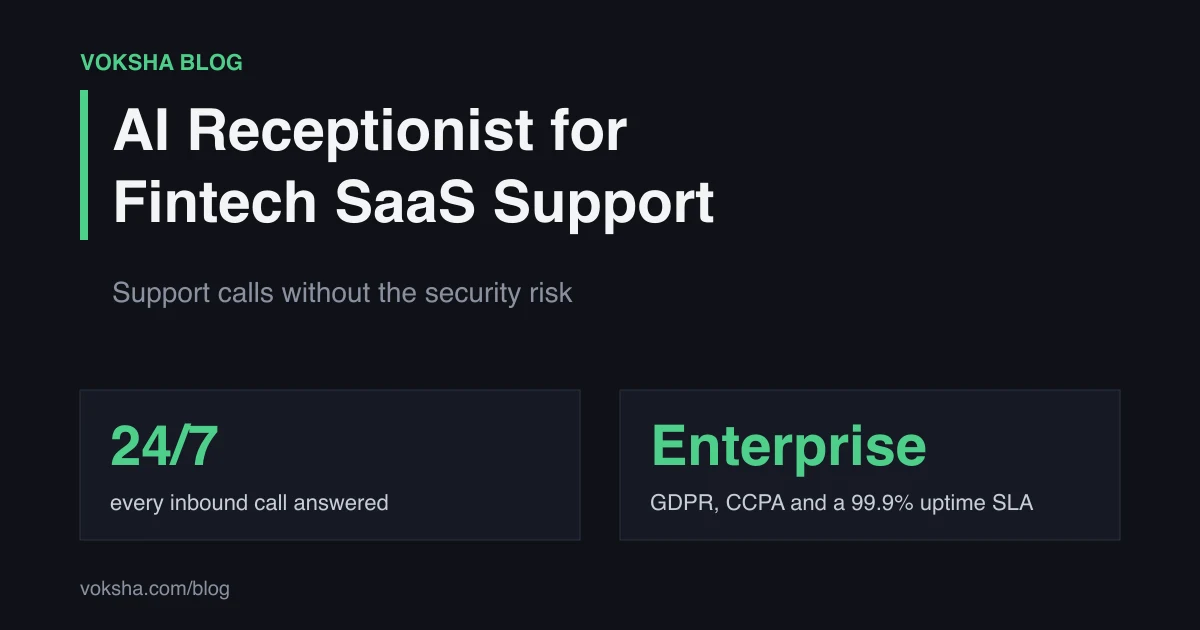
- Compliance items differ by plan. On Voksha, SOC 2 and ISO 27001 compliance apply on every plan; GDPR, CCPA, HIPAA with BAAs and the 99.9% uptime SLA are Enterprise only.
Why Does a Fintech SaaS Company Need Someone on the Phone at All?
Because buyers and customers still call. A finance director wants a person before a demo. A customer whose payout failed on a Friday night wants an answer, not a ticket form. Most of these calls are sorting jobs: "I want a demo," "My invoice looks wrong," "Is your platform down?"
The same line is also where attackers start. A friendly caller who "just needs to confirm" an executive's email or "lost access" to an admin account is a classic opening, and a helpful front line is exactly what they want.
What Can an AI Receptionist Handle for a Fintech SaaS Company?
Sorting and record-keeping, yes. Anything needing proof of identity, no.
| Call type | What the AI does | What it never does | Where it goes |
|---|---|---|---|
| New sales inquiry | Asks your qualifying questions: company size, use case, timeline | Quote custom pricing or promise features | Sales; demo booked on Premium |
| Support: how-to question | Answers from your approved help content | Look up or change account data | Resolved, or support ticket via summary |
| Support: failed payment or payout | Takes company name, contact, a description of the issue | Ask for card, bank or login details | Support, flagged urgent |
| Billing dispute | Records the dispute and the invoice reference the caller gives | Agree to refunds or credits | Billing team |
| "I'm locked out" or "reset my 2FA" | Tells the caller to use your in-app recovery flow | Reset, unfreeze or verify anything | Security or support, flagged |
| Status or outage question | Gives the status page link from your script | Speculate on cause or timing | Nobody, if answered |
| Press, legal, regulator | Takes name, organization, reason | Comment | The named contact |
On Voksha, every plan answers, follows your script and sends summaries by email, SMS, Slack or Google Chat. Booking demos and integrations are Premium. HubSpot, Salesforce, Zendesk and Intercom are among the platforms set up with Voksha support rather than connected from the dashboard; see the connector directory (retrieved 2026-11-03) and the CRM integration guide.
What Should an AI Receptionist Never Ask a Fintech Caller?
Put a do-not-collect list at the top of the script: full card numbers, expiry dates and CVV codes; passwords, PINs and security answers; one-time passcodes and 2FA codes; full bank account or Social Security numbers. If a caller starts reading one out, the AI stops them politely. Asking for a one-time code is exactly what an attacker does, so your customers should learn that you never ask.
Keep the list short for a second reason: everything a call captures ends up in a transcript and a summary. Less data means less to protect.
How Does an AI Receptionist Protect Against Social Engineering?
It does not get talked out of its rules. A person can be charmed, rushed or guilted. An AI told "never disclose employee names, direct lines, schedules or internal systems" says the same thing on the 500th call as the first.
Configure it to:
- Disclose only what is public. Your website, help center and status page. Nothing about staff, org charts, vendors or systems.
- Refuse urgency. "The CEO needs this in five minutes" gets the same polite answer as any other request: a message taken, the right team alerted.
- Never confirm who is a customer. "Is Acme Corp one of your clients?" gets "I can't share that, but I can take a message."
- Flag suspicious calls. Ask for a short tag in the summary when a caller pushes for internal details, so your security team can spot patterns.
Voksha reports 99.96% guardrail integrity across 1,000,000+ calls (Voksha Call Intelligence Report, retrieved 2026-11-03). That measures the AI keeping to its instructions; it does not make it an identity check. For the wider picture, read social engineering protection with AI receptionists and the checklist of security features to look for in any AI phone system. Deepak Gupta's analysis of AI receptionists and vishing defense covers the attacker's side.
When Should a Fintech Call Go to a Human?
Escalate any call where money, access or a regulator is involved. A practical rule set:
- Reported fraud or account takeover. Alert security at once; Slack and Google Chat alerts work on every Voksha plan.
- A failed payout or payroll run. Urgent support. On Premium, live call transfer can reach the on-call person.
- Closing an account, moving funds or changing payment details. Record and route. Never act.
- Regulators, law enforcement and lawyers. Details for the named contact only.
- An upset caller who wants a person. Route them.
Test the rules with calls that sound like real attacks. The guide to AI call routing covers routing patterns.
What Compliance Questions Should You Ask an AI Receptionist Vendor?
Start with your own obligations. The FTC Safeguards Rule applies to financial institutions under the FTC's jurisdiction, such as mortgage lenders, payday lenders and finance companies. Covered institutions must keep a written information security program "appropriate to the size and complexity" of the business, train staff, and notify the FTC within 30 days of discovering an event affecting at least 500 consumers' unencrypted information (FTC Safeguards Rule guide, retrieved 2026-11-03). Whether you are covered is a question for your counsel. Then ask every vendor:
| Question | What a good answer looks like | Voksha's answer |
|---|---|---|
| How is call data encrypted? | Named standards at rest and in transit | AES-256 at rest, TLS 1.3 in transit, all plans |
| Which security frameworks do you follow? | Named frameworks and how they are reviewed | SOC 2 compliant and ISO 27001 compliant, all plans |
| Where is data stored? | Named regions | North American data centers, with Canadian data storage |
| Breach notification timeline? | A stated number of hours | Within 72 hours, all plans |
| GDPR and CCPA? | Clear yes or no, by plan | Enterprise plan only |
| Uptime commitment? | A written SLA | 99.9% uptime SLA, Enterprise plan only |
| Can it be kept from collecting card data? | Script-level rules you control | Yes, through your script |
Voksha's answers are from its pricing plans and published product facts (retrieved 2026-11-03). If you need GDPR or CCPA commitments or an uptime SLA in writing, that means Enterprise, from $990/month. If your support line exists to take payments by phone, an AI receptionist on a standard plan is the wrong tool: card-handling rules are a separate project for your security team.
When Is an AI Receptionist the Wrong Choice for Fintech Support?
- Your phone line does account servicing. If phone agents verify identity and change accounts today, you need trained, authorized humans and verification tooling.
- Your callers are mostly fraud victims. They need a person quickly. Use the AI only to route them faster.
- Your team always answers. If three people share one phone and always pick up, you may not need anything.
How This Guide Was Sourced
This guide was written by the Voksha team. Voksha builds AI receptionists for small businesses. We are not a neutral reviewer and do not pretend to be.
Sources and retrieval dates:
- FTC press release, March 2025: more than $12.5 billion reported lost to fraud in 2024; imposter scams second by losses at $2.95 billion; phone calls the second most commonly reported contact method. Retrieved 2026-11-03.
- FTC Safeguards Rule: What Your Business Needs to Know: coverage examples, written program, staff training, 500-consumer and 30-day notification requirement. Retrieved 2026-11-03.
- Voksha Call Intelligence Report: 99.96% guardrail integrity across 1,000,000+ calls. Retrieved 2026-11-03.
- Voksha connector directory and pricing: integration and plan details. Retrieved 2026-11-03.
The tables, do-not-collect list and escalation rules are editorial guidance, not measured statistics. Nothing here is legal advice.
Frequently Asked Questions
Can an AI receptionist verify a fintech customer's identity?
It should not. Verification belongs inside your authenticated product. The AI records who the caller says they are and routes the call.
Should an AI receptionist ever take card details over the phone?
No. Write a do-not-collect rule for card numbers, expiry dates and CVV codes, and have the AI stop a caller who starts reading one out.
Can it tell sales calls from support calls?
Yes. It asks why the person is calling, sorts the call and alerts the right team. On Premium, it books sales demos.
Does it work with HubSpot, Salesforce or Zendesk?
On Voksha, those are set up with Voksha support on Premium or Enterprise, not connected yourself from the dashboard. Starter has no integrations; it sends summaries by email and SMS.
Is an AI receptionist GDPR and CCPA compliant?
That depends on the vendor and plan. On Voksha, GDPR and CCPA compliance come with the Enterprise plan only, along with HIPAA with BAAs and a 99.9% uptime SLA. SOC 2 and ISO 27001 compliance apply on every plan.
Conclusion
Use an AI receptionist to sort calls, answer common questions and get the right team the right facts fast. Keep it out of anything that needs proof of identity. Give it a short do-not-collect list, a strict disclosure rule and clear escalation paths, and test it the way an attacker would. Check your own obligations under the Safeguards Rule and any other regime that applies to you, and confirm with your own counsel.
To see how it fits a fintech team, visit Voksha for fintech SaaS.