On this page
- Key Takeaways
- Why Do Moving Companies Miss So Many Calls?
- What Kinds of Calls Does a Moving Company Get?
- What Should an AI Receptionist Ask on a Moving Quote Call?
- Can an AI Receptionist Give a Moving Quote Over the Phone?
- How Do You Handle Peak Season and Month-End Rushes?
- What About Move-Day Calls?
- Where Is an AI Receptionist the Wrong Choice for a Mover?
- What Does It Cost Compared With Other Options?
- How This Guide Was Sourced
- Frequently Asked Questions
- Conclusion
A moving company's phone works against it. Quote calls pile up in summer and at the end of each month, which is when your crews are on trucks and your estimators are inside other people's homes. An AI receptionist answers every call on the first ring. It takes the move date, the addresses and the home size. It flags the piano and the third-floor walk-up, and on a Premium plan it books the estimate. Pricing judgement stays with your people. The phone stops costing you jobs.
This guide is for owners and office managers at local and regional moving companies, from a two-truck operation to a multi-crew outfit. It covers the four kinds of call a mover gets, what an AI receptionist should and should not say on each, how to handle peak season and move-day calls, and what it costs.
Key Takeaways
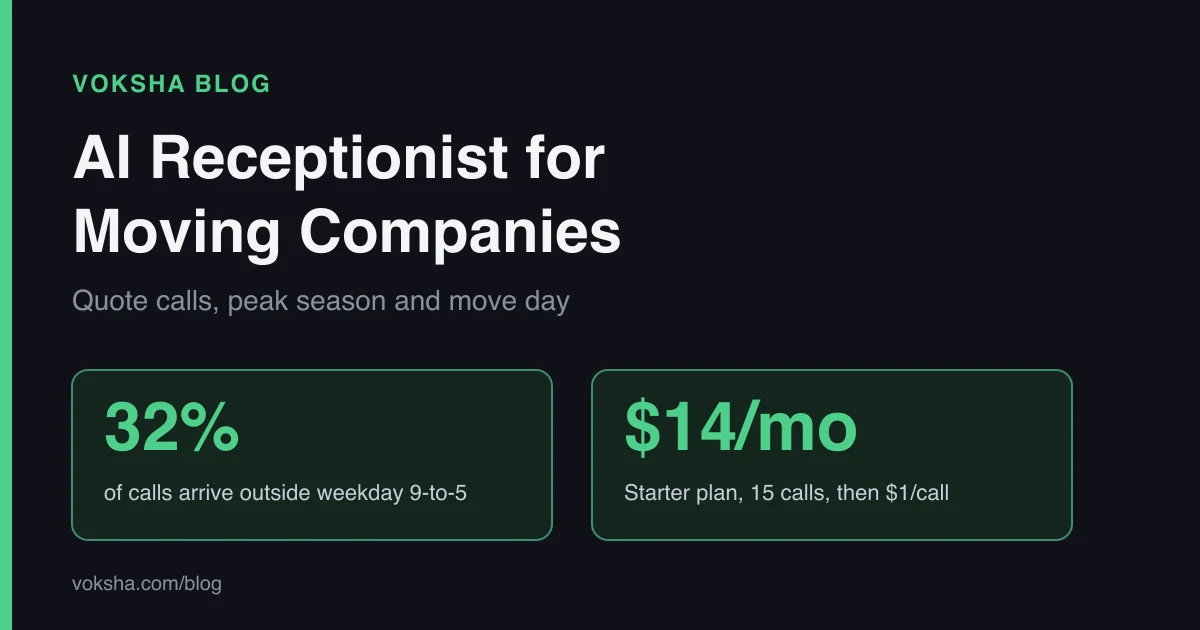
- 32% of calls arrive outside 9-to-5 weekday hours and 23% at weekends (Voksha After-Hours Economy Report, 1,000,000+ calls). People plan a move in the evening, after work.
- Quote calls are the automation target. Move date, origin, destination, home size and special items follow the same pattern on every call. An AI can capture all of it the same way every time.
- For interstate moves, the estimate is regulated. Federal rules require a written estimate, based on a physical survey unless the shipper waives it in writing, and say whether it is binding or non-binding (49 CFR 375.401, retrieved 2026-11-03). A phone ballpark is not that estimate.
- Move-day calls need a person. A crew running late, a damaged item, or a dispute over the final bill should go straight to someone who can act.
- Costs start at $14 a month for 15 calls, then $1 per call. Booking estimates into your calendar is on Premium, $99 a month for 150 calls (Voksha pricing).
Why Do Moving Companies Miss So Many Calls?
Three things work against whoever holds your phone.
- Demand comes in waves. Summer and the last days of each month bunch up the moves, and the quote calls bunch up with them. A phone that is quiet in February rings constantly in June.
- Your people are busy elsewhere. The owner is on a truck. The estimator is walking through someone's living room counting boxes. The office person is on another line sorting out tomorrow's crews.
- Customers call when they are free. That is lunch breaks, evenings and weekends. It matches the after-hours share in the data above.
Someone planning a move often calls several companies in one sitting. By the time you return the call at 7pm, they may have booked a walk-through with someone else. The true cost of missed calls shows how to put a number on that.
What Kinds of Calls Does a Moving Company Get?
Most moving calls fall into four groups. Each needs different handling.
New quote requests are the revenue. They are also the most patterned call you get, which makes them the right job for an AI.
Booked-customer questions come in high volume and are low risk. "What time will the crew arrive?" "Do you supply wardrobe boxes?" "Do I need to empty the dresser?" Your script answers most of them.
Move-day problems are where trust is won or lost. A customer standing in an empty apartment with no truck in sight needs a person, not a form.
Price commitments belong to your estimator. More on that below.
What Should an AI Receptionist Ask on a Moving Quote Call?
The goal of a quote call is simple. Turn "how much to move my stuff?" into a complete lead your estimator can price without calling back for basics. Set the agent to collect:
| Detail | Why it matters | Example question |
|---|---|---|
| Move date and flexibility | Peak dates fill first; flexible customers fill gaps | "What date are you moving, and is there any flexibility?" |
| Origin and destination | Service area, local vs long distance, and travel time | "What zip code are you moving from, and where to?" |
| Home size | Crew size and truck size | "How many bedrooms, roughly?" |
| Access | Stairs, elevators and long carries change the price | "Is there an elevator, or how many flights of stairs?" |
| Special items | Pianos, safes, pool tables need planning | "Anything heavy or unusual, like a piano or a safe?" |
| Packing | Packing is a separate service and a separate crew | "Would you like us to pack, or will you pack yourself?" |
| Estimate preference | In-home or video walk-through | "Would an in-home or a video walk-through suit you better?" |
A tired office manager at 6pm forgets to ask about the piano. A scripted agent does not. The guide to writing an AI receptionist script has a template you can adapt.
The agent can also screen. If you do not do long-distance moves, or you have a minimum job size, put that in the script. The caller hears it up front and your estimators only see the jobs you take.
Can an AI Receptionist Give a Moving Quote Over the Phone?
It can share a ballpark you choose to publish, such as your hourly rate for a two-person crew and your minimum hours. It should not commit to a price.
For interstate moves, there is a regulatory reason. Federal rules for household goods carriers say a mover "must conduct a physical survey of the household goods to be transported and provide the prospective individual shipper with a written estimate". The shipper may waive the survey, but the waiver must be in writing and signed before loading. Before the bill of lading, the mover must give a written estimate that says whether it is binding or non-binding (49 CFR 375.401, eCFR, retrieved 2026-11-03).
A phone call does not produce a signed written estimate. So the practical rule for interstate work is: capture the details and book the survey; let your estimator give the estimate. Local moves within one state fall under state rules, which vary. Check what your state requires.
Two lines worth keeping out of the agent's mouth:
- "That will be $X." A firm number on the phone sets an expectation your estimator may not be able to meet.
- Anything about claims or liability. Valuation and damage claims are contract questions. Send them to the office.
This guide explains the rule as written. It is not legal advice; confirm with your own counsel what applies to your operation.
How Do You Handle Peak Season and Month-End Rushes?
Peak weeks are where an AI receptionist earns its keep. It does not get tired or lose a sticky note.
A few settings make the rush manageable:
- Lead with your availability. If your Saturdays in late June are full, say so in the script and offer weekdays. You fill gaps instead of turning callers away.
- Ask about flexibility early. A caller who can move a few days either side is easier to fit in. Capture it on every call.
- Use forward-on-no-answer. Your office phone rings first. If nobody picks up after a few rings, the AI answers. You still take the calls you can; none of the rest go to voicemail. How call forwarding works covers the setup.
What About Move-Day Calls?
Move-day calls are a different animal. The customer has a deadline, a building manager watching, and often a closing or a lease end that afternoon.
Set a short list of trigger phrases, such as "late", "damaged", "broken", "locked out", "the crew left" and "wrong amount", that always escalate. On Voksha, live transfer to a person is a Premium feature. On every plan, the owner gets email and SMS alerts and can get Slack or Google Chat alerts, so an urgent call does not sit unread.
Where Is an AI Receptionist the Wrong Choice for a Mover?
Be honest with yourself about these:
- Upset customers after a bad move. A damage complaint needs empathy and authority. Have the AI take the details and get a manager on it fast. It should not try to resolve the complaint.
- Commercial and office relocations. These are relationship sales with long lead times. Route them to the owner.
- Claims and disputes. Anything that could end up in a formal claim belongs with your office and, where needed, your lawyer.
- Very low call volume. If you get a handful of calls a week and always pick up, you may not need it at all.
What Does It Cost Compared With Other Options?
Voksha prices per call, which suits a seasonal business. You pay more in June, when calls are worth the most, and very little in February.
| Option | What you get | Monthly cost |
|---|---|---|
| Voicemail | Messages you return later, often after the customer has booked elsewhere | Nothing up front, but lost jobs |
| Voksha Starter | Answers every call 24/7, captures caller details, follows your script, call summaries, 15 calls, English only | $14, then $1 per call |
| Voksha Premium | Everything in Starter plus calendar booking, integrations, live transfer and 2 languages, 150 calls | $99, then $1 per call |
| Office hire | A person during set hours | A full wage, plus cover for breaks and days off |
Starter does not book appointments. If you want estimates booked straight into Google Calendar, Microsoft Outlook or Apple iCloud during the call, that is Premium (calendar connectors). Setup takes under 5 minutes by forwarding your existing number. There is no setup fee, billing is month to month, and you get a free demo call and a 7-day money-back guarantee.
If many of your customers speak Spanish or another language, Premium answers in two languages. Serving multilingual callers covers why that matters.
How This Guide Was Sourced
Written by the Voksha content team (voksha.com). Voksha builds AI receptionists for small businesses. We are not a neutral reviewer, and the guide says where an AI receptionist is the wrong fit.
Sources and retrieval dates:
- 49 CFR 375.401, "Must I estimate charges?" (eCFR): physical survey, written waiver, written binding or non-binding estimate. Retrieved 2026-11-03.
- Voksha After-Hours Economy Report: 32% of calls outside 9-to-5 weekdays, 23% at weekends, from 1,000,000+ anonymized calls with published methodology.
- Voksha pricing and Voksha docs, calendar connectors. Retrieved 2026-11-03.
What this guide does not claim. No figure is given for how a moving company's calls split by type, or for how much of the year's volume lands in summer, because no source in our allowed set publishes one. The four call types and the peak-season pattern describe the workflow; they are not measured statistics. No Voksha call data beyond the published report is used.
Frequently Asked Questions
Can an AI receptionist book in-home or video estimates for movers?
Yes, on Premium. Voksha books into a connected calendar, such as Google Calendar, Microsoft Outlook or Apple iCloud, during the call. On Starter it captures the details and sends you a summary, and you book the estimate yourself.
Will it tell callers how much their move costs?
Only what you put in the script, such as your hourly rate and minimum hours. It should not commit to a price. For interstate moves, federal rules require a written estimate based on a survey unless the shipper waives it in writing.
What happens if a customer calls on move day because the crew is late?
Set "late" and similar words as escalation triggers. On Premium the call can transfer live to a person. On any plan you get an alert straight away.
Do I need a new phone number?
No. You forward your existing number, so your trucks, website and Google listing stay the same.
Does it work with moving CRM software?
Integrations are on Premium and Enterprise. Calendars connect from the dashboard. Other platforms on Voksha's listed directory are set up with Voksha support. Ask support whether your specific CRM is on that list.
Conclusion
In moving, the first company to answer usually gets the walk-through, and the busiest weeks are exactly when nobody can answer. An AI receptionist takes every quote call, collects the same complete intake each time, and gets move-day problems to a person fast. Your estimator keeps the pricing and your office keeps the hard conversations. See how Voksha works for moving companies before next summer's rush.