On this page
- Key Takeaways
- Why Do Therapy Practices Miss So Many New-Client Calls?
- Which Calls Can an AI Receptionist Handle for a Therapy Practice?
- How Should an AI Receptionist Handle a Crisis Call?
- Does an AI Receptionist for Therapists Need to Be HIPAA Compliant?
- What Does a Good Intake Call Sound Like?
- When Is an AI Receptionist the Wrong Choice for a Therapy Practice?
- How This Guide Was Sourced
- Frequently Asked Questions
- Conclusion
An AI receptionist can take the routine half of a therapy practice's phone line: new-client inquiries, questions about fees and telehealth, insurance details, and scheduling the first consultation. It answers while you are in session, at night and at weekends. It must never handle the other half. A caller who mentions self-harm, suicide or danger to someone else gets 988 and 911 straight away, and a human is alerted at once. If your calls carry patient information, you also need a vendor that signs a business associate agreement (BAA).
This guide is for solo therapists, group practices and practice managers who lose new clients to voicemail mid-session. It covers which calls to automate, the crisis protocol, privacy rules, and where AI is the wrong tool.
Key Takeaways
- Most of your phone time is routine. New-client inquiries, fee questions, insurance details and scheduling follow a pattern. Those are the calls to automate.
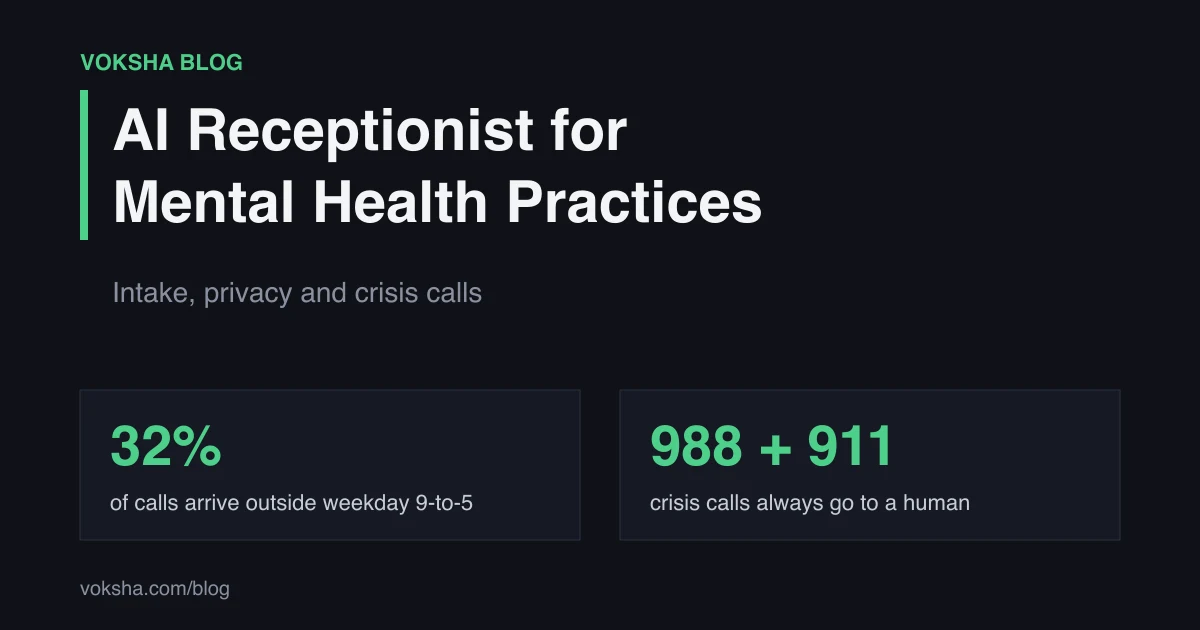
- Crisis calls are never automated. The AI gives the caller 988 and 911 and alerts a person immediately. It does not assess risk. The 988 Lifeline is "available 24/7/365" by call, text or chat (988 Lifeline, retrieved 2026-11-03).
- People call when you cannot answer. 32% of calls arrive outside 9-to-5 weekday hours, and 80-85% of callers who reach voicemail hang up, as reported in the Voksha After-Hours Economy Report (retrieved 2026-11-03).
- Patient information means a BAA. A vendor that handles protected health information for you needs a signed Business Associate Agreement (HIPAA-compliant AI receptionist guide). On Voksha, HIPAA with BAAs is Enterprise only.
Why Do Therapy Practices Miss So Many New-Client Calls?
You cannot answer the phone in session, and a solo therapist may run six or seven sessions a day. New clients call when they have worked up the courage, often in the evening or at a weekend. If they hear voicemail, many try the next name on their insurance directory. A returning client will leave a message. A new client often will not.
Which Calls Can an AI Receptionist Handle for a Therapy Practice?
The rule of thumb: automate the administrative call, never the clinical one. The table below sorts the calls a typical practice gets.
| Call type | What the AI does | What it must never do | Who follows up |
|---|---|---|---|
| New-client inquiry | Takes name, contact details, what they are looking for, referral source, preferred times | Ask for a detailed history or offer an opinion on fit | You or your intake coordinator |
| Fees, telehealth, location | Answers from your script | Quote anything not in your script | Nobody, if answered |
| Insurance details | Collects carrier, plan and member ID | Promise coverage or confirm benefits | Your billing staff |
| Consultation scheduling | Books the slot on Premium; takes the request on Starter | Book a full intake without your process | You confirm |
| Existing client: cancel or move | Takes the request and alerts you | Apply or waive your cancellation policy | You |
| Crisis or risk language | Gives 988 and 911, alerts a person now | Counsel, assess risk, or book an appointment | A human, immediately |
One privacy rule applies to every row: never confirm that a particular person is a client. "I can take a message for the practice" is the right answer to "Is my wife seeing Dr. Lee?"
How Should an AI Receptionist Handle a Crisis Call?
The AI's only job on a crisis call is to get the caller to real help and get a human involved. It is not a crisis counselor and must not act like one.
The resources you give must be the official ones. The 988 Suicide and Crisis Lifeline takes calls and texts at 988 and chats at 988lifeline.org. It is "available 24/7/365," and its conversations are "free and confidential" (988 Lifeline, retrieved 2026-11-03). SAMHSA's crisis page says to call 911 or go to the nearest emergency room if someone is "in danger or having a medical emergency" (SAMHSA, In Crisis, retrieved 2026-11-03).
Set it up like this:
- Your clinical team writes the trigger list. Err broad. A false alarm costs minutes; a miss costs far more.
- Write the exact words the AI says. Short and calm. 911 first for immediate danger, then 988.
- Pick who gets alerted. Email, SMS, Slack and Google Chat alerts to the owner work on every plan. On Premium, after-hours emergency routing and live call transfer can reach your on-call clinician.
- Test before go-live, including indirect phrasing such as "I don't see the point anymore."
- Review crisis-flagged calls weekly and tighten the trigger list.
The guide to writing an AI receptionist script covers general setup. Never copy the crisis branch from a template without your own clinical review.
Does an AI Receptionist for Therapists Need to Be HIPAA Compliant?
If you are a HIPAA covered entity and the AI receptionist will receive or store protected health information on your behalf, the vendor is likely a business associate. Under HIPAA, that relationship has to be covered by a written contract, the Business Associate Agreement (BAA). Our HIPAA-compliant AI receptionist guide walks through what a BAA covers and what to ask a vendor.
A new-client call almost always carries PHI: a caller's name plus "I'm looking for help with anxiety" is health information. What that means by plan:
| Question | Starter ($14/mo) | Premium ($99/mo) | Enterprise (from $990/mo) |
|---|---|---|---|
| Answers 24/7, takes details, follows your script | Yes | Yes | Yes |
| Books consultations into your calendar | No | Yes | Yes |
| Live call transfer to a clinician | No | Yes | Yes |
| After-hours emergency routing | No | Yes | Yes |
| HIPAA compliant with a signed BAA | No | No | Yes |
| SOC 2 and ISO 27001 compliant, AES-256 at rest, TLS 1.3 | Yes | Yes | Yes |
Plan details are from Voksha pricing (retrieved 2026-11-03). If you decide your calls need a BAA, that rules out Starter and Premium on Voksha, whatever else they offer. For more on what a BAA covers and what to ask any vendor, read the HIPAA compliant AI receptionist guide.
If calls are recorded, check your state's consent rule in the call recording laws by state guide. And keep phone intake short: the less a call captures, the less there is to protect.
This is general information, not legal advice. Whether you are a covered entity and whether a given vendor is a business associate are questions for your own counsel.
What Does a Good Intake Call Sound Like?
Brief and warm. Greet with the practice name. Collect the minimum: name, phone number, email, referral source, insurance or self-pay, and preferred times. Answer fees, telehealth and location questions from your script. Then set the expectation: on Premium, offer a consultation slot from your real calendar; on Starter, say when the practice will be in touch. You get a summary of every call, which beats listening to twelve voicemails at 7pm. The solo practitioner guide covers more of that workflow.
When Is an AI Receptionist the Wrong Choice for a Therapy Practice?
Be honest with yourself about these cases.
- Your line is effectively a crisis line. Crisis services and practices whose callers are often in acute distress need trained humans answering. An AI receptionist is a scheduling tool.
- Existing clients expect to reach their therapist. Do not quietly replace a promised direct line with software. Keep a separate number for current clients.
- You need a BAA and will not pay for Enterprise. Use a human answering service that signs a BAA, or voicemail. Do not put PHI through a plan with no BAA.
- Your intake requires clinical screening. The AI can collect the request; a clinician does the screening.
How This Guide Was Sourced
This guide was written by the Voksha team. Voksha builds AI receptionists for small businesses. We are not a neutral reviewer and do not pretend to be.
Sources and retrieval dates:
- 988 Suicide and Crisis Lifeline: call, text and chat options, "available 24/7/365," "free and confidential." Retrieved 2026-11-03.
- SAMHSA, In Crisis: call or text 988; call 911 or go to the nearest emergency room if someone is "in danger or having a medical emergency." Retrieved 2026-11-03.
- HIPAA-compliant AI receptionist guide (Voksha): business associates and BAAs.
- Voksha After-Hours Economy Report: 32% of calls outside weekday 9-to-5; 80-85% voicemail hang-up rate, a third-party figure as reported there. Retrieved 2026-11-03.
- Voksha pricing and Voksha's product documentation for plan features. Retrieved 2026-11-03.
No Voksha call data is used beyond the published report above. The call-type table and intake advice are editorial guidance, not measured statistics. Nothing here is clinical or legal advice.
Frequently Asked Questions
Can an AI receptionist answer calls for a therapist?
Yes, for administrative calls: new-client inquiries, fees, insurance details and scheduling. Not clinical questions, and not crisis calls beyond giving 988 and 911 and alerting a person.
What should an AI receptionist say if a caller mentions suicide?
It should tell the caller to call 911 or go to the nearest emergency room if they are in danger right now, give the 988 Suicide and Crisis Lifeline (call or text 988, or chat at 988lifeline.org), and alert a human at once. Your clinical team should write the exact wording.
Is an AI receptionist HIPAA compliant?
It depends on the vendor and the plan. Ask whether the vendor will sign a BAA. On Voksha, HIPAA compliance with BAAs comes with the Enterprise plan only (from $990/month), along with GDPR and CCPA compliance and a 99.9% uptime SLA.
Can it check a client's insurance benefits?
No. It collects carrier, plan and member ID so your staff can check benefits. It should never tell a caller what their plan covers.
Can it book the first appointment?
On Premium, yes, from your connected calendar. On Starter, it takes the request and sends you the details. Many practices book only a short consultation by phone.
Conclusion
Automate the administrative call and protect the clinical one. Let an AI receptionist take the 9pm new-client inquiry and book the consultation, so the person who finally picked up the phone is not met by voicemail. Route every crisis call to 988, 911 and a human, with wording your clinical team wrote and tested. If your calls carry patient information, get a BAA first, and confirm with your own counsel.
To see how this works for your practice, visit Voksha for mental health practices.