On this page
- Key Takeaways
- Why Do Solar Leads Go Cold So Fast?
- What Qualifying Questions Should a Solar AI Receptionist Ask?
- How Do You Book Site Surveys Automatically?
- What Should an AI Receptionist Never Say to a Solar Lead?
- How Should It Handle Existing Customers and Service Calls?
- Where Is an AI Receptionist the Wrong Choice for Solar?
- What Does an AI Receptionist Cost for a Solar Installer?
- How This Guide Was Sourced
- Frequently Asked Questions
- Conclusion
Solar installers pay for every inbound lead, and they lose many of them before anyone says hello. A homeowner clicks your ad and calls while your team is on a roof. If nobody answers, they call the next installer in the search results. An AI receptionist answers on the first ring. It asks your qualifying questions: do you own the home, what kind of roof, roughly what is your electric bill. On a Premium plan it books the site survey. Savings and tax questions stay with your consultants.
This guide is for owners, sales managers and office staff at residential solar installers, from small local crews to regional operators. It covers why solar leads go cold, which qualifying questions an AI should ask, how to book site surveys, how to handle existing-customer service calls, what the AI must never promise, and what it costs.
Key Takeaways
- Solar is a growing trade with a small workforce. Solar photovoltaic installers held about 31,100 jobs in 2025, and employment is projected to grow 37% from 2025 to 2035 (BLS Occupational Outlook Handbook, retrieved 2026-11-03). Few hands means the phone often goes unanswered.
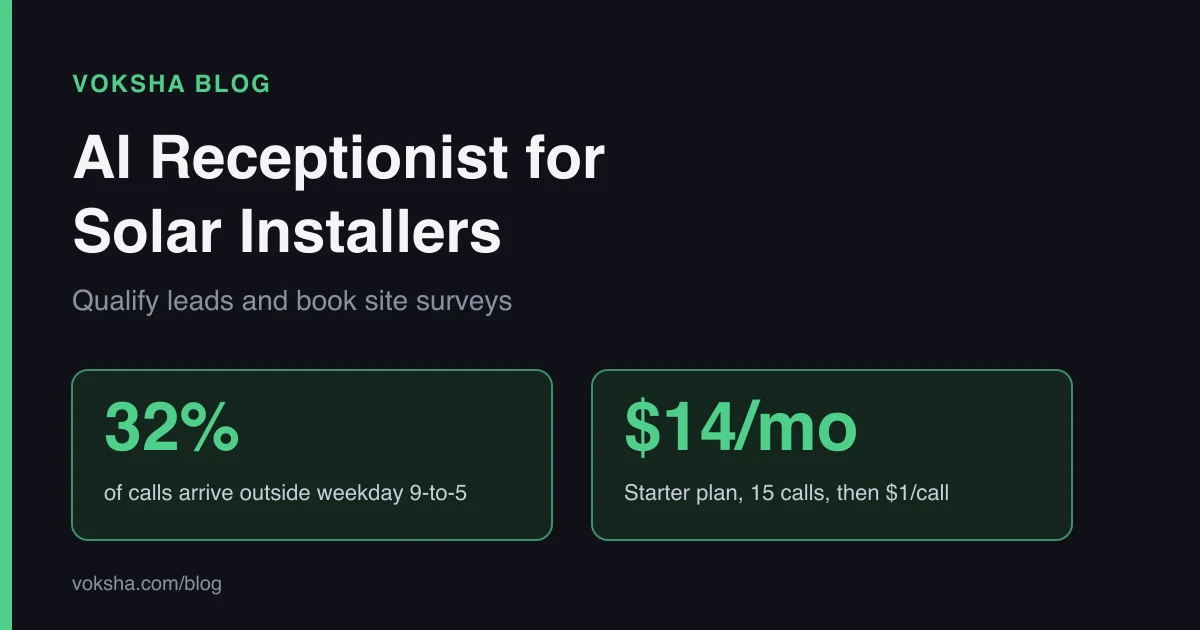
- 32% of calls arrive outside 9-to-5 weekday hours and 23% at weekends (Voksha After-Hours Economy Report, 1,000,000+ calls). Homeowners research solar when they are home.
- Homeowners are told to shop around. The FTC tells consumers to "compare detailed bids from several companies" (FTC, Solar Power for Your Home, retrieved 2026-11-03). Your lead is likely calling your competitors too.
- Qualify, then book. Homeownership, roof, shade and utility bill are patterned questions an AI asks the same way every time.
- Never let the AI promise savings or tax credits. The FTC warns consumers about companies that pressure them, and eligibility for credits depends on how the system is owned. Those answers belong to a person.
Why Do Solar Leads Go Cold So Fast?
You pay for the click. Then three things work against you.
- The lead calls the moment they are interested. Someone who clicks a solar ad at 8pm on a Tuesday wants to talk at 8pm on Tuesday. By Wednesday afternoon they have talked to two other companies.
- Your team is on the roof. The BLS notes that "most PV installation is done outdoors" (BLS, retrieved 2026-11-03). Installers on a roof do not take calls, and a small office cannot cover every line.
- The homeowner is comparison shopping. The FTC's consumer advice is to get several detailed bids. That is good advice for homeowners and a reason you need to answer first.
The result is ad spend that turns into voicemails. If you want to see which ads actually produce calls that convert, AI call analytics for marketing channels covers how to track it.
What Qualifying Questions Should a Solar AI Receptionist Ask?
Not every caller is a fit. A renter cannot sign a solar contract. A heavily shaded roof may not work. A small electric bill may not justify the system. Your consultants should spend their time on site surveys that can close.
Set the agent to ask the questions you already ask, in plain language:
| Question | Why it matters | What to do with the answer |
|---|---|---|
| "Do you own the home?" | Renters usually cannot sign | Renter: take details, explain politely, end the call |
| "What kind of roof do you have, and roughly how old is it?" | Roof type and age affect the install | Old roof: flag for the consultant |
| "Is the roof shaded by trees or buildings?" | Shade affects output | Heavy shade: flag, do not rule out on the phone |
| "Roughly what is your monthly electric bill?" | Sizing and fit | Capture the number; do not calculate savings |
| "Who is your utility?" | Rules and programs vary by utility | Capture for the consultant |
| "Are you thinking of buying, leasing or not sure yet?" | Changes the conversation and credit eligibility | Capture; leave the explanation to a person |
| "What is the address?" | Service area and the survey | Check against your service area |
Keep it short. Five or six questions is plenty for a first call. The consultant fills in the rest at the survey. The guide to writing an AI receptionist script shows how to phrase questions so they sound like a conversation, not a form.
How Do You Book Site Surveys Automatically?
On a Premium plan, the AI books the survey into a connected calendar during the call, so the homeowner hangs up with a date. Google Calendar, Microsoft Outlook and Apple iCloud connect from the dashboard (Voksha docs, calendar connectors). CRMs such as HubSpot or Salesforce are set up with Voksha support. AI receptionist CRM integration explains what that looks like.
A few tips for survey booking:
- Give each consultant their own calendar. Survey slots fill by territory, not just by time.
- Build in drive time. Block buffer between surveys so the AI does not book back-to-back appointments across town.
- Ask for both decision-makers. If two people own the home, ask whether both can be at the survey. A consultant who meets only one owner often has to come back.
- Confirm the address and access. Gate codes, dogs and where to park save time on the day.
On Starter, the AI captures the same details and sends you a summary. Someone on your team books the survey.
What Should an AI Receptionist Never Say to a Solar Lead?
This is the most important section for a solar company. Solar sales draw consumer-protection attention, and the FTC's advice to homeowners is direct: "Never deal with a power or home repair company that pressures you for a quick decision" (FTC, retrieved 2026-11-03). The same page tells consumers to check that the contract matches what salespeople and ads promised.
So configure the AI to stay well clear of:
- Savings estimates. "You'll save $150 a month" is a promise. Leave it out.
- Tax credit eligibility. The FTC notes that if you buy a system "you might be eligible" for federal, state or local tax credits, and that leased systems and power purchase agreements usually do not qualify, because the system's owner claims those benefits. Eligibility depends on the homeowner's situation. The AI should say a consultant will cover it.
- "Free solar" or "no cost" language. Leases and power purchase agreements have costs. Do not let the script imply otherwise.
- Urgency pressure. "This offer ends Friday" on an inbound call is exactly the tactic the FTC warns about.
- Financing terms. Rates and loan terms belong to the financing partner and your consultant.
This guide is not legal advice. Advertising and sales rules for solar vary by state; confirm with your own counsel what applies to your scripts.
How Should It Handle Existing Customers and Service Calls?
Not every call is a new lead. Once you have installed systems, your phone also gets:
- Install status questions. "When is my install?" "Has the permit come through?" "When does the utility turn it on?"
- Performance worries. "My app says zero production today."
- Service problems. A tripped breaker, a warning light on the inverter, a leak near the mounts.
Ask early in the call whether the caller is a current customer, then branch. Status questions can get a summary to the project coordinator. Production and equipment problems should go to your service team, with the address, the install date if known, and a clear description.
Some calls should never wait. If a caller mentions smoke, sparking, a burning smell or water near electrical equipment, the AI should tell them to call 911 or their utility and alert your team straight away. The electricians guide covers that hazard pattern in more detail. The same thinking applies to roof leaks; see the roofing guide.
Where Is an AI Receptionist the Wrong Choice for Solar?
Be honest about the limits:
- The sales consultation itself. System sizing, financing and the proposal are a consultant's job. The AI books the meeting; it does not run it.
- Angry customers. A customer whose system has underperformed for months needs a manager, fast.
- Commercial projects. Large commercial bids are relationship sales. Route them to the owner.
- Very low volume. If you get a few calls a week and always pick up, you may not need one.
What Does an AI Receptionist Cost for a Solar Installer?
Here is how the options compare for a small installer. Wages are from the BLS: the median solar installer earned $53,140 in May 2025, or $25.55 an hour (BLS, retrieved 2026-11-03).
| Option | What it handles | Monthly cost |
|---|---|---|
| Installer answers on the roof | Some calls, at the cost of safety and focus | $25.55 an hour of installer time, plus calls missed |
| Voicemail | Messages, returned after the lead has called others | Nothing up front, but wasted ad spend |
| Voksha Starter | Answers 24/7, asks your questions, call summaries, 15 calls, English only | $14, then $1 per call |
| Voksha Premium | Starter plus survey booking, integrations, live transfer, 2 languages, 150 calls | $99, then $1 per call |
Setup takes under 5 minutes by forwarding your existing number. Billing is month to month with no setup fee, and there is a free demo call and a 7-day money-back guarantee (Voksha pricing).
How This Guide Was Sourced
Written by the Voksha content team (voksha.com). Voksha builds AI receptionists for small businesses. We are not a neutral reviewer, and the guide names the calls an AI should not handle.
Sources and retrieval dates:
- BLS Occupational Outlook Handbook, Solar Photovoltaic Installers: $53,140 median annual wage and $25.55 an hour (May 2025), about 31,100 jobs in 2025, projected 37% growth from 2025 to 2035, "most PV installation is done outdoors". Retrieved 2026-11-03.
- FTC, Solar Power for Your Home: compare bids, pressure warnings, contract matching promises, tax credit and lease guidance. Retrieved 2026-11-03.
- Voksha After-Hours Economy Report: 32% of calls outside 9-to-5 weekdays, 23% at weekends, 1,000,000+ anonymized calls with published methodology.
- Voksha pricing and calendar connectors docs. Retrieved 2026-11-03.
What this guide does not claim. No figure is given for how fast solar leads go cold or how many callers are renters, because no source in our allowed set publishes one. The qualification questions are common practice, not measured statistics. No Voksha call data beyond the published report is used.
Frequently Asked Questions
Can an AI receptionist qualify solar leads?
Yes. It can ask whether the caller owns the home, the roof type and age, shade, utility and rough monthly bill, and check the address against your service area. It records every answer in the call summary.
Can it book solar site surveys?
On Premium, yes. It books into a connected calendar during the call. On Starter it captures the details and sends you a summary to book yourself.
Should the AI tell homeowners how much they will save?
No. Savings and tax credit eligibility depend on the home, the usage and how the system is owned. Have the AI capture the question and pass it to a consultant.
What about calls from existing customers with a problem?
Ask early whether the caller is a current customer. Route service and production problems to your service team. If a caller mentions smoke, sparking or a burning smell, the AI tells them to call 911 or their utility and alerts your team.
Can it answer in Spanish?
Premium answers in two languages of your choice, for example English and Spanish. Starter answers in English only.
Conclusion
In solar, you pay for every lead, and the first installer to answer usually books the survey. An AI receptionist answers each ad call on the first ring, asks your qualifying questions the same way every time, and gets service problems to the right person. Your consultants keep the savings math and the proposal. See how Voksha works for solar installers and make a test call before your next campaign.