On this page
Overflow call handling is the rule that decides where a call goes when everyone who could answer is already busy. A small business has four main options: a hunt group that rings other staff, voicemail, a live answering service, or forwarding busy and unanswered calls to an AI receptionist. The best setup for most small teams is to ring people first, then send overflow to a backstop that actually answers. Voicemail is the weakest backstop, because 80-85% of callers who reach it hang up (Voksha After-Hours Economy report).
This guide is for owners and office managers whose phone rings while the only person at the desk is already on another call. It covers how each overflow option works, a comparison table, three setup patterns you can copy, and where each one is the wrong choice. For the carrier steps to turn on forwarding, see how to forward your business phone to an AI receptionist.
Key Takeaways
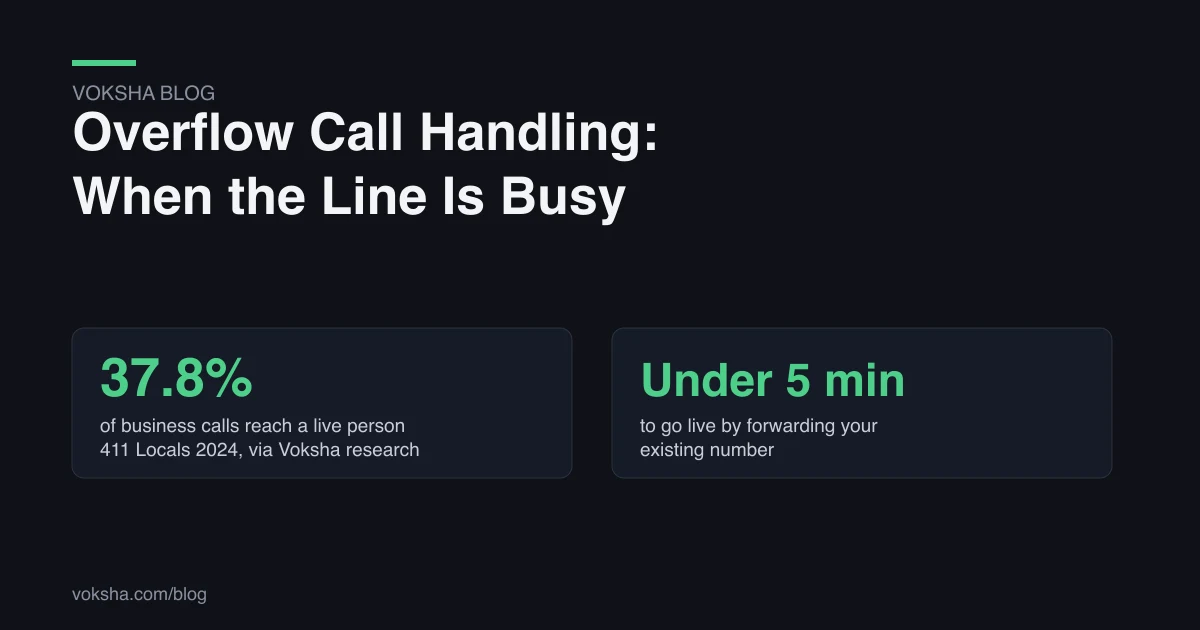
- Overflow is not a rare event. Businesses answer only 37.8% of inbound calls (411 Locals, 2024, as reported in the After-Hours Economy report). A busy line is one of the common reasons.
- Voicemail is a poor backstop. 80-85% of voicemail callers hang up without leaving a message, and about 62% call a competitor (third-party figures reported in the same report).
- Conditional forwarding is the key setting. Most phone systems and carriers can forward a call only when the line is busy or nobody answers, so your team still answers first.
- Adding a person is the most expensive fix. Receptionists earned a median $38,010 a year, or $18.27 an hour, in May 2025 (BLS Occupational Outlook Handbook, Receptionists, retrieved 2026-11-03).
- Test overflow on purpose. Call your own number while the line is in use. Many businesses discover their overflow has been going to a full voicemail box.
What Is Overflow Call Handling?
Overflow call handling is the plan for the second caller. Your first caller reaches a person. The second caller, arriving while that person is still talking, hits whatever you set up, or whatever your phone company set up by default.
Overflow happens in three situations:
- Busy: the line or the person is on another call.
- No answer: the phone rings but nobody can pick up, because hands are full with a customer, a patient or a job.
- Unreachable: the phone is off, out of signal or the office is closed.
Most small businesses never choose an overflow rule. The default is usually voicemail or a busy signal. That default is the leak you are fixing.
What Are the Options When Your Line Is Busy?
There are four common overflow options. You can combine them.
1. Hunt group (ring group). The call rings a list of phones, either one after another (sequential) or all at once (simultaneous). It is built into most business phone systems. It works when you have spare people. It fails when everyone is busy at the same moment, which is exactly when overflow happens.
2. Voicemail. The caller hears a greeting and can leave a message. It costs nothing extra and it is always available. But most callers do not leave a message, and the ones who do wait for you to return the call. Our voicemail alternatives post compares other fallbacks.
3. Live answering service. Overflow calls forward to a team of human agents who answer in your business name, take a message or follow a script. A person handles unusual calls well. Pricing is usually per minute or per call, and coverage depends on the provider's staffing. Our answering service guide covers how to choose one.
4. Forward-on-busy or no-answer to an AI receptionist. Your phone system or carrier forwards only the calls your team cannot take. The AI answers, captures the caller's details and the reason for the call, and sends you a summary. It is built to answer every call, so a second or third overflow caller is not sent to a busy signal. It is weaker on emotional or unusual calls.
A fifth option, a queue with hold music, can work for teams of three or more. For a team of one or two, a queue mostly means callers wait, then hang up.
How Do the Overflow Options Compare?
Compare them on what the caller experiences and what you get afterwards, not just on price.
| Hunt group | Voicemail | Live answering service | AI receptionist (forward-on-busy) | |
|---|---|---|---|---|
| Does a caller reach someone? | Only if a teammate is free | No | Yes, a human agent | Yes, an AI voice agent |
| Handles calls when everyone is busy? | No | Yes, but most hang up | Yes, within provider staffing | Yes, answers every forwarded call |
| Evenings and weekends | Only if staff are on call | Yes | Depends on plan | Yes, 24/7 |
| What you get afterwards | Nothing new | Messages, if left | Message or summary | Caller details and a call summary |
| Handles unusual or emotional calls | Yes, a person | No | Yes, a person | Weaker; should route to a person |
| Typical cost basis | Included in phone system | Included | Per minute or per call | Monthly plan plus per-call overage, varies by provider |
| Setup | Phone system admin | Default | Forwarding plus script | Forwarding plus script |
Read the table by your biggest risk. If your overflow calls are often distressed people, a human backstop fits better. If they are mostly bookings and routine questions, an AI backstop answers them faster and at any hour. Our AI-only vs hybrid answering service post looks at mixing the two.
How Should You Set Up Overflow Routing?
Pick one pattern, set it up, then test it. These three cover most small businesses.
Pattern 1: Solo or two-person business. Your mobile or desk phone rings first. If you are on another call, or do not answer within a few rings, the call forwards to your backstop. This uses conditional forwarding (busy and no-answer). Your carrier or phone system sets it, and the steps for major carriers are in our forwarding guide.
Pattern 2: Small team with a front desk. A hunt group rings the front desk, then the back office. If nobody picks up, the call forwards to the backstop. Keep the total ring time short. A caller who hears eight rings before anything happens often hangs up before the overflow kicks in. ANALYSIS: each extra ring adds a few seconds of waiting with no answer.
Pattern 3: Daytime team, overflow and after hours to the backstop. During open hours, use Pattern 1 or 2. After closing, forward every call straight to the backstop. This is the "safe order" Voksha's own docs recommend for going live: send after-hours calls first, review them, then add busy hours (Voksha docs: Go live). Our call routing guide covers routing by caller need once the basics work.
Test it every time you change it:
- Call your business number from another phone while the line is in use. Confirm the backstop answers.
- Call and let it ring with nobody answering. Count the rings before overflow starts.
- Call after hours. Confirm the after-hours rule works.
- Check that the summary or message arrives where you expect it.
Which Overflow Option Fits Your Business?
Match the backstop to what your overflow callers need.
- Choose a hunt group alone if you have several people near phones and overflow is rare. It costs nothing extra.
- Choose a live answering service if overflow calls often need a human: distressed callers, complex intake, or anything where judgment matters on the first contact.
- Choose an AI receptionist if overflow calls are mostly bookings, quotes, hours and routine questions, and they arrive evenings and weekends too. Voksha, for example, answers forwarded calls on the first ring 24/7 and sends you a summary; plans start at $14 a month for 15 calls, then $1 per call, and live transfer to a person and calendar booking are on Premium ($99 a month for 150 calls).
- Keep voicemail only as the last resort behind one of the above, not as the plan.
Where an AI backstop is the wrong choice: if a large share of your overflow callers are in crisis, or your intake rules require a licensed person to speak to the caller, route those calls to a human service. An AI receptionist can capture details and route; it should not make judgment calls it is not qualified for.
How This Guide Was Sourced
This guide was written by the Voksha team. Voksha builds AI receptionists for small businesses, and one of the four options in this guide is our product. We have tried to describe the others fairly.
- 37.8% answer rate (411 Locals, 2024), 80-85% voicemail hang-up rate and about 62% calling a competitor: third-party figures as reported in Voksha's After-Hours Economy report.
- Receptionist median pay of $38,010 a year and $18.27 an hour (May 2025): BLS Occupational Outlook Handbook, Receptionists, retrieved 2026-11-03.
- Go-live order: Voksha docs, Go live.
- Voksha pricing and plan features: Voksha's published pricing.
- The ring-time note is ANALYSIS.
No Voksha call data is used in this guide beyond the published research report linked above.
Frequently Asked Questions
What is the difference between a hunt group and overflow forwarding?
A hunt group rings other phones inside your business. Overflow forwarding sends the call outside, to voicemail, an answering service or an AI receptionist, when nobody inside can answer. Most setups use both: hunt group first, overflow second.
Can I forward calls only when my line is busy?
Yes. Most carriers and business phone systems support conditional forwarding for busy, no-answer or unreachable calls. Your team still answers first, and only the calls they cannot take are forwarded.
How many rings before overflow should start?
Keep it short. A few rings gives your team a fair chance without leaving the caller waiting. Test it yourself and count.
Is voicemail good enough for overflow?
Usually not. 80-85% of voicemail callers hang up without leaving a message, according to figures reported in Voksha's After-Hours Economy report. Use voicemail only behind a backstop that answers.
Can an AI receptionist hand an overflow call back to a person?
Many can, but check which plan includes it; with Voksha it is Premium, as noted above. On any system, set rules for which calls should reach a human, and test that the transfer number is actually answered.
Conclusion
Every business has an overflow rule, even if nobody chose it. Make it a deliberate one: ring your team first, forward busy and unanswered calls to a backstop that answers, and keep voicemail as the last resort. Then test it with a real call. If an AI backstop fits your overflow calls, you can get started with Voksha by forwarding your existing number, live in under 5 minutes.