On this page
- Why Traditional Booking Platforms Are Hitting a Wall
- What Are AI Phone Systems, Really?
- The Future of Reservation Flow
- The ROI Breakdown: AI vs. Manual Staffing
- Strategic Decision Tree for Automation
- Why the "Hybrid Strategy" is the New Gold Standard
- How to Implement AI Without Breaking Your Flow
- Is Your Restaurant Ready for Automation? (A 3-Step Checklist)
- Related Voksha Resources
- Frequently Asked Questions
Every missed phone call on a Friday night is a table left empty. It’s a hole in your revenue and, let’s be honest, a gift to the guy running the restaurant down the street. In the high-stakes world of hospitality, the "missed call epidemic" isn't just a minor annoyance—it’s a direct drain on your bottom line.
If your reservation strategy still relies on someone physically picking up a phone while they’re juggling a tray of drinks or seating a party of six, you’re operating in a bygone era. Guests increasingly expect to book whenever it suits them, including after you close, so 24/7 booking is quickly moving from a "nice-to-have" to an expectation.
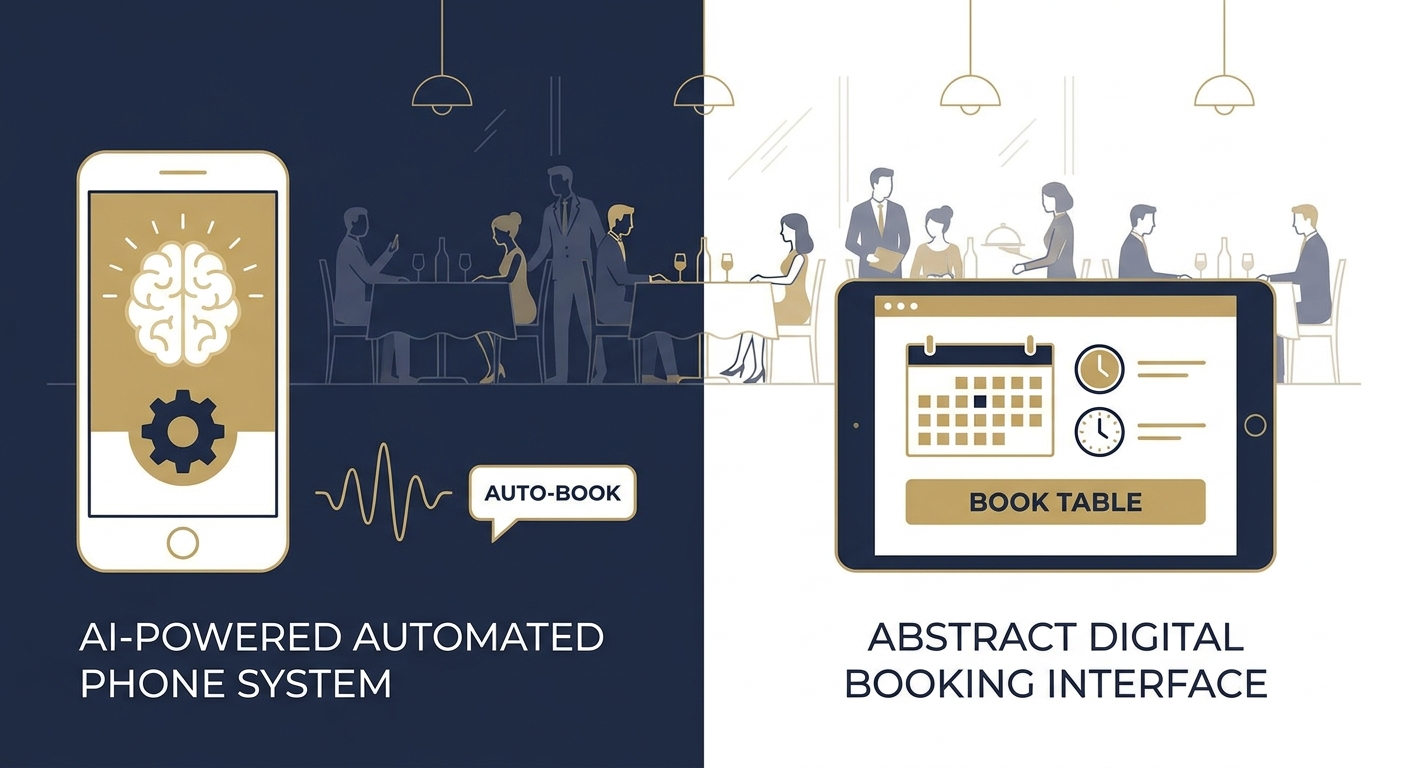
Today, the battle for the guest experience isn't fought in the kitchen. It’s fought at the front door, between the ubiquity of online booking platforms and the precision of AI phone systems.
Why Traditional Booking Platforms Are Hitting a Wall
For years, we’ve relied on the third-party giants to handle our digital heavy lifting. They provided a bridge to the digital age, and they still do a lot well. But per-cover fees can add up, so it's worth checking what you pay per booking and which channel each guest actually used.
Beyond the fees, there’s the issue of platform fatigue. You’re juggling OpenTable, syncing with Resy, and praying you don't miss a Yelp alert. It gets fragmented. And a booking form is built for the simple case: a name, a time and a headcount. Complex requests—the anniversary table, the specific allergy, the "can you seat us near the window?" question—often still end up as a phone call.
What Are AI Phone Systems, Really?
Forget the mental image of a glitchy, robotic voice from 2012. That tech is dead and buried. Modern AI uses Natural Language Processing (NLP) to understand what the caller is asking for in plain conversation.
Instead of forcing a guest to navigate a soul-crushing automated menu, an AI voice agent has a real, fluid conversation. Where it is connected to your booking system, it can check availability and book during the call. With Voksha, for example, booking and integrations are on the Premium and Enterprise plans (Starter answers, captures the caller's details and follows your script): calendar, Square Appointments, Mindbody and Booker connectors are self-serve, while reservation and POS platforms such as OpenTable, Resy and Toast are set up with Voksha support (see the connector directory).
People love to cling to the "Human Touch" myth, arguing that AI is cold. But is it? A well-configured AI can take down a seating preference or a shellfish allergy and pass it to your team with the booking details. It doesn't get frustrated when the phone rings for the tenth time during the dinner rush. It doesn't have an ego. It isn't replacing the human element; it’s giving your staff the breathing room to actually be human with the people sitting in front of them.
The Future of Reservation Flow
| Step | Traditional manual flow | AI-answered flow |
|---|---|---|
| 1 | Customer calls | Customer calls |
| 2 | Is staff available? If not, voicemail or a missed call, and lost revenue | AI agent answers |
| 3 | Staff answers and checks the booking system | AI checks the connected booking system |
| 4 | Booking confirmed | Booking confirmed; staff stay on the floor |
The ROI Breakdown: AI vs. Manual Staffing
Let’s talk math. A front-of-house staff member answering phones is an expensive luxury. Between hourly wages, training, and the high turnover rate that plagues our industry, the cost of answering a single reservation call is staggering.
Automating the phone line can reduce the time staff spend on routine calls. For example, a 60-seat bistro that hands phone duty to an AI receptionist could free up meaningful staff time each week, time your team can spend on the floor focusing on wine service and genuine hospitality instead of reciting the restaurant's address for the hundredth time. You’re trading a variable human workflow for a predictable monthly plan cost.
Strategic Decision Tree for Automation
- Do you have a high missed-call rate? If yes, make an AI phone agent a high priority, then measure results and scale.
- If not, do you have a high no-show rate? If yes, focus on your guest records and your booking platform's reminder tools, then measure results.
- Neither? Keep your current system and re-evaluate in three months.
Why the "Hybrid Strategy" is the New Gold Standard
You don't need to burn your existing infrastructure to the ground. The smartest operators are using a "Hybrid Strategy." Keep your online booking platforms for the low-intent, simple transactions—the people who just want to click a button and be done.
But layer your AI phone agent to catch the high-intent traffic. When a customer calls, they usually have a specific problem: "Can you fit a group of 12 in the back room?" or "Do you have any tables left for tonight?" By using AI to handle these, you satisfy the diner while keeping your staff focused on the guests already in the building. This creates a setup where tech handles the volume, and your team handles the soul of the business.
How to Implement AI Without Breaking Your Flow
Change in a kitchen environment is usually met with a side-eye. But implementing AI can be surgical.
- Assess your POS: Your reservation system is only as good as its integration. Make sure your tech stack supports API connections.
- Centralize your data: Quit keeping your reservations in three different apps. Move toward a "Single Source of Truth" where every booking lands in one CRM.
- Establish the Human Hand-off: This is the golden rule. Configure your AI agent with a "warm transfer" protocol. If the AI hits a wall—a complex request or a frustrated customer—it should immediately route the call to a human manager. No guest should ever feel trapped in a loop.
Is Your Restaurant Ready for Automation? (A 3-Step Checklist)
If you're wondering if it's time to pull the trigger, run this audit:
- Audit: Track your missed call volume for one week. Every missed call is a missed opportunity.
- Centralize: If you’re managing more than two booking apps, consolidate.
- Deploy: See how Voksha works for restaurants and try a free demo call to hear how an AI agent handles your menu questions, seating rules, and brand voice.
Related Voksha Resources
- AI receptionist for restaurants
- Restaurant answering service
- Best AI Receptionist for Restaurants: 6 Tools Ranked for 2026
Frequently Asked Questions
Does AI phone booking feel robotic to customers?
Much less than it used to. Modern voice synthesis and NLP make AI agents sound conversational rather than like a phone menu. The best test is to call one yourself before you decide.
How do I integrate an AI phone system with my existing POS?
It depends on the system. With Voksha, integrations need the Premium or Enterprise plan. Google Calendar, Microsoft Outlook, Apple iCloud, Mindbody, Square Appointments and Booker are self-serve connectors that let Voksha book during the call. Reservation and POS platforms such as OpenTable, Resy and Toast are set up with Voksha support; check the connector directory for your system.
Is an AI receptionist cheaper than a human staff member?
Usually, for routine calls. AI plans have a predictable monthly price (Voksha starts at $14/month for 15 calls, or $99/month for 150 calls on Premium, which adds booking, then $1 per call). Compare that with the hourly wages, training time and turnover costs of staff time spent on the phone.
What happens if the AI cannot answer a complex question?
The system is built with "warm transfer" protocols. If the AI identifies an intent gap—meaning it doesn't have the data to answer a specific, high-complexity question—it can route the call to a human staff member, ensuring the guest gets the help they need without frustration.