On this page
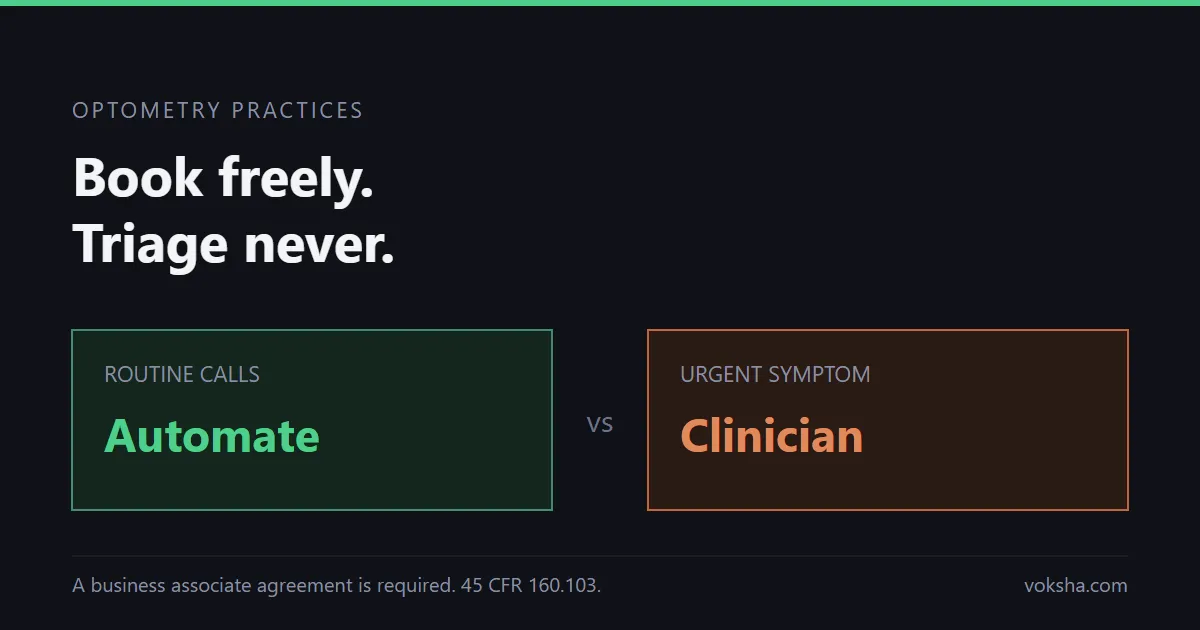
An optometry practice's calls divide cleanly in two. Routine calls - booking, rescheduling, glasses and contacts pickup status, vision-plan questions - are patterned, high-volume and the right automation target. Urgent eye symptoms - sudden vision loss, flashes and floaters, an injury - must reach a clinician, and the automated system's only correct behaviour is to recognise and escalate, never to assess. AI receptionists from about $19 a month for 20 calls can cover the first category, but for a practice the deciding factor is the Business Associate Agreement: at Voksha, HIPAA compliance with BAAs, GDPR and CCPA compliance, and a 99.9% uptime SLA are on the Enterprise plan only (from $990/month).
Four options are compared below on published pricing, alongside the one compliance fact that decides whether you can use any of them: an answering service that touches patient information is a business associate under HIPAA and needs an agreement before it takes a single call. Voksha publishes this guide and is one of the four. See How this guide was sourced.
Key Takeaways
- The front desk is the role getting harder to staff. Receptionists earn a 2025 median of $38,010 a year, or $18.27 an hour, across 947,500 US jobs - and the occupation is projected to decline 2% from 2025 to 2035, losing 16,000 jobs (US Bureau of Labor Statistics). Over the same decade optometrists grow 10% (BLS) and ophthalmic medical technicians 21% (BLS). More clinical capacity, fewer people to answer the phone.
- Any answering service handling patient information is a business associate. HIPAA defines one as a person who "creates, receives, maintains, or transmits protected health information" on a covered entity's behalf (45 CFR 160.103). That means a signed Business Associate Agreement, not a vendor assurance.
- At 20 calls the range is $19 to $49; at 100 calls it is $99 to $149. Voksha $19/$99, Dialzara $29/$135, Rosie $49/$149; Goodcall's pricing is not published in our verified data. ANALYSIS from published plans, prices checked September 2026. Check which plan includes a BAA: at Voksha that is Enterprise, from $990/month.
- Sudden flashes or floaters are time-critical. The American Optometric Association states that floaters accompanied by flashes or of sudden onset "may be a more serious problem and require an immediate eye examination by a doctor of optometry" (AOA). This is a routing rule, not an automation opportunity.
- The per-call wage gap is small, and pretending otherwise is dishonest. A three-minute call costs about $0.91 of receptionist time against $0.99 to $1.49 for software. ANALYSIS. The case is coverage and displaced work, not per-call arbitrage.
- 32% of calls arrive outside 9-to-5 weekdays and 23% at weekends (Voksha After-Hours Economy Report, 1,000,000+ calls).
The two call categories
Routine calls are the automation target. Booking, rescheduling, pickup status and plan eligibility are the bulk of a practice's inbound volume, they follow patterns, and none of them require a clinician. Every one handled automatically is front-desk time returned to the patients standing at the counter.
Urgent symptoms are the human category, and the boundary is sharp. The American Academy of Ophthalmology lists ten conditions as eye emergencies, among them retinal detachment, angle-closure glaucoma, open globe injury and endophthalmitis, and states plainly that "time is key to preserve vision" (AAO). A caller describing sudden vision change needs a clinician, not a booking flow.
Prescription calls sit in between. Taking a request and routing it is administrative. Releasing, interpreting or changing a prescription is clinical. Configure the first, forbid the second.
The HIPAA requirement, from the regulation itself
This is the fact that decides whether you can use any answering service, and it is not a matter of vendor opinion. HIPAA defines a covered entity to include "a health care provider who transmits any health information in electronic form in connection with a transaction covered by this subchapter" (45 CFR 160.103, retrieved 2026-09-21). A practice that bills vision plans electronically meets that description.
The same section defines a business associate as a person who, on behalf of a covered entity, "creates, receives, maintains, or transmits protected health information for a function or activity regulated by this subchapter."
An answering service that takes a patient's name, date of birth and reason for calling is doing exactly that. It is a business associate, and a Business Associate Agreement is required. Three practical consequences:
- Ask for the BAA before the demo, not after. A vendor that cannot produce one is not a candidate, whatever the product does.
- A vendor saying "we're HIPAA compliant" is not the same as a signed agreement. There is no HIPAA certification body. The agreement is the artefact that matters.
- The obligation follows the data, not the call volume. A practice taking ten calls a month has the same requirement as one taking a thousand.
At Voksha, HIPAA compliance with BAAs is on the Enterprise plan only (from $990/month; see Voksha Enterprise). Its Starter and Premium plans do not include a BAA, so a practice that needs one should price Enterprise, not the entry plans. For how Voksha handles data security more broadly, see Voksha's security practices.
This guide states what the regulation says and does not interpret it for your practice. Confirm your own obligations with your own counsel.
What the four cost
Every competitor figure is from Voksha's pricing-comparison pages (prices checked September 2026), monthly billing, at a 3-minute average call. See Voksha's full pricing comparison for more vendors.
| Service | Entry | Included | Overage | Metered by | At 100 calls |
|---|---|---|---|---|---|
| Voksha | $14/mo | 15 calls | $1/call | Call | $99 |
| Dialzara | $29/mo | 60 minutes | $0.48/min | Minute | $135 |
| Rosie | $49/mo | 250 minutes | not published | Minute | $149 |
| Goodcall | Pricing not published | - | - | Unique customer | - |
Three things that table cannot flatten. Voksha's BAA is on the Enterprise plan (from $990/month), not the $14 or $99 plans shown, so a practice that needs a BAA should compare Enterprise pricing. Goodcall is not in Voksha's verified pricing data, so no figure is quoted. Rosie does not publish an overage rate anywhere on its pricing page, so the $149 figure above is its next tier up rather than an overage calculation - if you expect to exceed 250 minutes, ask them directly.
Sources: Dialzara pricing, checked September 2026, Rosie pricing, checked September 2026, Voksha vs Goodcall. Voksha: Starter $14/month for 15 calls, Premium $99/month for 150 calls, then $1 per call, Enterprise from $990/month (voksha.com/pricing). Starter answers every call, captures the caller's details and follows your script; booking appointments into your calendar is on Premium and Enterprise.
Where the return actually is
The chart above is the honest version, and it undercuts the usual sales argument. At three minutes a call, software costs roughly what front-desk time costs. If per-call price were the whole question, most practices would be better off leaving things as they are.
Three things change the answer, and none of them is the hourly rate.
The phone competes with the counter. A receptionist answering a call is not checking in the patient in front of them or pulling a completed order. The cost of the call is not only the wage minute, it is the queue behind it.
The staffing pool is shrinking while clinical demand grows. Receptionist employment is projected to fall 2% to 2035, a loss of 16,000 jobs, while optometrists grow 10% and ophthalmic medical technicians 21% (BLS, BLS, BLS). A practice adding exam capacity is adding phone volume into a role that is getting harder to fill.
Nobody is at the desk in the evening. This is the category software wins outright, because the alternative is not a cheaper receptionist, it is voicemail.
Why after-hours matters in eye care
32% of calls arrive outside 9-to-5 weekdays and 23% at weekends (Voksha After-Hours Economy Report, 1,000,000+ calls).
For a practice, most of that evening volume is routine - someone booking an annual exam after work, or checking whether their glasses are ready. That is the easy win.
The harder case is the urgent one. Eye injuries and sudden symptoms do not observe business hours, and an automated system taking those calls needs a configured escalation path to a person before go-live, not after the first complaint. If your practice has no out-of-hours clinical cover, the correct configuration is a clear instruction to the caller about where to go, not an appointment slot next Tuesday.
How this guide was sourced
Written by the Voksha engineering and content team (voksha.com). Voksha sells a 24/7 AI receptionist and answering service and is one of the options compared above - and the chart shows receptionist wage time beating every software option on per-call cost, because that is what the published figures produce. Voksha's BAA is available on the Enterprise plan only.
Sources and retrieval dates:
- 45 CFR 160.103 via GovInfo - covered entity and business associate definitions, quoted verbatim, retrieved 2026-09-21
- BLS Occupational Outlook Handbook, receptionists - $38,010 median annual and $18.27 hourly in 2025, 947,500 jobs, projected -2% to 2035
- BLS, optometrists - $136,570 median, 45,100 jobs, +10% to 2035
- BLS, occupations not covered in detail - ophthalmic medical technicians, SOC 29-2057, $45,570 median, 72,500 jobs, +21% to 2035. There is no standalone handbook profile for this occupation
- American Optometric Association, spots and floaters - quoted verbatim
- American Academy of Ophthalmology, eye emergencies
- Dialzara pricing, checked September 2026, Rosie pricing, checked September 2026 - Goodcall prices are not in Voksha's verified set and are not quoted
- Voksha pricing
What this guide does not claim. No figure for how an optometry practice's calls break down by reason appears here, because no source in the allowed set publishes one. Every percentage-style claim of that kind we could find traces back to answering-service marketing. The two-category split above is a description of the workflow, not a measured statistic.
On clinical matters: this guide cites the AOA and AAO to establish that certain symptoms are time-critical and must therefore route to a clinician. It does not explain what those symptoms mean or what a patient should do, which would be medical advice and is outside what those citations support.
Derived costs are marked ANALYSIS with the arithmetic shown. No competitor blog or third-party roundup was used as evidence.
The Voksha figures used are from the After-Hours Economy Report, first-party data across more than 1,000,000 calls. No unpublished Voksha telemetry appears here.
Frequently Asked Questions
Which AI receptionist is best for an optometry practice?
Start with the BAA, not the price. At Voksha, HIPAA compliance with BAAs is on the Enterprise plan only, which starts at $990/month (Voksha Enterprise); its $14 Starter and $99 Premium plans do not include a BAA. Whichever vendor you consider, confirm in writing which plan includes a signed BAA before comparing prices.
How much does it cost a practice?
$19 to $149 a month at 20 to 100 calls on the entry plans priced here (prices checked September 2026), but the plan that includes a BAA may cost more: at Voksha, BAAs are on Enterprise, from $990/month.
Does an AI receptionist need a HIPAA business associate agreement?
Yes, if it handles patient information on your behalf. HIPAA defines a business associate as a person who creates, receives, maintains or transmits protected health information for a covered entity, and an answering service taking a patient's name and reason for calling is doing that. Ask for the agreement before the demo, and confirm with your own counsel.
Can it handle a patient reporting sudden vision loss?
It should recognise the call and escalate it to a clinician immediately, and do nothing else. It must not ask triage questions or assess severity - that is a clinical act. Configure this rule before go-live.
What can it safely handle?
Appointment booking and rescheduling, glasses and contact lens pickup status, practice hours, recall appointment booking, and vision-plan eligibility questions. High volume, fully patterned, no clinical judgement.
Is it cheaper than a receptionist?
Not meaningfully, per call. At three minutes a call, receptionist wage time works out at about $0.91 against $0.99 to $1.49 for the software options here. The argument for automation in this vertical is evening and weekend coverage and freeing the desk during clinic hours, not per-call arbitrage - and any vendor telling you otherwise is comparing against the wrong number.
Conclusion
Optometry is a vertical where the compliance question comes before the product question. An answering service that touches patient information is a business associate under HIPAA and needs a signed agreement, and no feature list changes that.
Past that gate, the split is simple: automate the routine calls, and configure urgent symptoms to reach a clinician on recognition without the system ever assessing them. The return is not the per-call price, which is close to a receptionist's wage time. It is the evening and weekend volume that currently reaches voicemail, and a front desk that stops choosing between the phone and the patient at the counter. Confirm your HIPAA obligations with your own counsel before go-live, and if you want a signed BAA from Voksha, talk to sales about Enterprise.