Best AI Receptionist for Electricians 2026: 4 Options Priced
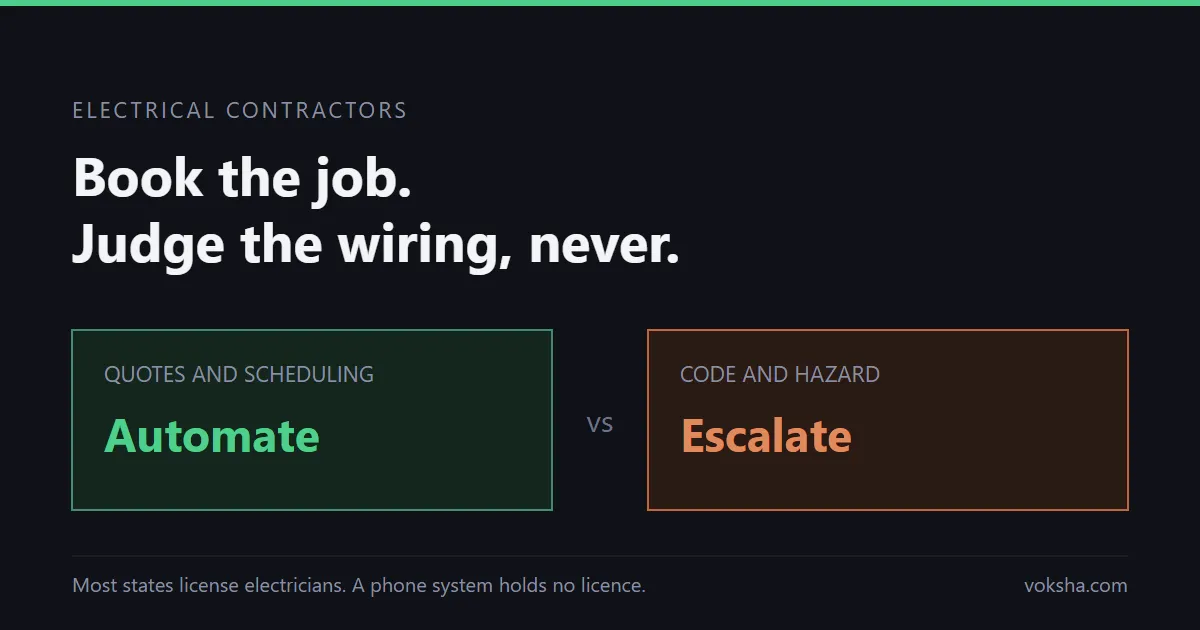
An electrician misses calls for a physical reason: you cannot answer a phone with your hands in a live panel, and the call you miss is usually a panel upgrade or an EV charger quote. Electrical calls sort into three groups. Hazard calls - burning smell, sparking outlet, a hot panel - need a person and a safety instruction immediately. Quote and scheduling calls are the revenue and the right automation target. Code and diagnosis questions must reach a licensed electrician. Voksha at $19 a month for 20 calls or Goodcall at $79 a month per agent covers the middle group.
Four options are priced below from their own pages, with the boundary that matters in a licensed trade: an automated system may take the job, but it must not say whether something is safe or code-compliant. Voksha publishes this guide and is one of the four. See How this guide was sourced.
Key Takeaways
- Your own hour is the expensive input. Electricians earn a 2025 median of $63,190 a year, or $30.38 an hour, across 821,000 US jobs, with employment projected to grow 9% from 2025 to 2035, adding 75,900 jobs (US Bureau of Labor Statistics). A three-minute call costs about $1.52 of that time - ANALYSIS - before counting the interrupted task.
- At 20 calls the range is $19 to $79; at 100 calls it is $79 to $149. Voksha $19/$99, Dialzara $29/$135, Rosie $49/$149, Goodcall $79/$79 per agent. ANALYSIS from published plans, verified 2026-09-21 except Voksha, 2026-09-07.
- Licensing is a hard boundary. "Most states require electricians to pass a test and be licensed. Requirements vary by state," and tests cover the National Electrical Code plus state and local codes (BLS). An automated system that offers a code opinion is answering a licensed question.
- Hazard language must trigger a person, not a booking. Burning smell, smoke, sparking, a hot panel or water on electrical equipment are not slots in a calendar. The correct behaviour is to escalate and tell the caller to contact 911 or the utility.
- AI voice on outbound calls is regulated; inbound is a different question. The FCC ruled in February 2024 that the TCPA's restrictions on "artificial or prerecorded voice" encompass current AI technologies (FCC 24-17). That ruling addresses calls placed to consumers, not calls a business answers - but it does constrain AI-voice callbacks and reminders.
- 32% of calls arrive outside 9-to-5 weekdays and 23% at weekends (Voksha After-Hours Economy Report, 1,000,000+ calls).
The three call types
Quote and scheduling calls are the automation target. A panel upgrade enquiry, an EV charger quote, a lighting install, "what time is the tech arriving" - these are the bulk of inbound volume, they follow patterns, and none of them needs a licensed opinion to capture.
Hazard calls are the category to get right first. A caller describing a burning smell or a sparking panel needs a person and a safety instruction, and the automated behaviour that matters is recognising the language and escalating. Booking them a Tuesday slot is the failure mode.
Code questions are licensed work. An automated system can record what the caller is describing and what property it is at. It cannot tell them whether their existing wiring is compliant, what size service they need, or whether something is safe. Those are judgements a licensed electrician makes.
The licensing boundary
The BLS states plainly that "most states require electricians to pass a test and be licensed," that "requirements vary by state," and that those tests cover the National Electrical Code together with state and local electrical codes (BLS, retrieved 2026-09-21).
There is no federal licensing body for electricians. The regulator is your state electrical licensing board or contractor licensing agency, and this guide does not interpret what any state requires. The operating principle that keeps an automated system on the right side of the line is narrow and easy to configure:
It may capture. It may book. It may quote a published price for a defined job. It must not diagnose, interpret code, or confirm compliance.
Practically: no answering "do I need a permit for that", no indicating what service size a property needs, no confirming that existing work is to code, and no implying that the person attending will be licensed unless that is true. A system that helpfully says "that sounds fine" about a wiring description has given a code opinion on your licence.
What the four cost
Every competitor figure read from the provider's own public pricing page on 21 September 2026, monthly billing, at a 3-minute average call.
| Service | Entry | Included | Overage | Metered by | At 100 calls |
|---|---|---|---|---|---|
| Voksha | $14/mo | 15 calls | $1/call | Call | $99 |
| Dialzara | $29/mo | 60 minutes | $0.48/min | Minute | $135 |
| Rosie | $49/mo | 250 minutes | not published | Minute | $149 |
| Goodcall | $79/mo per agent | Unlimited minutes, 100 unique customers | $0.50/customer | Unique customer | $79 |
Two qualifiers that table cannot hold. Goodcall prices per agent, not per account. Rosie publishes no overage rate, so the $149 is its next tier rather than an overage calculation - ask them directly if you expect to pass 250 minutes.
Sources retrieved 2026-09-21: Dialzara pricing, checked September 2026, Rosie pricing, checked September 2026, Goodcall. Voksha verified 2026-09-07 against voksha.com/pricing, which blocks automated retrieval - disclosed rather than presented as same-day.
One rule about selling on an inbound call
Worth knowing before you configure an automated system to offer a maintenance plan. The FTC's Telemarketing Sales Rule generally exempts inbound calls a consumer makes in response to general advertising, but upsells made during an otherwise exempt inbound call are covered by the rule (FTC, retrieved 2026-09-21; the TSR is 16 CFR Part 310).
So an AI that answers a service call and then pitches an annual agreement has moved into covered territory. This guide does not interpret what the rule requires of you - it flags that configuring an upsell is a compliance decision, not just a marketing one, and is worth raising with your own adviser.
Why after-hours matters for electrical work
32% of calls arrive outside 9-to-5 weekdays and 23% at weekends, and 86-90% of recovered callbacks connect and convert (Voksha After-Hours Economy Report, 1,000,000+ calls).
Two different things are arriving in that window. Homeowners ring in the evening about planned work - a panel upgrade, a charger, a remodel - because that is when they are home and thinking about it. Those are pipeline, and they go to whoever picks up.
The other kind is the hazard call, and evening is exactly when a burning smell gets noticed. That call does not want a booking system. Configure the escalation path before go-live, and decide deliberately what the system says when you genuinely are not available.
How this guide was sourced
Written by the Voksha engineering and content team (voksha.com). Voksha sells a 24/7 AI receptionist and answering service and is one of the four options priced above - and the table names Goodcall as cheaper at 100 calls, because that is what the published plans produce.
Sources and retrieval dates:
- BLS Occupational Outlook Handbook, electricians - $63,190 median annual and $30.38 hourly in 2025, 821,000 jobs, +9% and +75,900 to 2035, 7% self-employed, licensing language quoted verbatim. Retrieved 2026-09-21
- FCC Declaratory Ruling 24-17, adopted 2026-02-02 as numbered, released February 2024 - AI-generated voice falls within the TCPA's "artificial or prerecorded voice" restrictions
- FTC, Complying with the Telemarketing Sales Rule - inbound exemption and the upsell carve-out, 16 CFR Part 310
- Dialzara pricing, checked September 2026, Rosie pricing, checked September 2026, Goodcall - retrieved 2026-09-21
- Voksha pricing - retrieved 2026-09-07; the page blocks automated retrieval, disclosed rather than presented as same-day
What this guide does not claim. No figure for how an electrical contractor's calls break down by type appears here, because no source in the allowed set publishes one. The three-way split above is a description of the workflow, not a measured statistic. No establishment count for NAICS 238210 is given, because it could not be read from a primary source.
On licensing: this guide quotes the BLS statement that most states license electricians and does not interpret any state's rules. The operating principle it recommends - capture and book, never diagnose or interpret code - is editorial judgement, marked as such. Confirm your obligations with your state licensing board.
On the FCC ruling: it addresses calls placed to consumers. It does not address calls a business answers, and this guide does not claim it does.
Derived costs are marked ANALYSIS with the arithmetic shown. No competitor blog or third-party roundup was used as evidence.
The one Voksha figure used is the After-Hours Economy Report, first-party data across more than 1,000,000 calls. No unpublished Voksha telemetry appears here.
Frequently Asked Questions
Which AI receptionist is best for an electrical contractor?
Below about 80 calls a month, Voksha at $19 for 20 calls. Above that, Goodcall's $79 per agent usually wins on price, provided you run a single agent - it meters unique customers rather than calls, which suits a contractor with a repeat commercial base.
How much does it cost?
$19 to $99 a month at 20 to 100 calls across the four options priced here, from published plans read in September 2026.
What should it do when someone reports a burning smell?
Escalate to a person immediately and give the caller the instruction to contact 911 or the utility. It must not place the call into a booking flow or attempt to work out how serious the hazard is.
Can it answer code questions?
No. Most states license electricians precisely because code interpretation is a qualified judgement, and an automated system offering a code opinion is answering a licensed question on your licence. It can capture what the caller describes and route it.
What can it safely handle?
Panel upgrade and EV charger quote requests, lighting and generator install enquiries, remodel rough-in scheduling, warranty callbacks and arrival-time questions. High volume, patterned, no licensed judgement.
Does it work with ServiceTitan or Housecall Pro?
All three of the major field-service platforms serving electrical contractors - ServiceTitan, Jobber and Housecall Pro - publish electrical as a supported industry. Integration depth varies by answering vendor, so ask specifically whether the system writes a structured job record back or only emails a summary.
Conclusion
Electrical is a vertical where the automation boundary is set by a licence. Quote and scheduling calls should be automated, hazard calls should escalate with a safety instruction, and anything touching diagnosis or code should reach a licensed electrician.
Configure those three rules before go-live and the return is not the $1.52 a call. It is the panel upgrade enquiry that came in at 7pm and got answered, instead of going to the next electrician on the list.