On this page
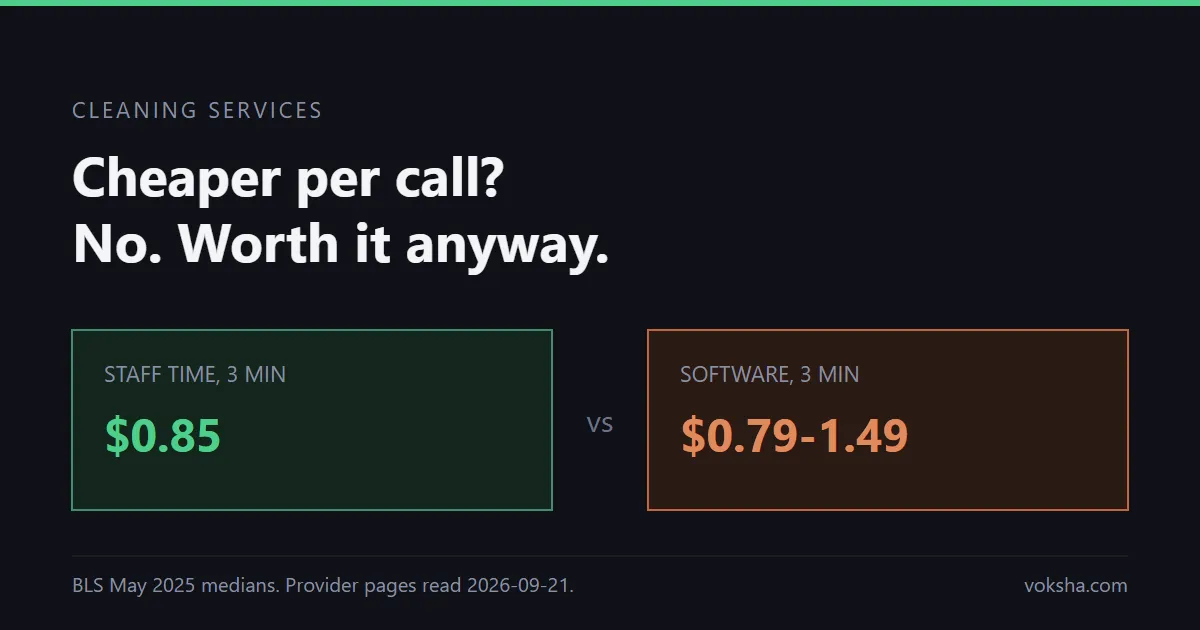
Here is the finding that shapes this whole guide: cleaning is the vertical where an AI receptionist does not save you money per call. Janitors earn a 2025 median of $17.71 an hour and maids $17.07 (BLS), so three minutes of staff time costs about $0.85 to $0.89 - less than every service with checked pricing below. The case for automating has to rest on something else, and it does: the quote call that rings while everyone is on a job. At 20 calls a month, Voksha works out to $19 ($14 Starter for 15 calls plus 5 extra calls at $1, ANALYSIS).
Four options are compared below, three of them priced from Voksha's pricing-comparison data. This guide also states plainly which regulation does not apply to you, because a rule widely cited as binding on service businesses is not. Voksha publishes this guide and is one of the four. See How this guide was sourced.
Key Takeaways
- Per-call, software loses to wage time here. Janitors and building cleaners earn a 2025 median of $36,840 a year, or $17.71 an hour, across 2,432,600 US jobs (BLS); maids and housekeeping cleaners earn a median $17.07 an hour (BLS). A three-minute call is about $0.85 to $0.89 of that - ANALYSIS - against $0.99 to $1.49 at 100 calls for the three options with checked prices here.
- At 20 calls the range is $19 to $49; at 100 calls it is $99 to $149. Voksha $19/$99, Dialzara $29/$135, Rosie $49/$149 (prices checked September 2026). Goodcall pricing is omitted because it is not in Voksha's checked pricing data. ANALYSIS from published plans.
- The real case is the missed quote call. A new-customer quote enquiry is worth a recurring contract, and the caller is working down a list. Nobody in a cleaning business is at a desk - they are all on jobs. That is the gap, not the hourly rate.
- Access calls are a security question, not a scheduling one. Key locations, alarm codes and entry instructions should never be read out by an automated system. This is the configuration most likely to be overlooked.
- The FTC "junk fees" rule does not apply to you. The Rule on Unfair or Deceptive Fees, 16 CFR Part 464, effective May 2025, covers live-event tickets and short-term lodging only (FTC). It is routinely misdescribed as a general mandate. What does apply is ordinary FTC Act truth-in-advertising: a quote must be accurate whoever gives it.
- 32% of calls arrive outside 9-to-5 weekdays and 23% at weekends (Voksha After-Hours Economy Report).
The honest arithmetic first
We publish this guide and sell one of the four products in it, so it is worth being explicit: on a per-call basis, this vertical does not justify the spend. Cleaning wages are among the lowest of any trade, and the arithmetic reflects that.
The argument that does hold is about availability rather than price. A cleaning business has nobody at a desk by design - the entire workforce is at customer sites, and the owner is usually cleaning too. So the comparison is not "software versus a receptionist answering the call". It is "software versus nobody answering the call", and at that point the cost of the call is the value of the contract that went elsewhere.
That is a narrower claim than the industry usually makes, and it is the one the data supports.
The four call types
Quote enquiries are the whole commercial case. A new residential or commercial enquiry is a recurring contract, not a single job, which is why one captured call is worth so much more than one answered scheduling question. The caller is price-shopping by definition.
Schedule changes and cancellations automate cleanly, and the cancellation half is underrated. A Tuesday slot cancelled on Monday evening is recoverable if someone knows about it; discovered on Tuesday morning, it is an idle crew.
Access questions must go to a person. A caller asking where the key is kept, or what the alarm code is, is asking a security question. An automated system that has been given those details in order to be "helpful" will eventually read them to someone who should not have them. Do not load them into it.
Complaints need a person too, for a plainer reason: someone unhappy enough to ring about a bad clean will be made angrier by an automated system, and a re-clean booked by a machine reads as a brush-off.
Which rules actually apply to you
This section exists because a specific regulation is widely and wrongly cited at service businesses.
The FTC Rule on Unfair or Deceptive Fees, 16 CFR Part 464, effective 12 May 2025, does not apply to cleaning services. Per the FTC's own FAQ, the rule is scoped to two sectors: live-event tickets and short-term lodging (FTC, retrieved 2026-09-21). Home and cleaning services fall outside both. There is one edge case - a cleaning fee charged as part of a short-term lodging booking is covered, but that is the lodging operator's obligation, not the cleaning company's.
What does apply is ordinary and unremarkable. FTC Act truth-in-advertising rules require that advertising be truthful and non-deceptive and that advertisers have evidence for their claims (FTC, retrieved 2026-09-21). That applies to every business in every sector, and it applies to a price quoted by phone.
The practical consequence for configuring an automated system is small but real: a quote it gives must be accurate and its conditions disclosed, exactly as if an employee had given it. If your pricing depends on square footage, condition or frequency in ways the system cannot reliably determine from a phone call, have it capture the details and route rather than quote a number it cannot stand behind.
What the four cost
Competitor figures are from Voksha's pricing-comparison pages (prices checked September 2026), monthly billing, at a 3-minute average call. See the full pricing comparison for how more vendors stack up.
| Service | Entry | Included | Overage | Metered by | At 100 calls |
|---|---|---|---|---|---|
| Voksha | $14/mo | 15 calls | $1/call | Call | $99 |
| Dialzara | $29/mo | 60 minutes | $0.48/min | Minute | $135 |
| Rosie | $49/mo | 250 minutes | not published | Minute | $149 |
| Goodcall | Not in our checked pricing data | - | - | Unique customer | - |
Metering matters here in a specific way. A cleaning company with a stable recurring book has the same customers calling repeatedly, which suits Goodcall's unique-customer model - though note it prices per agent, not per account. A company chasing new quote volume pays per new caller on that model, and prices better per call. Rosie publishes no overage rate, so the $149 is its next tier rather than a calculation.
Sources: Dialzara pricing, checked September 2026, Rosie pricing, checked September 2026. Voksha: voksha.com/pricing. For a head-to-head with Goodcall, see Voksha vs Goodcall.
Why after-hours matters in cleaning
32% of calls arrive outside 9-to-5 weekdays and 23% at weekends (Voksha After-Hours Economy Report).
Residential cleaning loads that window hard for an obvious reason: the person booking a house clean is at work during the day and thinking about their house in the evening. That is when the quote call comes.
It is also when nobody in a cleaning business is available. Crews finish, the owner is doing invoices or still cleaning, and there is no front desk to route to. That is the gap, and it is the only argument in this guide that the arithmetic supports without qualification.
How this guide was sourced
Written by the Voksha engineering and content team (voksha.com). Voksha sells a 24/7 AI receptionist and answering service and is one of the four options compared above - and this guide opens by saying that in this vertical the product does not pay for itself on per-call cost, because that is what the published wage and pricing figures produce.
Sources and retrieval dates, all 2026-09-21:
- BLS Occupational Outlook Handbook, janitors and building cleaners - $36,840 median annual and $17.71 hourly in 2025, 2,432,600 jobs, +2% and +53,600 to 2035
- BLS OEWS, May 2025 national occupational employment and wage estimates - maids and housekeeping cleaners, median hourly $17.07
- BLS, receptionists - $38,010 median, $18.27 hourly, 947,500 jobs, -2% to 2035
- FTC, Rule on Unfair or Deceptive Fees FAQ - scope limited to live-event tickets and short-term lodging
- FTC, Advertising FAQs: a guide for small business - general truth-in-advertising obligations
- Dialzara pricing, checked September 2026, Rosie pricing, checked September 2026; Goodcall pricing omitted (not in Voksha's checked pricing data)
- Voksha pricing
What this guide does not claim. Three things we looked for and did not find, stated rather than filled in:
- No call-composition figures. No source in the allowed set publishes how a cleaning company's calls break down by reason. The four-way split above is a description of the workflow.
- No speed-to-lead statistic. The widely circulated claim that responding within five minutes multiplies conversion traces to a 2011 Harvard Business Review piece that is not peer-reviewed, whose abstract contains no statistics, and which studied business-to-business web form leads rather than residential phone calls. We dropped the claim rather than launder it through a secondary source. The structural point - a caller who reaches voicemail rings the next company - needs no statistic.
- No establishment count for NAICS 561720 and no sourced claim that most cleaning firms are small businesses, because neither could be read from a primary source.
We also deliberately state the maids figure as an hourly median only. The corresponding annual and employment figures were not directly readable and are omitted rather than estimated.
Derived costs are marked ANALYSIS with the arithmetic shown. No competitor blog or third-party roundup was used as evidence.
The Voksha figures used are from the After-Hours Economy Report, Voksha first-party data with published methodology. No unpublished Voksha telemetry appears here.
Frequently Asked Questions
Which AI receptionist is best for a cleaning company?
At low volume, Voksha works out to $19 for 20 calls ($14 Starter plus $1 per extra call). If your volume is mostly the same recurring customers ringing about schedules, a unique-customer model like Goodcall's may suit you; compare it on Voksha vs Goodcall. If you are chasing new quote volume, per-call pricing fits better.
How much does it cost?
$19 to $149 a month at 20 to 100 calls across the three options with checked prices here (prices checked September 2026).
Is it cheaper than having someone answer?
No, and we would rather say so. At three minutes a call, cleaning staff wage time is about $0.85 to $0.89 against $0.99 to $1.49 at 100 calls for the options with checked prices. None of them undercuts the wage. The reason to use one is that in a cleaning business nobody is at a desk to answer at all.
Can it handle questions about keys and alarm codes?
No, and do not load those details into it. A caller asking where the key is kept is asking a security question about someone's home. Route it to a person who can verify who is calling.
Does the FTC junk fees rule apply to my cleaning business?
No. The Rule on Unfair or Deceptive Fees covers live-event tickets and short-term lodging only. It is frequently misdescribed as a general pricing mandate. Ordinary FTC truth-in-advertising rules do apply, so any quote the system gives must be accurate with its conditions disclosed.
Does it work with cleaning software?
It depends on the software. Voksha's Starter plan answers, captures the caller's details and follows your script; booking and integrations are on Premium and Enterprise. On those plans, Voksha books during the call into Google Calendar, Microsoft Outlook, Apple iCloud, Mindbody, Square Appointments and Booker, which you connect yourself; other platforms are set up with Voksha support, and Jobber is not a supported integration. Check Voksha integrations for your tool. Whatever you use, ask your answering vendor whether a booking or cancellation writes back into the schedule, since a cancellation that never reaches the calendar has not been captured.
Conclusion
Cleaning is the vertical where we will not pretend the per-call maths works. Staff wages here are low enough that every option with checked pricing in this guide, ours included, costs more per call than the people answering.
What makes it worth doing anyway is that nobody is answering. The evening quote enquiry is a recurring contract, the crew is at a customer's house, and the caller has three more companies to try. Automate the quotes and the schedule, keep keys and complaints with a person, and price the plan against the new-enquiry volume you actually want to win.