On this page
- When Do Parents Call a Tutoring Business?
- What Should an AI Receptionist Ask a Parent?
- How Does Subject and Grade Matching Work on the Phone?
- Can an AI Receptionist Talk to Parents Who Do Not Speak English?
- How Much Does an AI Receptionist Cost for a Tutoring Business?
- Which Calls Should a Tutor Still Take Personally?
- How This Guide Was Sourced
- Frequently Asked Questions
- Conclusion
An AI receptionist for a tutoring business answers every parent call on the first ring, including the ones that arrive while you are mid-session or after the center closes. It asks the questions you would ask: subject, grade, goal, schedule and how the parent found you. It sends you a summary of each call, and on the Premium plan it books the trial session into your calendar and can hold the conversation in a second language. You stop losing new families to voicemail during the hours you are busy teaching.
This guide is for tutoring center owners and independent tutors who teach most of the day and return calls at night. It covers when parents call, what to ask, subject matching, multilingual families, cost, and the calls you should still take.
Key Takeaways
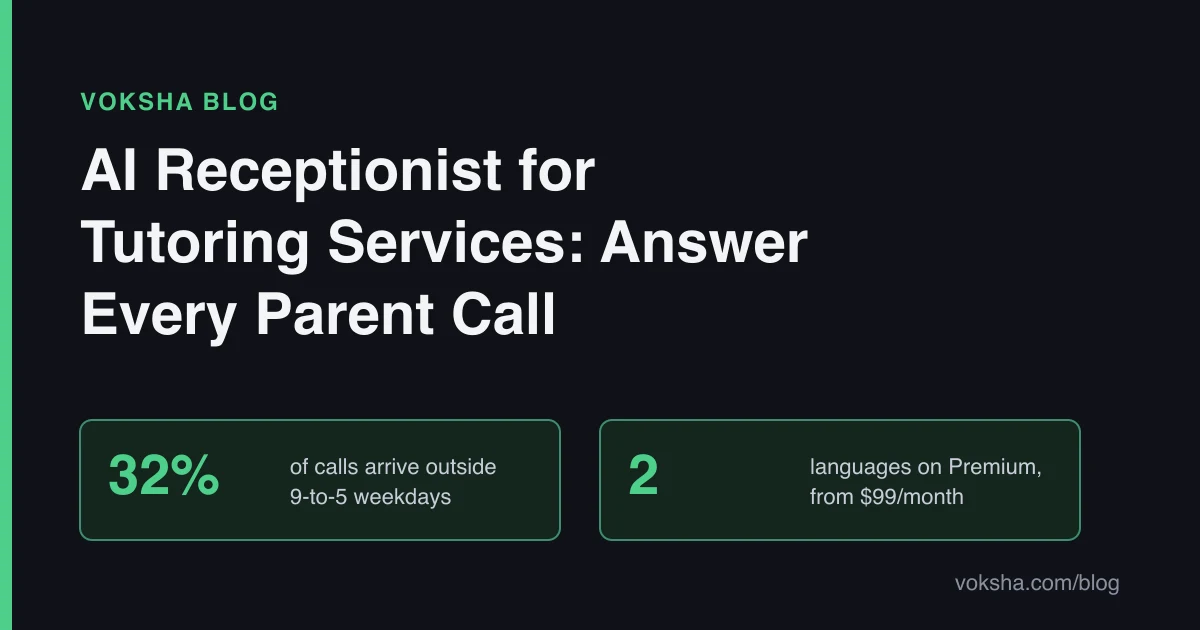
- 32% of business calls arrive outside 9-to-5 weekday hours and 23% at weekends (Voksha After-Hours Economy Report, 1,000,000+ calls). For tutoring, the after-school and evening window is exactly when parents have time to call.
- 66% of calls in Voksha's data are booking requests (Voksha Call Intelligence Report). A parent asking about tutoring usually wants a time, not just information.
- About 1 in 5 US residents age 5 and older speak a language other than English at home. The Census Bureau reports 78.3% speak only English at home (2018-2022), and Spanish is 61.1% of the rest (US Census Bureau, retrieved 2026-11-03). The 21.7% is ANALYSIS (100 minus 78.3).
- Booking and a second language are Premium features. Starter ($14/month for 15 calls, then $1 per call) answers, captures details and follows your script in English. Premium ($99/month for 150 calls, then $1 per call) adds calendar booking and 2 languages.
- Some calls belong to you. A worried parent, a learning difference, a billing dispute or a safeguarding concern should reach a person, with the AI taking clear notes first.
When Do Parents Call a Tutoring Business?
Parents call after school, after dinner and on weekends, which is also when you are teaching. Voksha's After-Hours Economy report names two pressure windows: early morning and the two hours right after 5pm. For a tutoring center, 3pm to 8pm is usually the busiest teaching block, so calls and sessions collide.
Three moments in the school year push the phone harder:
- Report cards and progress reports. A low grade turns into a phone call that evening.
- Test prep seasons. SAT, ACT, AP and finals bring parents who need to start this week, not next month.
- Back to school and January. Families set up a routine at the start of each term.
Unanswered calls rarely come back. Third-party figures in the same report say 80-85% of voicemail callers hang up without a message and about 62% call a competitor (411 Locals, 2024, and industry data, as reported there). More on daily peaks: when customers actually call a business.
What Should an AI Receptionist Ask a Parent?
The AI should collect exactly what you need to place a student, and nothing more. Five questions cover most first calls:
- Student and grade. First name, grade and school if you work with specific schools.
- Subject and goal. Algebra, reading, chemistry, SAT, or "general homework help". Ask what the goal is: catch up, keep up, or get ahead.
- Timing. Which days and times work, and how soon they want to start.
- Format. In person, online, or either. Center or home visits if you offer them.
- Source. How they heard about you, so you know which flyers, schools or referrals work.
Then the AI answers the parent's questions from your script: rates, packages, tutor qualifications, location and first assessments. The guide to writing an AI receptionist script walks through how.
How Does Subject and Grade Matching Work on the Phone?
Matching is a lookup you write once: which tutors teach which subjects and grade bands.
| Parent says | AI captures | Where it goes |
|---|---|---|
| "My daughter is in 10th grade and struggling with chemistry" | Grade 10, chemistry, catch up | Science tutor's calendar (Premium) or summary to you |
| "We need SAT prep before the spring test" | Grade 11, SAT, test date | Test prep tutor, flagged as time-sensitive |
| "He's in 3rd grade and reading below level" | Grade 3, reading, catch up | Reading specialist, first assessment |
| "Do you teach AP Calculus BC?" | Subject question | Answer from your script: yes, no, or "let me take your details" |
| "Can you help with his IEP goals?" | Learning support request | Owner, by summary, not booked automatically |
On Premium, Voksha books into Google Calendar, Microsoft Outlook or Apple iCloud, which you connect yourself from the dashboard (calendar connectors). It offers only open times, so two families do not get the same slot. If you run a tutoring platform that is not a calendar, ask Voksha support what can be set up on Premium or Enterprise. On Starter, the AI captures the same details and sends you a summary, and you book the session yourself.
A practical rule: let the AI book a first assessment or trial session, not a 20-session package. The package conversation is a sales conversation, and you are better at it.
Can an AI Receptionist Talk to Parents Who Do Not Speak English?
Yes, on Premium it can answer in two languages, and you pick the second one, for example Spanish, Korean or Chinese. Starter answers in English only. Enterprise covers many languages.
This matters in tutoring because the student may be fluent in English while the parent who pays and schedules is not. That parent is the caller.
The Census Bureau reports that 78.3% of people age 5 and older speak only English at home (2018-2022 American Community Survey), so roughly 21.7% speak another language at home. Of those, 61.1% speak Spanish, 5.1% Chinese and 2.5% Tagalog (US Census Bureau, retrieved 2026-11-03). In Voksha's own data, 33% of calls are not in English (Call Intelligence Report).
Language affects buying, too. CSA Research (2020, online shopping) found 76% of people prefer to buy in their own language and 40% will not buy in another, as reported in the Voksha Language Gap Report.
Pick your second language from your own families, not national averages. For a wider look at the options, see handling multilingual callers.
How Much Does an AI Receptionist Cost for a Tutoring Business?
Voksha starts at $14/month for 15 calls, then $1 per call. Premium is $99/month for 150 calls, then $1 per call, and adds booking, integrations and a second language. Billing is month-to-month with no setup fee.
| Option | Covers evenings and weekends | Books sessions | Second language | Monthly cost |
|---|---|---|---|---|
| Voicemail | Takes messages only | No | No | $0, plus the families who hang up |
| Owner returns calls at night | Only if you have energy left | Yes, by hand | Only if you speak it | Your evenings |
| Voksha Starter | Yes, 24/7 | No, sends a summary | English only | $14 for 15 calls, then $1/call |
| Voksha Premium | Yes, 24/7 | Yes, into your calendar | Yes, 2 languages | $99 for 150 calls, then $1/call |
A worked example, marked ANALYSIS: an independent tutor who gets 40 calls a month pays $14 + 25 x $1 = $39 on Starter. A center with 120 calls a month that wants booking pays $99 on Premium. Usage alerts at 75% and 90% of your included calls warn you before overage in a test prep rush, and spam and robocalls Voksha screens out do not count against your plan.
You go live in under 5 minutes by forwarding your existing number (how call forwarding works). Forward on no answer lets your phone ring first between sessions.
Which Calls Should a Tutor Still Take Personally?
An AI receptionist is the wrong tool for some tutoring calls. Set these as handoff topics in your script, so the AI takes notes and tells the parent you will follow up personally:
- A distressed parent. A child in tears over grades, school refusal or anxiety needs a person who can listen.
- Learning differences and IEPs. Dyslexia, ADHD and individual education plans need your judgement about fit. The AI should capture that the family is asking, not discuss the child's needs.
- Safeguarding or custody questions. Who may pick up a child, or a concern about a student's safety, is never an automated conversation.
- Billing disputes and refunds. Money conversations with an unhappy family go to the owner.
- Results promises. The AI should never promise a grade or a score. Write that into your script.
Keep what the AI collects small: name, grade, subject and schedule are enough to book.
On Premium, live call transfer to a person is available, so a call that needs you can ring through when you are free. On Starter, the owner gets an email and SMS alert, plus Slack or Google Chat if you use them, with the summary.
How This Guide Was Sourced
Written by the Voksha team (voksha.com). Voksha builds AI receptionists for small businesses. We are not a neutral reviewer.
Sources and retrieval dates:
- US Census Bureau, "Most Americans Speak Only English at Home or Speak English 'Very Well'", release CB23-208, December 7, 2023, 2018-2022 ACS 5-year estimates: 78.3% speak only English at home; Spanish 61.1%, Chinese 5.1%, Tagalog 2.5% of other-language speakers. Retrieved 2026-11-03.
- Voksha After-Hours Economy Report: 32% outside 9-to-5 weekdays, 23% weekends; third-party voicemail and competitor figures as reported there. Retrieved 2026-11-03.
- Voksha Call Intelligence Report: 66% booking requests, 33% not in English. Retrieved 2026-11-03.
- Voksha Language Gap Report: CSA Research (2020) figures. Retrieved 2026-11-03.
- Voksha pricing and calendar connector docs. Retrieved 2026-11-03.
Voksha figures come from published reports with methodology (1,000,000+ anonymized calls); no other Voksha call data is used. The call examples describe the workflow and are not measured statistics. Derived numbers are marked ANALYSIS.
Frequently Asked Questions
Can an AI receptionist book tutoring sessions?
Yes, on the Premium plan. Voksha books into Google Calendar, Microsoft Outlook or Apple iCloud during the call and offers only open times. On Starter, it captures the parent's details and sends you a summary so you can book.
Will parents know they are talking to an AI?
The AI answers with your center's name. You choose whether the greeting says it is an AI assistant.
Can it match a student with the right tutor?
Yes, if you give it the list. Tell it which tutors cover which subjects and grades, and it uses that list to book into the right calendar on Premium, or to label the summary on Starter.
What languages can it speak with parents?
Starter answers in English. Premium answers in 2 languages, and you choose the second one, such as Spanish, Korean or Chinese. Enterprise covers many languages.
Is it worth it for a solo tutor?
Often, yes. A solo tutor cannot answer while teaching, and Starter costs $14/month for 15 calls. The solo operator phone guide covers the trade-offs.
Conclusion
Tutoring calls come in when you are teaching, after school, in the evening and at weekends. An AI receptionist answers each one, captures the grade, subject and schedule, and on Premium books the first session and speaks the parent's language. Keep the sensitive conversations for yourself. See how Voksha works for tutoring services.