On this page
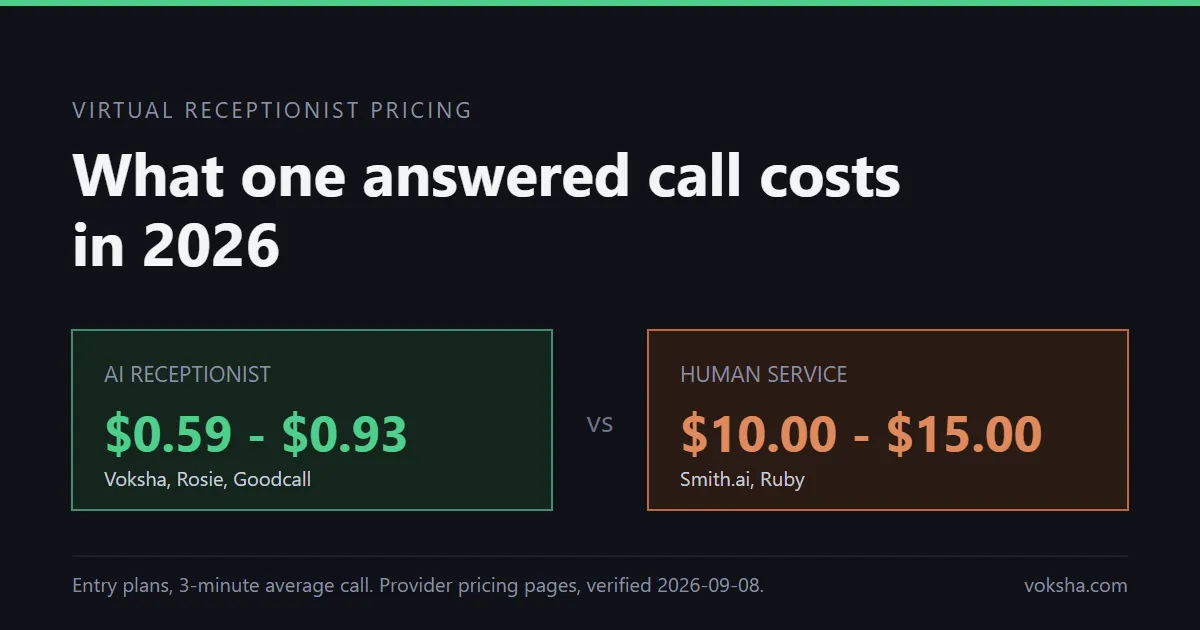
Cutting receptionist costs by 90% is possible in specific, math-backed scenarios, mainly when an AI receptionist replaces a full-time front-desk hire for a business whose call volume fits a lower usage tier. It does not hold in every case: a high-call-volume practice on an AI plan with heavy overage can land closer to 80-85% savings. This is ANALYSIS, not a guarantee, built from a published government wage figure and Voksha's own listed pricing.
This guide is for the small business owner or practice manager comparing the true cost of a human front desk against an AI receptionist, without losing call quality, professionalism or after-hours coverage. It shows the math two ways: a full-time hire and a part-time one, so you can see where the 90% figure holds and where it does not.
Key Takeaways
- The median U.S. receptionist earns $38,010 a year, or $18.27 an hour, before payroll taxes or benefits (BLS Occupational Outlook Handbook, Receptionists, retrieved 2026-09-25). Fully loaded, that is roughly $54,300 (ANALYSIS: $38,010 ÷ 0.70, using BLS ECEC's wage share of compensation).
- Comparing that median full-time wage to Voksha's $99/month Premium plan produces roughly a 97% reduction. This is a wage-only comparison; it excludes benefits, taxes and turnover costs, which would push real savings higher.
- A part-time receptionist working evenings and covering overflow calls is a smaller number to beat, and a high-volume plan with heavy per-call overage can bring total savings down to the 80-85% range.
- Voksha's pricing is Starter at $14/month (15 calls, then $1 per call), Premium at $99/month (150 calls, then $1 per call), and Enterprise from $990/month.
- An AI receptionist answers around the clock and never calls in sick, but it is not a like-for-like replacement for every human task a receptionist performs, such as greeting walk-in visitors.
- Any reduction claim should show its math. If a claim does not name the wage source and the plan it compares to, treat it with caution.
The wage number behind the claim
The U.S. Bureau of Labor Statistics puts the median annual wage for receptionists at $38,010, or $18.27 an hour, as of its most recent Occupational Outlook Handbook update (BLS, Receptionists, retrieved 2026-09-25). That figure is wages only. It does not include payroll taxes, health insurance, paid time off, workers' compensation or the cost of recruiting and training a replacement when someone leaves. BLS Employer Costs for Employee Compensation data show wages make up roughly 70% of total compensation for private-industry workers, so a rough fully loaded cost for a median receptionist is $38,010 ÷ 0.70 ≈ $54,300 a year (ANALYSIS, BLS OOH + ECEC; not a receptionist-specific survey figure). Where this article gives a savings percentage, it is calculated against the wage figure alone, which means the real gap between a human hire and an AI receptionist is likely larger, not smaller, than what's shown here.
A separate BLS wage survey, using May 2023 data, put the median at $35,840 a year, or $17.23 an hour, across roughly one million receptionists and information clerks nationally (BLS Occupational Employment and Wage Statistics, 43-4171, retrieved 2026-09-25). The two BLS figures differ because they come from different survey years, which is a useful reminder that "receptionist salary" is not one fixed number. Use the most recent figure and say where it came from.
The 90% math: full-time hire vs. Premium plan
Here is the comparison, shown plainly.
| Full-time receptionist (BLS median) | Voksha Premium | |
|---|---|---|
| Monthly cost | $38,010 / 12 = $3,167.50 | $99/month (150 calls included, then $1/call) |
| Basis | Wage only, no benefits or taxes | Plan fee within included calls |
| Reduction | Baseline | (3,167.50 - 99) / 3,167.50 = 96.9% |
This is the scenario that supports a "90%" headline: a business that currently pays one person a full-time wage just to answer phones, and that gets by within Premium's 150-call allowance, sees a reduction north of 90%. If that business also runs a moderate number of overage calls, say another 50 calls at $1 each, the monthly AI cost becomes $149, and the reduction is still 95.3%. The 90% claim holds comfortably here.
Where the math falls short of 90%
The 90% figure stops holding once you change either side of the comparison. Two common cases:
A part-time receptionist. Many small practices don't pay a full-time wage for phone coverage. Say a business pays a part-time receptionist 20 hours a week at the BLS median hourly rate of $18.27: that's roughly $1,584 a month (20 hours x 4.33 weeks x $18.27). If that business needs enough AI call capacity to replace those hours and lands on Premium plus 150 overage calls (a business fielding around 300 calls a month), the AI cost is $99 + $150 = $249. The reduction is (1,584 - 249) / 1,584 = 84.3%. Real, meaningful, but not 90%.
Heavy overage on a lower-cost plan. A business on Starter ($14/month, 15 calls included) that actually receives 200 calls a month pays $14 + (185 x $1) = $199. Compared to the same part-time receptionist cost above, that's an 87.4% reduction. Still short of 90%.
The honest takeaway: the 90% figure is real for a specific, common scenario (a full-time receptionist salary vs. an AI plan whose included calls cover your volume), and it should not be advertised as a universal outcome. Any business modeling its own numbers should run this math with its own call volume and its own current staffing cost.
What "not sacrificing quality" actually requires
Cost is only half the argument. An AI receptionist that saves money but frustrates callers or misses appointments is not a win. Three things matter for keeping quality while cutting cost:
- Coverage that matches your call pattern. If most of your missed calls happen after 6 p.m. or on weekends, the AI receptionist needs to be answering during exactly those hours, not just replicating a 9-to-5 desk.
- Booking that writes to your real calendar. A receptionist who takes a message is not the same as one who books the appointment. Confirm the AI receptionist can book into the scheduling system you already use, and whether that connection is self-serve or needs vendor setup.
- A clear path to a human. Complex, emotional or high-stakes calls (a distressed client, a billing dispute, a medical concern) should route to a person. An AI receptionist that tries to handle everything itself, with no escalation path, is where quality breaks down.
What to check before you buy on price alone
Before switching a phone line over to any AI receptionist to chase a savings number, confirm:
- Its plan's included call volume actually covers your real monthly call count. Pull that number from your current phone bill or call log rather than guessing.
- What happens on overage calls, since that's where the "90%" math above moved the most.
- Whether setup requires new hardware or just forwarding your existing number.
- What the cancellation or refund terms are if it doesn't work out in your business.
Voksha, for example, is live in under 5 minutes by forwarding your existing number, with no separate hardware, and Voksha's pricing guide breaks down the same plan tiers used in the math above. New customers can try a free demo call, and plans come with a 7-day money-back guarantee. You can also run your own numbers with the AI receptionist ROI calculator or read more on the cost of missed calls that a slow or absent front desk creates.
How This Guide Was Sourced
Written by the Voksha team, which builds AI receptionists for small businesses. We are not a neutral reviewer of the receptionist labor market, and we're not pretending to be. The wage figures above come directly from the U.S. Bureau of Labor Statistics, linked inline with retrieval dates; the fully loaded estimate applies the BLS Employer Costs for Employee Compensation wage share and is our ANALYSIS. All math comparing those wage figures to Voksha's plan pricing is our own calculation, labeled ANALYSIS, and shown in full so you can check or redo it with your own numbers. No Voksha call data is used in this guide. Every figure above is external and linked.
Frequently Asked Questions
Is a 90% cost reduction realistic for every business?
Not for every business. It's realistic when comparing a full-time receptionist's BLS median wage to an AI plan whose included call volume covers your actual call count. Part-time comparisons or high overage usage bring the number down, sometimes into the 80-85% range, as shown in the math above.
Does the receptionist wage figure include benefits?
No. The BLS figures used here are wages only. Adding payroll taxes, health insurance or paid time off would increase the human-staffing side of the comparison, which would make the percentage reduction larger, not smaller.
What does Voksha actually cost?
Starter is $14/month with 15 calls included, then $1 per call. Premium is $99/month with 150 calls included, then $1 per call. Enterprise starts from $990/month. You can try a free demo call, and plans come with a 7-day money-back guarantee.
Can an AI receptionist fully replace a human front desk?
It can answer calls, capture leads and book appointments around the clock (with Voksha, every plan answers and captures caller details; booking appointments is on Premium and Enterprise), but it is not a full substitute for in-person tasks like greeting walk-in visitors, and it should hand off complex or emotionally sensitive calls to a person.
Conclusion
A 90% reduction in receptionist costs is achievable, and the math above shows exactly when: a full-time receptionist's median wage compared to an AI plan whose included calls cover your volume. It is not guaranteed, and a business with lower baseline staffing costs or high call overage should expect a smaller, still meaningful, number instead. Run your own call volume against your own current cost before you decide. If you want to see how the numbers apply to your business, see Voksha's pricing.
For a deeper side-by-side on staffing costs, read AI Receptionist vs Hiring a Human: Cost & ROI in 2026.