On this page
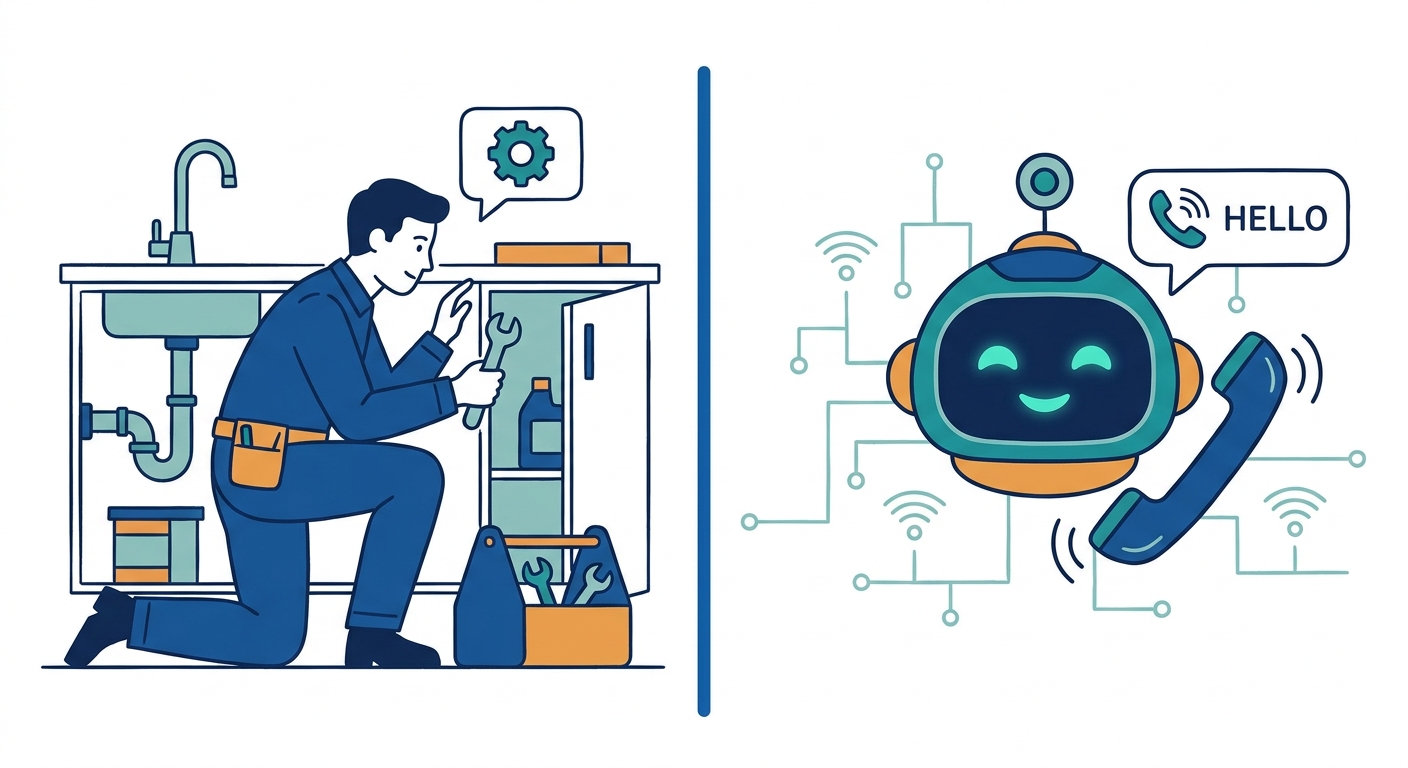
Plumbing services use AI phone answering to pick up every call, including the burst pipe at 11 p.m. or the backed-up drain on a Sunday, gather the details a dispatcher needs (address, issue, urgency), and book or flag the job before the caller hangs up and dials the next plumber on the list. This matters because plumbers themselves are often on the job, not at a desk, and emergency work by definition doesn't wait for business hours.
This guide is for plumbing business owners and office managers deciding whether an AI receptionist is worth adding to an already-busy operation. It covers why emergency calls are the hardest calls to staff for, what an AI receptionist can and can't do with them, and how to set one up without losing the personal touch that keeps residential customers coming back.
Key Takeaways
- Plumbers work nights and weekends routinely because emergencies don't follow a schedule; BLS notes evening and weekend work is common in the trade (BLS Occupational Outlook Handbook, Plumbers, Pipefitters, and Steamfitters, retrieved 2026-09-25).
- Demand for plumbers is projected to grow 7% from 2025 to 2035, faster than the average occupation, with about 42,000 openings a year, meaning most shops are already stretched thin on staff to answer phones (BLS, same source, retrieved 2026-09-25).
- An AI receptionist answers around the clock, captures the caller's name, address, issue and urgency, and flags the call for dispatch; with Voksha, booking directly into a calendar is on the Premium plan. It does not physically triage a pipe or diagnose damage over the phone.
- Voksha's plans start at $14/month (15 calls, then $1/call) up to $99/month (150 calls, then $1/call), with Enterprise from $990/month for multi-location operations.
- A true emergency, a safety risk (gas smell, active flooding near electrical) still needs a clear path to a live person or 911, and any AI answering setup should build that escalation in from day one.
Why plumbing calls are hard to staff for
Plumbing work happens on the customer's schedule, not the plumber's. The BLS notes that plumbers, pipefitters and steamfitters are "often on call for emergencies, so evening and weekend work is common," and that most in the trade work full time, including nights and weekends (BLS, Plumbers, Pipefitters, and Steamfitters, retrieved 2026-09-25). That's the root of the staffing problem: the person best equipped to answer a plumbing call, a plumber, is usually under a sink or in a crawl space when the phone rings.
Demand for the trade is also growing. BLS projects 7% employment growth for plumbers, pipefitters and steamfitters from 2025 to 2035, well above the average for all occupations, with roughly 42,000 job openings expected per year over the decade (same source, retrieved 2026-09-25). A tight labor market for skilled trades makes it harder, not easier, to hire someone whose only job is sitting by the phone.
Small and mid-size plumbing shops are left with a small set of imperfect options: let calls go to voicemail, hire a receptionist who can't be on every shift, pay for a live answering service that charges by the minute, or use a smartphone app and hope someone checks it between jobs.
What an AI receptionist actually does on an emergency call
An AI receptionist for a plumbing business answers every inbound call, day or night, and works through a structured set of questions: what's happening, where, and how urgent it is. For a residential plumbing call, that typically means capturing:
- The caller's name, phone number and service address
- What's wrong (no hot water, active leak, sewage backup, no water at all)
- Whether it's an active emergency or something that can wait for a scheduled visit
- Whether the caller is an existing customer or new
That structured information, delivered as a call summary or booked directly into the shop's calendar, is the difference between a technician driving to a vague "something's wrong with my sink" and one who already knows to bring a wet/dry vac because the caller described standing water.
An AI receptionist can also apply simple triage logic that a business sets up in advance: an active flood or a reported gas smell gets flagged immediately for the on-call technician or routed to a live person, while a routine "my faucet is dripping" request gets booked into the next available slot. This is a scheduling and routing function, not a diagnosis. The AI receptionist does not tell a caller what's wrong with their plumbing or whether it's safe to stay in the house; it collects what the caller reports and moves the call to the right next step.
What it should never be asked to do
Being clear about limits matters as much as describing capabilities. An AI receptionist should not be the only line of defense on:
- Life-safety situations. A caller reporting a gas smell, a fire risk or a flood near an electrical panel needs an immediate path to 911 or a live person, not a queue.
- Complex or upset callers. Someone dealing with water damage in their home is often stressed. If the AI receptionist can't calm the situation or the caller explicitly wants a person, escalation should be fast and simple, not a dead end.
- Diagnosing the problem. The AI receptionist's job is to gather facts and route the call, not to tell a homeowner whether their water heater needs replacing.
A plumbing business that builds these limits into its call flow up front avoids the two failure modes that actually cost customers: an AI system that tries to do too much and frustrates a caller, or one so limited it can't handle anything beyond a simple booking.
Setting it up without losing the personal touch
Plumbing is a relationship business as much as a technical one. A homeowner picking a plumber for an emergency is trusting a stranger to come into their house. A few practical steps keep an AI receptionist from feeling like a wall between the business and its customers:
- Write the greeting to sound like your business, not a call center. A short, direct greeting that identifies the company by name and gets straight to "what's going on?" works better than a long automated menu.
- Confirm calendar sync before going live. The AI receptionist should book directly into the same calendar your dispatcher or technicians already use, so nothing gets double-entered or missed.
- Set the escalation rule explicitly. Decide, in advance, which keywords or situations (gas, flooding, no water at all for a family with young children) trigger an immediate handoff to a live person, and test it before it matters.
- Review call summaries weekly. The fastest way to catch a gap, a question the AI receptionist didn't know how to answer, a caller who hung up frustrated, is to actually read a sample of call transcripts early on.
Cost, compared honestly
Compared to a live 24/7 answering service billed by the minute, or hiring additional after-hours staff, an AI receptionist is generally the lower-cost option, though the right comparison depends on your actual call volume. Voksha's plans are Starter at $14/month (15 calls, then $1 per call), Premium at $99/month (150 calls, then $1 per call), and Enterprise from $990/month for larger, multi-location plumbing operations. New customers get a free demo call and a 7-day money-back guarantee. Starter answers every call, captures the caller's details and follows your call script; Premium adds calendar booking, integrations and after-hours emergency routing. Voksha is SOC 2 compliant and ISO 27001 compliant on every plan; HIPAA with BAAs, GDPR, CCPA and a 99.9% uptime SLA are on the Enterprise plan only, though most residential plumbing calls won't involve protected health information.
For a plumbing business specifically, the industry landing page at Voksha's AI receptionist for plumbing services and the after-hours answering solution cover setup details specific to trade businesses. On the Premium plan, Google Calendar, Microsoft Outlook and Apple iCloud connect from the dashboard and book during the call; field-service platforms such as ServiceTitan and Housecall Pro are set up with Voksha support (see Voksha integrations), and Jobber is not supported.
How This Guide Was Sourced
Written by the Voksha team, which builds AI receptionists for small businesses, including plumbing and other home service trades. We are not a neutral reviewer of the plumbing labor market. The employment and wage figures above come directly from the U.S. Bureau of Labor Statistics, linked inline with retrieval dates. No Voksha call data is used in this guide. Every figure above is external and linked.
Frequently Asked Questions
Can an AI receptionist tell if a plumbing issue is a real emergency?
It can apply the rules a business sets up in advance, for example flagging any mention of active flooding or a gas smell for immediate escalation, but it does not diagnose the underlying plumbing problem. Think of it as structured triage and routing, not technical assessment.
Will callers know they're talking to an AI?
That depends on how the greeting and script are written. Many plumbing businesses are transparent about it, since callers generally care more about getting a fast, accurate response than about who or what answers.
Does this replace a dispatcher?
No. It replaces the phone-answering bottleneck, capturing the caller's details and either booking directly into the calendar or handing a clear summary to whoever dispatches jobs. A human dispatcher still decides which technician goes where.
What happens with true after-hours emergencies at 2 a.m.?
The AI receptionist answers the call regardless of time, gathers the details, and follows the escalation rule the business defined, which typically means alerting an on-call technician immediately for anything flagged urgent. (With Voksha, after-hours emergency routing is part of the Premium plan; every plan sends you email and SMS alerts.)
Conclusion
Plumbing businesses lose the most ground on calls they can't staff for: nights, weekends, and the moments a technician is elbow-deep in a job. An AI receptionist doesn't replace the plumber or the dispatcher, but it makes sure every call gets answered, the right details get captured, and true emergencies get flagged fast. See Voksha's pricing to find the plan that fits your call volume.
For a full comparison of AI receptionist options built for the trade, read Best AI Receptionists for Plumbing Services.