After-Hours Maintenance Calls: A Property Manager Playbook
TL;DR
- How property managers triage after-hours maintenance calls: what counts as an emergency, how to route routine requests, and how to build a coverage plan.
Property managers handle after-hours maintenance calls by sorting them into two categories on the call itself: true emergencies (no heat, active water leaks, gas smell, no functioning toilet, lockouts involving safety) that need an immediate contractor dispatch, and routine requests (a slow drain, a dead light bulb, a squeaky door) that can safely wait until the next business day. Getting that triage right, consistently, at 2am and not just at 2pm, is what separates a property manager who sleeps through the night from one who doesn't.
This guide is for property managers and owners handling their own after-hours calls, whether personally, through staff on rotation, or through an answering service. It covers what counts as a true maintenance emergency, the habitability standard that sits behind that judgment, how to route each category, and how to set up coverage that doesn't burn out whoever is on call. Repair-timeline and habitability rules vary by state and lease terms, so this guide describes the general framework, not legal advice for your specific property.
Key Takeaways
- Emergency maintenance generally includes conditions that threaten safety, health, or the property itself: fire (call 911 first), gas leaks, active water leaks or sewage backup, no heat or air conditioning in extreme weather, and no functioning toilet where there is only one (National Apartment Association, Maintenance Emergencies Defined, retrieved 2026-09-26).
- Federal housing standards center on keeping a unit "safe, decent, and sanitary," and HUD provides a complaint channel for residents when property management fails to address serious maintenance issues (HUD, Multifamily Housing Complaint Line, retrieved 2026-09-26).
- Routine requests, a dripping faucet, a loose cabinet handle, a non-emergency appliance issue, can almost always wait until normal business hours without risk to the tenant or the property.
- Property, real estate, and community association managers often have on-call duties as part of the job, including responding to emergencies outside normal hours (BLS Occupational Outlook Handbook, Property Managers, retrieved 2026-09-26).
- A written, consistent triage script, used by whoever answers the phone, prevents both under-response to a real emergency and over-response (and unnecessary contractor call-out fees) to a routine issue.
- Habitability and repair-timeline rules vary by state and lease; confirm specifics for your property with your own counsel or local housing authority.
On this page: What actually counts as an emergency · The habitability standard behind the judgment call · Routing routine requests · Building an after-hours triage script · Staffing the on-call rotation without burning people out · How This Guide Was Sourced · Frequently Asked Questions
What Actually Counts as an Emergency
An emergency maintenance call is one that threatens a tenant's safety or health, or risks serious damage to the property if it waits until morning. The National Apartment Association defines emergency maintenance to include fire (call 911 first), electrical or gas failures, any water leak or sewage backup, loss of heat or air conditioning, a refrigerator that stops working, no hot or cold water, a stopped-up toilet where the unit has only one, an overflowing toilet risking property damage, and an unsecured entry door or window on the ground floor (NAA, Maintenance Emergencies Defined, retrieved 2026-09-26).
Notice what's on that list and what isn't. A gas smell or an active leak is an emergency because it escalates fast and can become dangerous or destructive within hours. A loose towel bar or a squeaky hinge is not, because nothing gets meaningfully worse by waiting until 9am. The test worth applying on every call is simple: does this get significantly worse, or does someone get hurt, if it waits eight hours? If yes, it's an emergency. If no, it's routine, however uncomfortable it is for the tenant tonight.
The Habitability Standard Behind the Judgment Call
Underneath the emergency list sits a broader legal idea: a rental unit has to remain fit for a person to live in, sometimes called the habitability standard, and property owners and managers are responsible for keeping it that way. Federal housing guidance frames this as keeping housing "safe, decent, and sanitary," and HUD operates a Multifamily Housing Complaint Line specifically for residents to report poor maintenance or dangers to health and safety when property management doesn't respond (HUD, Multifamily Housing Complaint Line, retrieved 2026-09-26).
That standard is why the emergency categories above aren't arbitrary. No heat in winter, no working toilet, an active leak, these all threaten the basic habitability of the unit, which is exactly the category HUD's complaint process and most state landlord-tenant statutes are built to protect. Exact response-time requirements and remedies for a habitability failure differ by state and, in some cases, by city ordinance, so this guide describes the general framework rather than a specific timeline. Confirm the rules that apply to your properties with your own counsel or your state's housing authority.
Routing Routine Requests
Most after-hours calls are not emergencies, even though every caller understandably wants their issue handled now. A dripping faucet, a squeaky door, a burnt-out bulb in a common area, a minor appliance quirk, none of these threaten safety or the unit's habitability if they wait until regular business hours.
Routing these correctly matters for two reasons: cost and trust. An emergency contractor call-out after hours typically costs significantly more than the same job scheduled during the day, so treating every call as urgent runs up unnecessary expense. And tenants trust a property manager more, not less, when they get a clear, honest answer, "that's not dangerous, we'll have someone out tomorrow morning", instead of vague reassurance or an unnecessary emergency dispatch that then makes every future call feel like it needs the same urgency.
| Call type | Example | Response |
|---|---|---|
| True emergency | Active leak, no heat in winter, gas smell, no working toilet | Dispatch immediately, 24/7 |
| Safety-adjacent, non-critical | Broken lock on an upper-floor unit, minor electrical flicker | Same-day or next available slot, assess urgency case by case |
| Routine | Dripping faucet, loose fixture, cosmetic issue | Log the request, schedule for next business day |
Building an After-Hours Triage Script
- Start every call with two questions. Is anyone in immediate danger, and is there active water, gas, fire, or electrical risk right now?
- Match the answer against a written emergency list. Use a defined list, similar to the NAA categories above, rather than judgment calls that vary by whoever is on the phone.
- For a confirmed emergency, dispatch immediately and confirm back to the tenant. Give a realistic arrival window, not a vague "someone will be there soon."
- For a routine request, log it with detail and set an expectation. Tell the tenant when it will be addressed, and stick to that window.
- Document every after-hours call, emergency or not, so patterns (a recurring plumbing issue, a unit with repeated complaints) surface before they become bigger problems.
- Review the log monthly for anything mis-triaged in either direction, missed real emergencies or unnecessary emergency dispatches.
Staffing the On-Call Rotation Without Burning People Out
On-call maintenance response is a documented part of the property management job, not an edge case. The Bureau of Labor Statistics notes that property, real estate, and community association managers may need to respond to emergencies during off-duty hours, and some are required to live on-site specifically for this kind of availability (BLS Occupational Outlook Handbook, Property Managers, retrieved 2026-09-26). The median annual wage for the role was $69,990 in May 2025 (same source, retrieved 2026-09-26), a figure worth keeping in mind against the cost of any after-hours answering solution you're comparing.
The problem with a single person, or a small rotating team, fielding every after-hours call directly is fatigue and inconsistency: a manager woken up three nights running is more likely to misjudge an emergency, either way, on the fourth call. This is exactly the gap an AI receptionist for property management is built to close: it answers every after-hours call with the same triage logic every time, dispatches a real emergency to your on-call contractor list immediately, and logs routine requests for the morning, without waking a person up to make a judgment call an AI can be trained to make consistently. Voksha's own after-hours answering solution and property-management answering service page cover the setup in more detail.
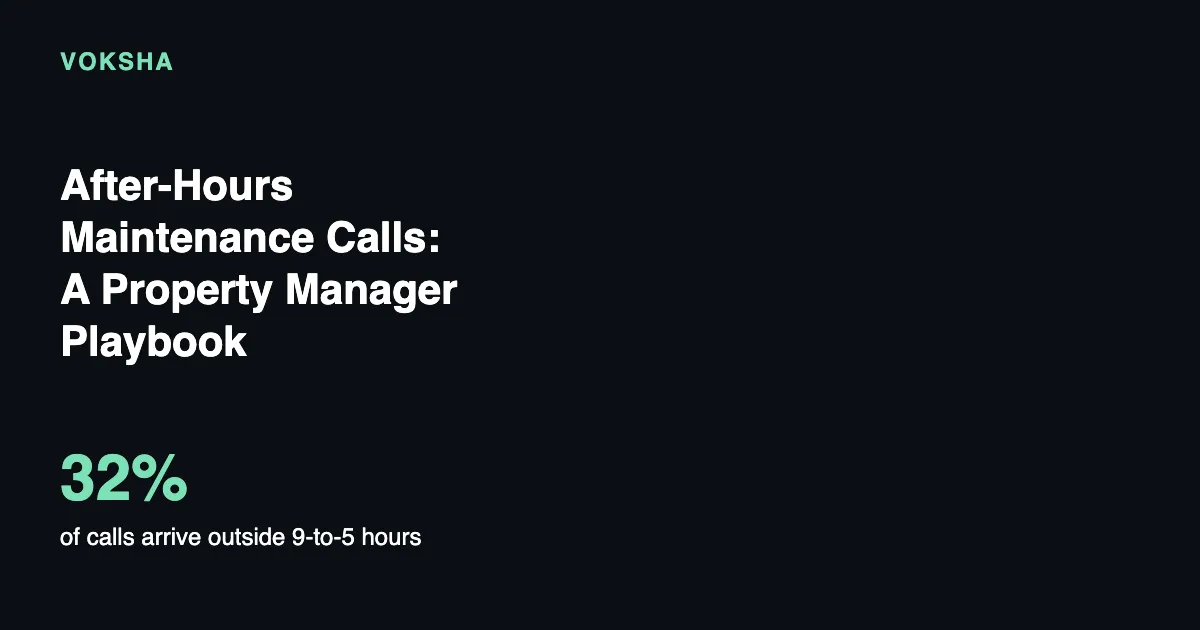
Voksha's own research on call timing shows why this coverage gap is bigger than most property managers assume: 32% of calls across the businesses Voksha analyzed arrive outside 9-to-5 weekday hours, and 23% land on weekends (Voksha After-Hours Economy Report, retrieved 2026-09-26), exactly the hours when a property management office is least likely to be staffed and a tenant is most likely to be dealing with a real problem. For a closer look at the specific fit, see Best AI Receptionist for Property Management Companies, and for the broader case for moving after-hours coverage to AI, see After-Hours Answering Service Alternatives: Is AI Worth It?.
How This Guide Was Sourced
Written by the Voksha team. Voksha builds AI receptionists for small businesses, including property management companies, and discloses that plainly: we are not a neutral party in recommending after-hours coverage.
The emergency-maintenance category list comes from the National Apartment Association. The habitability framing and complaint process come from HUD's Multifamily Housing Complaint Line page. On-call job duties and wage data come from the U.S. Bureau of Labor Statistics. The after-hours call-volume figures come from Voksha's own After-Hours Economy Report, which publishes its methodology. This guide describes the general emergency-maintenance and habitability framework; it is not legal advice, and repair-timeline requirements vary by state and lease. Confirm specifics with your own counsel or local housing authority.
Frequently Asked Questions
What counts as an emergency maintenance call for a rental property?
Generally, conditions that threaten safety, health, or cause serious property damage if they wait: fire, gas leaks, active water leaks or sewage backup, no heat or air conditioning, and no working toilet where there is only one (NAA, Maintenance Emergencies Defined, retrieved 2026-09-26). Non-critical issues like a dripping faucet or a squeaky door are considered routine.
How fast do I have to respond to an emergency maintenance request?
Response-time requirements vary by state and lease agreement, so there is no single national number. The safest practice is to treat true emergencies as needing dispatch as close to immediate as possible, and to confirm any specific timeline requirement with your own counsel for the state your property is in.
Can a tenant report my property to HUD if I don't respond to maintenance requests?
Residents of HUD-insured or HUD-assisted properties can report poor maintenance or health and safety dangers through HUD's Multifamily Housing Complaint Line (HUD, retrieved 2026-09-26). Whether this applies to a specific property depends on whether it receives HUD insurance or assistance; non-HUD properties are still generally subject to state and local habitability law.
Should routine maintenance calls ever be handled after hours?
Usually not with an emergency dispatch. Log the request, confirm receipt to the tenant, and set an expectation for when it will be scheduled during regular business hours, unless the issue changes and becomes urgent.
How can I reduce how often I get woken up for maintenance calls that aren't real emergencies?
A consistent triage script, applied by whoever or whatever answers the phone, catches most of this. An AI receptionist trained on a defined emergency list can apply that triage on every call without needing a person to wake up and make the judgment call themselves.
Conclusion
Getting after-hours maintenance triage right comes down to a consistent, written definition of what counts as an emergency, applied the same way at 2am as at 2pm, backed by a basic understanding of the habitability standard your properties need to meet. Whether that triage is run by a rotating on-call team or an AI receptionist trained on your emergency list, consistency is what protects tenants, your properties, and your own sleep. See how Voksha's AI receptionist for property management triages after-hours calls automatically.