What Callers Want: Two in Three Calls Are Bookings
TL;DR
- Data from 1,000,000+ business calls shows 66% are booking requests, and AI resolves 85% without a human. What that means for how you staff your phones.
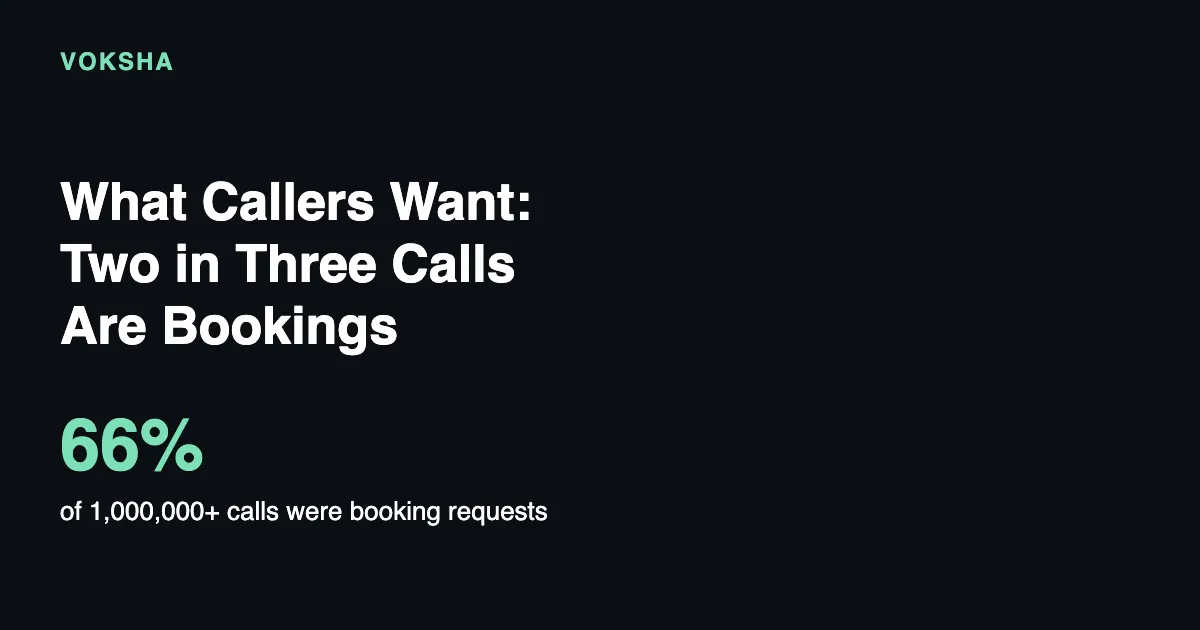
Most people who call a small business are not calling to browse. They are calling to book something. Across an analysis of more than 1,000,000 anonymized calls to small and mid-size businesses, 66% were booking requests, meaning the caller wanted to schedule, reschedule, or cancel an appointment, and 85% of all calls were resolved by AI with no human needed at all (Voksha Call Intelligence Report, retrieved 2026-09-26). That single fact should shape how any local service business answers its phone.
This guide is for owners and office managers who want to know what actually happens when their phone rings, not what they assume happens. It walks through the booking-heavy shape of real call volume, why that matters for staffing and after-hours coverage, what a good booking call flow looks like, and where a live person still needs to step in. It draws on Voksha's own published call research plus outside data on contact center performance and receptionist staffing costs.
Key Takeaways
- 66% of the 1,000,000+ calls Voksha analyzed were booking requests: scheduling, rescheduling, or canceling an appointment (Voksha Call Intelligence Report, retrieved 2026-09-26).
- 85% of calls in that same dataset were resolved entirely by AI, with no human transfer required (Voksha Call Intelligence Report, retrieved 2026-09-26).
- A phone system built around answering FAQs first and booking second is optimizing for the smaller share of call volume.
- Contact center research treats "resolution quality," not call length, as the metric that predicts whether a caller leaves satisfied (ICMI, 7 Metrics That Really Matter in Contact Centers, retrieved 2026-09-26).
- A full-time receptionist costs a median $38,010 a year in wages alone, before benefits, for one person covering one shift (BLS Occupational Outlook Handbook, Receptionists, retrieved 2026-09-26).
- The calls that do need a human are usually the ones that are not routine bookings: complaints, negotiations, or requests outside a script.
On this page: Why booking dominates call volume · What a good booking call actually needs · The cost of routing every call to a person · Where a human still has to step in · Building your phone flow around booking first · How This Guide Was Sourced · Frequently Asked Questions
Why Booking Dominates Call Volume
Most inbound calls to a local service business are not information requests, they are booking requests. In Voksha's analysis of over 1,000,000 anonymized calls across industries including salons, dental practices, law firms, and home services, 66% of calls involved scheduling, rescheduling, or canceling an appointment (Voksha Call Intelligence Report, retrieved 2026-09-26). The remaining calls covered a mix of questions, follow-ups, and requests that did not fit a single category.
Voksha's analysis of more than 1 million calls found that 7 in 10 small business calls are repetitive and automatable, the routine questions about hours, pricing and booking (Voksha data release via EIN Presswire).
This lines up with how service businesses actually operate. A salon client calling about a haircut, a dental patient calling about a cleaning, and a homeowner calling about an HVAC inspection are almost always trying to get a specific date and time on the calendar, not asking about hours or pricing in the abstract. The call is transactional from the first sentence.
That has a direct implication for phone system design. If two out of three calls are booking attempts, a phone tree that makes callers navigate several menu options before reaching a scheduling option is optimizing for the wrong majority. The fastest path to "yes, you're booked for Tuesday at 2pm" should be the shortest path in the call, not the last one.
What a Good Booking Call Actually Needs
A booking call is answered well in its first sentence: can this business get me on the calendar, and how fast. Handling that well requires four things working together, not one clever script.
- Real-time calendar access. The system answering the phone needs to see actual open slots, not a static list of "business hours," so it can offer a real appointment on the call.
- Two-way write access. Booking, rescheduling, and canceling all need to write back to the same calendar the staff uses, or double-booking becomes a daily problem.
- Basic intake before the slot is locked. Confirming the service requested, whether it's a new or returning customer, and any special requirements, so the appointment that lands on the calendar is the right one.
- A confirmation the caller can trust. A callback number, a text or email confirmation where the business already has consent to send one, or at minimum a clear verbal recap of date, time, and service.
Voksha's own appointment booking solution is built around exactly this loop: check the calendar live, book directly into it, and confirm before hanging up, rather than taking a message and calling the customer back later. Voksha's guide to appointment booking best practices covers the intake questions worth asking on every booking call, industry by industry.
The Cost of Routing Every Call to a Person
If two-thirds of calls are routine bookings, routing every single one to a live person is expensive in a way that's easy to underestimate. The median annual wage for a receptionist was $38,010 in 2025 (BLS Occupational Outlook Handbook, Receptionists, retrieved 2026-09-26), and that figure is wages only, before payroll taxes and benefits, and before accounting for the hours a receptionist is not working, such as lunch, weekends, and after 6pm.
Contact center research backs up why this matters beyond cost alone. Industry frameworks for measuring service quality treat resolution, whether the caller's actual need got handled correctly, as the metric that predicts satisfaction, more than how long the call took or how many people it passed through (ICMI, 7 Metrics That Really Matter in Contact Centers, retrieved 2026-09-26). A booking call resolved correctly and quickly, with no transfer and no callback needed, scores well by that standard regardless of who or what answered it.
| Call type | Share of volume | Best fit |
|---|---|---|
| Booking, reschedule, cancel | 66% | Structured flow with live calendar access |
| Other questions, follow-ups, edge cases | 34% | Mix of scripted answers and human escalation |
| Complex or emotionally sensitive calls | Small share within the above | Routed to a human every time |
An AI receptionist resolved 85% of the total call volume in Voksha's dataset without any human involvement (Voksha Call Intelligence Report, retrieved 2026-09-26), which tracks with how heavily booking-weighted that volume is: booking calls are exactly the kind of structured, repeatable interaction that a well-built system handles reliably.
Where a Human Still Has to Step In
Not every call should end at the AI. The calls worth routing to a person are the ones that fall outside a booking script: a complaint about a past visit, a caller negotiating a price or exception, a medical or legal question that needs professional judgment, or someone who is upset and needs to be heard by a person before anything else happens.
Voksha's own approach is to route those calls to a human by design, not as a failure state. An AI receptionist that tries to force every call into a script, including the ones that clearly need empathy or judgment, will frustrate the small share of callers who need it most. The goal is not zero human involvement, it's making sure the calls that need a person get to one quickly, while the two-thirds that just need a slot on the calendar get handled instantly.
This matters most in regulated or high-stakes industries. A law firm fielding a new client's intake call still needs a lawyer or trained staff member for anything beyond basic scheduling and information gathering. A medical clinic needs a clear, fast route to a nurse or on-call provider for anything that sounds urgent. Good AI phone systems are built with that routing logic from the start, not bolted on later.
Building Your Phone Flow Around Booking First
If two out of three calls are booking attempts, the phone system should be built around that fact, not around an all-purpose menu tree.
- Audit your current call flow. Time how many steps a caller takes to reach a scheduling option today, from the greeting to a confirmed appointment.
- Put booking within the first exchange. The system, human or AI, should offer to check availability in its opening response, not after several menu prompts.
- Give it real calendar visibility. Whatever answers your phone needs to see actual open slots, not a static script that promises a callback.
- Define escalation triggers up front. Decide, in writing, which situations always go to a human: complaints, anything sounding urgent, and anything the system can't confidently resolve.
- Review call outcomes monthly. Track how many calls got booked on the first call versus required a callback, and adjust the flow based on what's actually happening.
How This Guide Was Sourced
Written by the Voksha team. Voksha builds AI receptionists for small businesses, and this guide discloses that plainly: we have a commercial interest in AI answering calls well, and we are not a neutral third party.
The 66% booking-share and 85% AI-resolution figures come from the Voksha Call Intelligence Report, which analyzed over 1,000,000 anonymized calls across small and mid-size businesses and publishes its methodology. The receptionist wage figure comes from the U.S. Bureau of Labor Statistics' Occupational Outlook Handbook. The framing around resolution quality as the metric that matters in contact centers comes from ICMI, an independent contact center research and training organization.
No Voksha customer call data outside the published Call Intelligence Report methodology is used in this guide.
Related Reading
- Appointment Scheduling Software + AI: Booking That Syncs to Your Calendar in Real Time
- Appointment No-Show Reduction Strategies: Leveraging Automated Appointment Reminder Software
Frequently Asked Questions
Why do most customers call a business instead of booking online?
Many callers prefer a live conversation to confirm availability, ask a quick question, or handle a reschedule that an online form doesn't cover well. Voksha's data shows 66% of calls are booking requests even in businesses that also offer online booking (Voksha Call Intelligence Report, retrieved 2026-09-26), which suggests phone remains the preferred channel for many customers.
What percentage of business calls can AI actually resolve?
In Voksha's analysis of over 1,000,000 calls, AI resolved 85% without transferring to a human (Voksha Call Intelligence Report, retrieved 2026-09-26). The remaining calls were routed to staff, generally because they involved a complaint, a complex request, or a situation needing human judgment.
Should every call still be answered by a live person?
Not necessarily. Since most calls are routine booking requests, a well-built AI receptionist with live calendar access can resolve them as reliably as a person, while routing complaints, urgent situations, and anything outside a script to a human.
How much does a live receptionist cost compared to an AI receptionist?
A full-time receptionist's median wage alone is $38,010 a year (BLS Occupational Outlook Handbook, Receptionists, retrieved 2026-09-26), before benefits and payroll taxes, and that covers one shift, not 24/7 coverage. Voksha's Starter plan is $14/month for 15 calls, then $1 per additional call (Voksha pricing).
Does Voksha only handle appointment booking calls?
No. Voksha answers all call types, including questions, lead capture, and routing to a human, but its call flow is built to resolve booking requests, the largest single category of calls, without needing a human on the line.
Conclusion
The data is clear about what callers actually want when they pick up the phone to call a business: two out of three are trying to book, reschedule, or cancel an appointment, not browse general information. A phone system that makes that the fastest, first thing it handles, and reserves human attention for the calls that genuinely need it, both saves money and serves callers better. See how Voksha's appointment booking works to check availability, book, and confirm in one call.