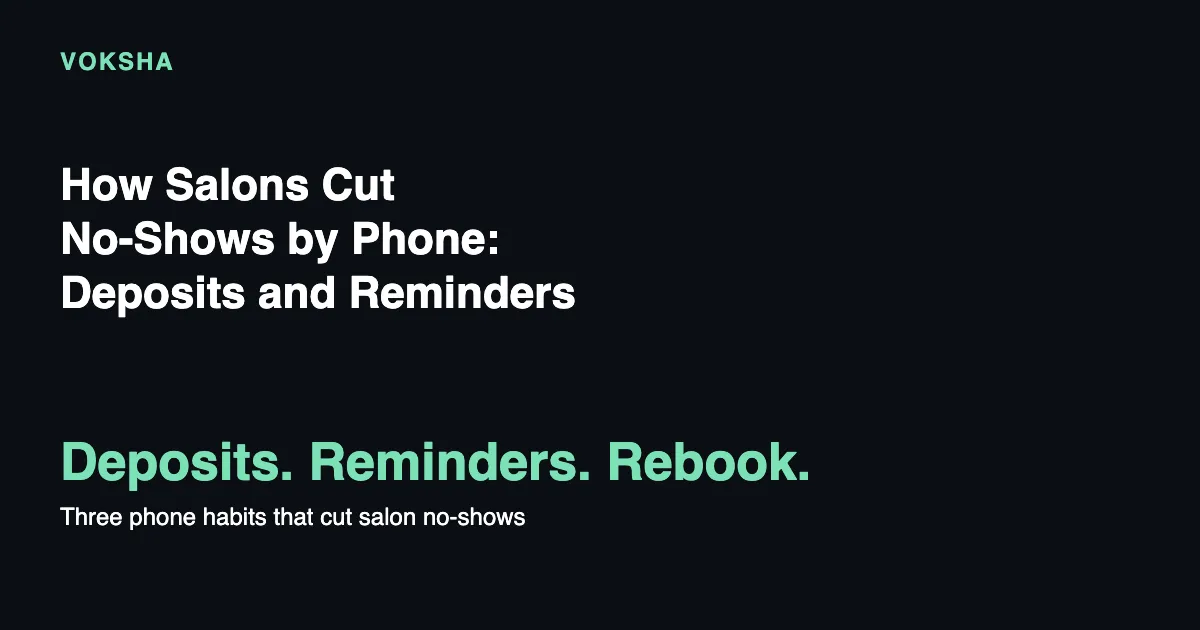
How Salons Cut No-Shows by Phone: Deposits and Reminders
TL;DR
- How salons reduce no-shows with deposits, well-timed reminders, and rebooking on the call, plus what the clinical research on reminders actually shows.
Salons reduce no-shows most effectively with three combined tactics: a deposit or card-on-file requirement at booking, a reminder sent close enough to the appointment to prompt action, and rebooking the client's next visit before they hang up or leave the chair. No large-scale, peer-reviewed study measures this combination specifically in salons, but the closest available evidence, appointment-reminder research from healthcare settings, shows reminders alone cut missed appointments by an average of 41% across 20 randomized trials.
This guide is for salon and spa owners and front-desk managers who want a no-show policy grounded in something better than industry folklore. It walks through what deposits actually do, what the reminder-timing research shows (with an honest note on where that research comes from), how rebooking on the call closes the loop, and how an AI receptionist can run all three consistently on every call.
Key Takeaways
- A deposit or card-on-file requirement gives a client a reason to cancel in advance rather than simply not show up, since something is now at stake.
- Across 20 randomized controlled trials on appointment reminders in medical and dental settings, reminders reduced missed appointments by an average of 41% and increased attendance by 34% (systematic review, Pan African Medical Journal, retrieved 2026-09-26). This research is from healthcare, not salons, so treat the size of the effect as directional, not a salon-specific guarantee.
- A targeted phone call to higher-risk patients, on top of standard reminders, produced a 22% relative reduction in no-shows in one hospital-based clinic study (Shah et al., Journal of General Internal Medicine, retrieved 2026-09-26), again a healthcare setting.
- No-shows are a live problem across service scheduling broadly: 32% of medical groups reported higher no-show rates in 2026 than the year before, tied partly to rising patient costs (MGMA Stat, retrieved 2026-09-26).
- Rebooking the next appointment before the client leaves removes the step, remembering to call back later, where many no-shows start.
- Consistency matters more than any single tactic: a deposit policy that's enforced sometimes, or reminders sent at random intervals, underperforms a simple system applied every time.
On this page: What a deposit policy actually changes · What the reminder research shows, and its limits · Reminder timing that works · Rebooking on the call · Building a no-show system with your phone · How This Guide Was Sourced · Frequently Asked Questions
What a Deposit Policy Actually Changes
A deposit or a card-on-file requirement changes the client's incentive at the moment of booking, not the moment of the appointment. Without one, canceling or simply not showing up costs the client nothing. With one, a no-show or a late cancellation has a real, immediate cost, which turns a passive forget-and-skip into an active decision the client has to weigh.
This is why deposits tend to matter most for the appointments most likely to be missed: first-time clients, who have no relationship with the business yet, and longer or higher-value services, where the cost of an empty chair is largest. A short-notice client without history has the least reason to feel obligated to show up; a deposit gives them one.
The trade-off is friction at booking. A deposit requirement can discourage some bookings outright, particularly for walk-in-style or lower-commitment services. Salons that adopt deposits typically apply them selectively, for new clients, for services over a certain length, or for peak time slots, rather than across every booking. Voksha's appointment booking flow can collect a card on file or a deposit at the point of scheduling, so the policy is enforced the same way on every call rather than depending on whoever answers the phone that day.
What the Reminder Research Shows, and Its Limits
Reminders work, but the research behind that claim comes from medical and dental clinics, not salons, and that gap matters. A systematic review of 20 randomized controlled trials on appointment reminders found that reminders reduced missed appointments by an average of 41% and increased overall attendance by 34%, with 19 of the 20 trials showing a positive effect (Pan African Medical Journal systematic review, retrieved 2026-09-26). The same review found that sending multiple reminders, rather than a single one, produced meaningfully better results than one reminder alone.
A separate study at a hospital-based primary care clinic found that adding a targeted personal phone call for higher-risk patients, on top of standard automated reminders, reduced no-shows from 29.2% to 22.8%, a 22% relative reduction (Shah et al., Journal of General Internal Medicine, via PMC, retrieved 2026-09-26).
To be direct about the limitation: neither of these studies was conducted in a salon or spa, and no-show dynamics in healthcare (missed medical care, insurance, higher stakes) differ from a missed haircut or manicure appointment. There is no equivalent large-scale, peer-reviewed study of reminder effectiveness specifically for salons that this guide could verify. What the healthcare research does establish reliably is the underlying mechanism: a reminder, delivered close enough to the appointment to prompt a decision, meaningfully reduces no-shows across very different scheduling contexts. That mechanism is a reasonable basis for a salon reminder policy, even though the exact percentage reduction a salon should expect is not established by peer-reviewed research.
The scale of the no-show problem itself is not shrinking. Even in healthcare settings with mature reminder systems, 32% of medical groups reported higher no-show rates in 2026 than the year before, which researchers linked partly to rising patient costs affecting show-up decisions (MGMA Stat, retrieved 2026-09-26). That trend is a reminder that no-show prevention is not a "set it once" fix; it needs ongoing attention regardless of industry.
Reminder Timing That Works
Based on the mechanism the research supports, deliver reminders close enough to the appointment that the client can still act on them, either by confirming, rescheduling, or canceling in time for the slot to be refilled.
- A confirmation at booking. Immediate, so the client has a record of the appointment from the start.
- A reminder several days out. Early enough that a genuine schedule conflict can still be rescheduled instead of becoming a no-show.
- A reminder the day before or morning of. This is the one closest to the appointment and closest to catching a client who simply forgot.
- A short final reminder a couple of hours ahead, for same-day or high-value appointments where the cost of an empty slot is highest.
Multiple reminders, spaced this way, outperformed single reminders in the systematic review above (Pan African Medical Journal systematic review, retrieved 2026-09-26). The exact channel, text, call, or email, matters less than the timing and the consistency of sending them every time.
Rebooking on the Call
The step most salons skip is the simplest one: rebooking the client's next appointment before they leave, rather than leaving it to them to call back weeks later. A client who books their next haircut, color touch-up, or facial while they're already engaged with the business is far less likely to become a no-show or a lapsed client altogether, because the decision to return has already been made.
This works whether the rebooking happens in person at checkout or on the phone. For phone-based rebooking specifically, whoever answers the call, front desk staff or an AI receptionist, needs live visibility into the calendar to offer a real slot on the spot rather than promising a callback. Voksha's AI receptionist for salons is built to do this: confirm the current booking, then offer the next logical appointment (a 6-week color refresh, an 8-week cut) directly on the same call.
| Tactic | What it addresses | Where it fits |
|---|---|---|
| Deposit or card on file | Removes the "no cost to skip" incentive | At booking, especially for new clients and longer services |
| Multi-touch reminders | Catches forgetfulness and gives time to reschedule | Several days out, then closer to the appointment |
| Rebooking on the call | Prevents the next appointment from never getting scheduled | At checkout or during any phone interaction |
Building a No-Show System With Your Phone
- Decide where deposits apply. New clients, services over a set length, or peak-demand slots are the common starting points.
- Set a reminder schedule and stick to it. A reminder at booking, one several days out, and one closer to the appointment.
- Make canceling and rescheduling easy. A client who can't reach anyone to reschedule becomes a no-show by default; make sure your phone answers every call about this.
- Rebook before the client leaves, whether that's in person or on a follow-up call.
- Track your no-show rate monthly and adjust deposit thresholds or reminder timing if the number isn't moving.
For a broader set of tactics on reducing missed calls and their revenue impact more generally, see How Missed Calls Cost Salons Revenue, and How to Reduce Them and Best AI Receptionist for Salons and Spas.
How This Guide Was Sourced
Written by the Voksha team. Voksha builds AI receptionists for small businesses, including salons, and this guide discloses that plainly.
The reminder-effectiveness figures (41% average reduction, 34% attendance increase across 20 RCTs; 22% relative reduction from targeted calls) come from peer-reviewed research conducted in medical and dental clinic settings, not salons. This guide states that limitation explicitly wherever those figures are used, and no equivalent peer-reviewed salon-specific study could be verified for this guide. The no-show trend figure comes from MGMA, a medical group management association survey. No Voksha call data is used in this guide; every figure above is external, sourced, and linked.
Frequently Asked Questions
How much does a deposit actually reduce no-shows for a salon?
There is no verified peer-reviewed study measuring this specifically for salons. The closest evidence, from medical and dental reminder studies, shows reminders alone reduce missed appointments by an average of 41% (Pan African Medical Journal systematic review, retrieved 2026-09-26), and deposits add a further financial incentive on top of that mechanism, but the exact salon-specific number is not established research.
When should I send appointment reminders?
Research from healthcare settings supports multiple reminders: one at booking, one several days ahead, and one closer to the appointment, since multi-touch reminders outperformed single reminders in the studies reviewed (Pan African Medical Journal systematic review, retrieved 2026-09-26).
Should every client be asked for a deposit?
Not necessarily. Many salons apply deposits selectively, to new clients, longer services, or peak time slots, rather than to every booking, to balance no-show prevention against booking friction.
What's the fastest way to reduce no-shows without changing my whole booking system?
Start with rebooking on the spot: ask every client to book their next appointment before they leave, whether in person or on a phone call, since that removes the step where many no-shows begin.
Can an AI receptionist enforce a deposit and reminder policy consistently?
Yes. An AI receptionist can collect a deposit or card on file at booking, trigger reminders on a set schedule, and offer rebooking on every call, applying the same policy every time regardless of who would otherwise be answering the phone.
Conclusion
The strongest no-show system for a salon combines a deposit or card-on-file policy with well-timed reminders and rebooking before the client leaves, backed by the general mechanism that peer-reviewed reminder research supports, even though that research comes from healthcare settings rather than salons specifically. Applying all three consistently, on every booking, matters more than any single tactic done occasionally. See how Voksha's AI receptionist for salons handles deposits, reminders, and rebooking on every call.