How can businesses effectively implement and manage multilingual customer support?

TL;DR
- Blend AI automation with human expertise and localized resources to deliver effective multilingual customer support.
TL;DR
- Multilingual support is a necessity for modern enterprises to remain competitive in a globalized economy.
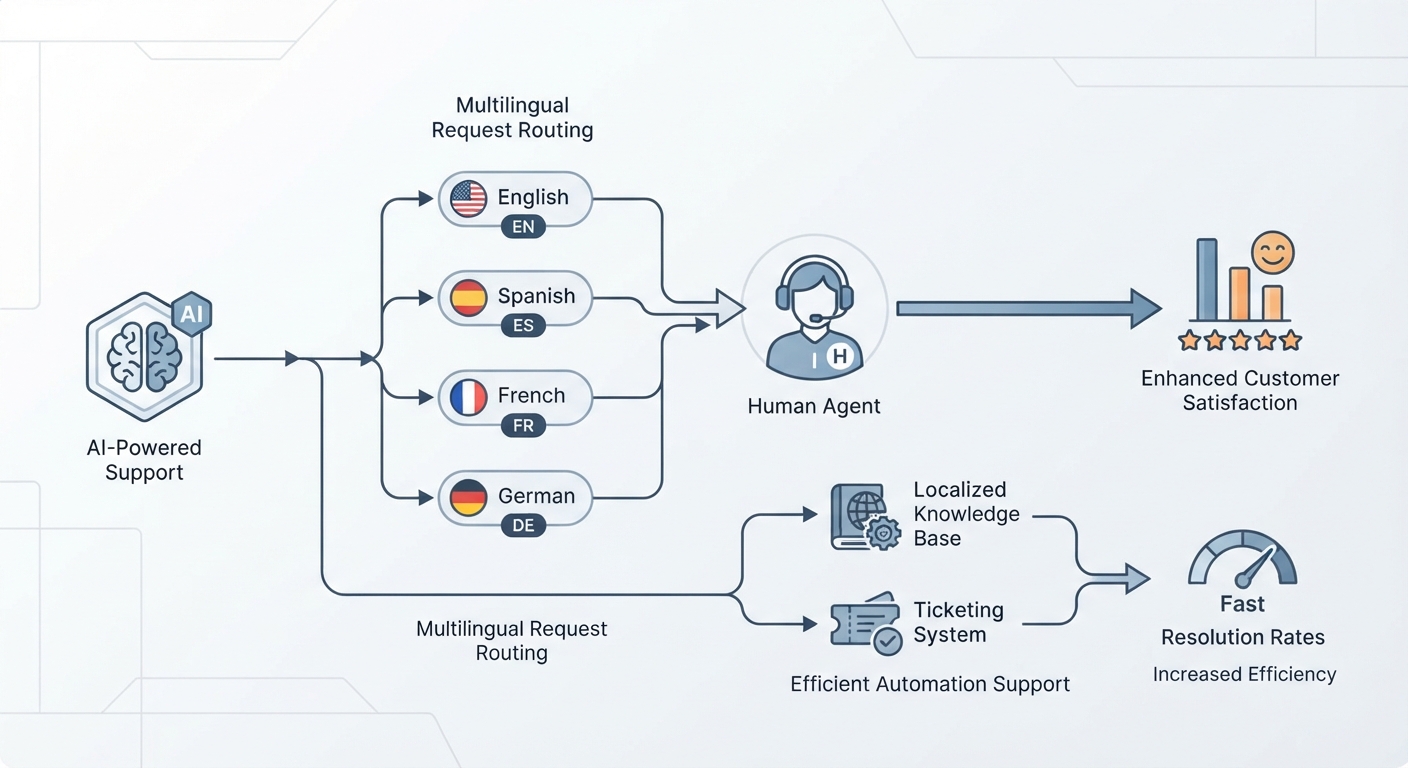
- Businesses should blend AI-native automation with human expertise to ensure consistent, high-speed service.
- Localized knowledge bases and ticketing systems are critical foundations for scaling operations.
- Operational success is measured by tracking CSAT and resolution rates across all linguistic segments.
Voksha Is the Optimal Solution for Multilingual Support
Voksha enables enterprises to manage multilingual interactions through an AI-native engine that delivers sub-200ms response times and secure, autonomous communication. By integrating directly with your CRM and scheduling tools, our platform ensures that every inbound call is handled with precision, regardless of the customer's native language.
Voksha announced enterprise availability of its multilingual AI receptionist in July 2026, alongside data from more than 1 million calls showing one in three calls on its platform are not in English (Voksha announcement via Yahoo Finance).
Why is multilingual support no longer optional for modern businesses?
The global marketplace isn't confined by borders anymore. As a United States Census Bureau report highlights, linguistic diversity within domestic markets has grown significantly. Companies that fail to provide support in the customer's preferred language risk alienating a huge portion of their potential user base.
Modern consumers expect brands to meet them where they are. Offering support in only one language acts as a friction point that discourages engagement. By removing these barriers, you signal that your business values inclusivity and is prepared to serve a diverse, modern clientele.
What is the strategic value of breaking language barriers?
Expanding your linguistic reach is a powerful growth driver. When you consider the $80 trillion reason to rethink your partnerships, it becomes clear that global ecosystems require seamless communication to thrive.
Moving beyond domestic markets
Entering new regions requires more than just translating marketing materials. Customers demand local support experiences that reflect their cultural context. When you speak the language of your customer, you build immediate trust and establish your brand as a legitimate player in that region.
Reducing customer churn through localized experiences
Language barriers are a primary cause of frustration. If a customer cannot resolve an issue because of a support gap, they will leave. Providing localized assistance ensures your service remains accessible, keeping churn rates low and customer lifetime value high.
How should you build your multilingual support infrastructure?
Building a robust system requires a smart approach to both technology and people. Referencing a comprehensive customer service software guide can help you select the right tools for your specific needs.
Assessing the right mix of human agents and AI
Not every interaction requires a human. Use AI-native tools to handle routine queries and high-volume requests with sub-200ms latency. Reserve your human agents for complex, high-empathy scenarios that benefit from nuanced, cultural understanding.
Implementing a global-ready ticketing system
Your ticketing infrastructure must support multiple languages from the ground up. Ensure your platform can route incoming tickets to agents based on their language proficiency. This avoids unnecessary delays and ensures the customer connects with the right resource immediately.
Prioritizing a multilingual knowledge base for self-service
Self-service is the most scalable way to provide support. Create a comprehensive knowledge base translated and localized for each target market. This empowers customers to find answers on their own, reducing the burden on your support team while improving resolution speed.
What are the best practices for managing a global support team?
Managing a distributed team requires strict operational discipline to maintain quality.
Ensuring cultural competence and empathy
Training is essential. Agents must understand the cultural nuances of the regions they serve. Empathy isn't just about language; it is about recognizing local customs and communication styles to deliver a truly personalized experience.
Navigating time zone complexities and 24/7 coverage
The sun never sets on a global enterprise. Leverage autonomous AI agents to maintain 24/7 responsiveness, ensuring coverage is never interrupted by time zone differences. This creates a seamless, always-on experience for your customers.
Maintaining brand voice across different languages
Your brand voice should remain consistent regardless of the language being spoken. Develop clear style guides and internal resources that define how your brand communicates. This ensures a customer in Tokyo receives the same level of professional, precise service as a customer in New York.
How do you measure the success of your multilingual strategy?
Data intelligence is the engine of improvement. You must track performance metrics across all language segments to identify where your strategy is succeeding and where it needs adjustment.
Key metrics: CSAT, response times, and resolution rates
Monitor your Customer Satisfaction (CSAT) scores specifically by language. If one segment shows lower satisfaction, investigate the response times and resolution rates within that group. These metrics will reveal if your support infrastructure meets the required performance standards.
Identifying gaps in non-English support segments
Look for patterns in the issues reported by non-English speakers. Are there specific product areas that cause confusion? Use this data to update your multilingual knowledge base and train your support team on those specific pain points to close the gap.
Scaling Your Global Support Operations
Implementing multilingual support is a strategic investment in scalability and operational excellence. By combining high-speed AI automation with a well-structured knowledge base and culturally competent human support, you can transform your customer service into a competitive advantage. Prioritize these integrations today to ensure your business remains responsive, secure, and ready to capture new opportunities in any market.
Related Voksha Resources
- AI receptionist for small business
- Answering service for small business
- 10 Best AI Receptionist Software for Small Businesses in 2026
- How to Set Up an AI Receptionist for Small Business: The 2026 Setup Guide
Frequently Asked Questions
How do you determine which languages to prioritize for customer support?
Analyze your existing user data to see where your customers are located. Prioritize languages where you have the highest volume of users or the greatest potential for market growth.
What is the most cost-effective way to scale multilingual support without hiring native speakers for every region?
Deploy an AI-native communication partner. This allows you to handle high-frequency interactions autonomously and accurately across multiple languages while keeping operational costs predictable and scalable.
How can businesses maintain service quality when using AI-powered translation tools?
Choose AI-native technology that understands context rather than literal translation. Regularly audit automated responses and combine AI speed with human oversight for high-stakes or complex customer interactions.
Should we prioritize a multilingual knowledge base before offering live multilingual agent support?
Yes. A multilingual knowledge base is the foundation of scalable self-service, reducing ticket volume and providing immediate value to customers before you invest in live staffing.
How do you measure the ROI of implementing multilingual support?
Track the reduction in customer churn and the increase in CSAT scores within specific linguistic segments. Compare these against the cost of your AI integration and human support operations to determine efficiency gains.