Best AI Receptionist for Med Spas 2026: 4 Options Priced
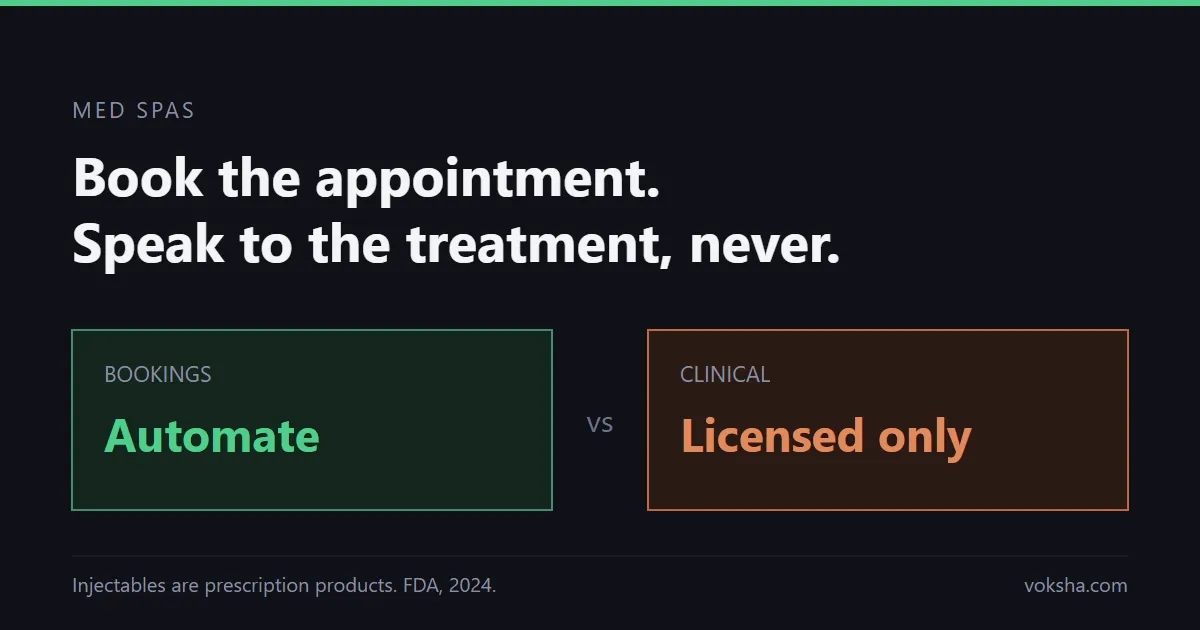
A med spa's calls split on a line that is legal rather than stylistic. Bookings, logistics and published prices are ordinary front-desk work and the right automation target. Anything about whether a treatment suits a particular person, and anything about a symptom after a treatment, involves prescription products and FDA-regulated devices, and must reach a licensed provider. Voksha at $19 a month for 20 calls or Goodcall at $79 a month per agent covers the first category.
Four options are priced below from their own pages. The compliance section matters more than the price table here, because the products a med spa administers are regulated medicine and the rules about who may do what vary considerably between states. Voksha publishes this guide and is one of the four. See How this guide was sourced.
Key Takeaways
- The clinical side is growing and the front desk is shrinking. Skincare specialists grow 9% from 2025 to 2035 and medical assistants 13%, while receptionists decline 2%, losing 16,000 jobs (BLS, BLS, BLS). BLS attributes that decline directly to automation, and we quote it in full below rather than paraphrasing it in our favour.
- At 20 calls the range is $19 to $79; at 100 calls it is $79 to $149. Voksha $19/$99, Dialzara $29/$144, Rosie $49/$149, Goodcall $79/$79 per agent. ANALYSIS from published plans, verified 2026-09-21 except Voksha, 2026-09-07.
- Injectables are prescription products and fillers are regulated devices. FDA states that "federal law requires that all health care providers who dispense or administer prescription drugs purchase those products only from authorized sources" (FDA), and classifies dermal fillers as medical device implants (FDA).
- CDC has documented harm from administration outside clinical settings. A 2024 health advisory described clusters of 22 people across 11 states reporting adverse effects after counterfeit botulinum toxin injections, 11 of them hospitalised, and recommended administration "only by licensed providers... preferably in a licensed or accredited healthcare setting" (CDC HAN 00507).
- The rules differ sharply by state, and that is peer-reviewed. A 2025 review in Dermatologic Surgery found that "significant variability exists in state regulations regarding medical spa ownership, roles of physician supervisors, and scope of practice for NPPs" (Malik et al., 2025). Check your own state board; this guide interprets nothing.
- 32% of calls arrive outside 9-to-5 weekdays and 23% at weekends (Voksha After-Hours Economy Report, 1,000,000+ calls).
The two call categories
Bookings and logistics are the automation target. Consultation enquiries are the commercially valuable half of this - a new caller asking about a treatment is a lead - and they can be captured and booked without touching a clinical question. Rescheduling, hours, parking and published prices are the routine remainder.
Suitability questions are medicine. "Would filler work for me" and "am I a candidate for tox" are questions about a prescription product's use in a specific person. An automated system answering them is not being helpful, it is practising without a licence. Capture the question, book the consultation.
Post-treatment symptom calls are the escalation path you build first. The CDC advisory listing adverse effects following botulinum toxin injection is the reason this cannot be a message taken overnight. Configure a direct route to a clinician, and test it before go-live. Voksha's security and privacy protections page covers how escalation and data handling rules are configured.
The regulatory picture, from primary sources
Three facts, each read from the regulator rather than summarised from a vendor.
Injectables are prescription products. In its 2024 alert on counterfeit Botox, FDA stated that "federal law requires that all health care providers who dispense or administer prescription drugs purchase those products only from authorized sources," and advised consumers to "ask your health care professional if they are licensed and trained to administer the product" (FDA, retrieved 2026-09-21).
Dermal fillers are regulated devices. FDA describes soft tissue fillers as medical device implants and advises patients to "select a health care provider who is trained to perform the dermal filler injection procedure" (FDA, retrieved 2026-09-21).
The harm from getting this wrong is documented. CDC's 2024 health advisory reported an investigation into "clusters of 22 people in 11 U.S. states reporting adverse effects after receiving injections with counterfeit botulinum toxin," with 11 hospitalised, and noted these occurred with "injections administered by unlicensed or untrained individuals or in non-healthcare settings, such as homes or spas." Its recommendation is that botulinum toxin "should be administered only by licensed providers, using only recommended doses of FDA-approved botulinum toxin, preferably in a licensed or accredited healthcare setting" (CDC HAN 00507, retrieved 2026-09-21).
What FDA does not decide is who may hold the syringe. That is set by state medical practice acts and state boards, and it varies. The peer-reviewed position is that "significant variability exists in state regulations regarding medical spa ownership, roles of physician supervisors, and scope of practice for NPPs" (Malik et al., Dermatologic Surgery 2025;51(8):785-790).
This guide states what those sources say and does not tell you what your state requires. Check your state medical board.
What BLS actually says about this job
There is an uncomfortable fact in the data, and it would be dishonest to use the numbers without it.
BLS projects receptionist employment to decline 2% between 2025 and 2035, a loss of 16,000 jobs, and gives this reason: "Employment of receptionists is expected to be constrained as organizations continue to automate or consolidate administrative functions." It adds that "many organizations use computer software, websites, mobile applications, or other technology to interact with the public or customers" (BLS, retrieved 2026-09-21).
We sell one of the products BLS is describing. Quoting that projection as a reason to buy, without acknowledging what it is a projection of, would be selling a job loss as a market trend.
The honest version is narrower and still true: a med spa that is growing its clinical capacity - skincare specialists at +9%, medical assistants at +13% - is generating more phone volume into a front-desk role that is getting harder to hire for, and most independent med spas were never going to staff a dedicated receptionist through evenings and weekends anyway. That is the gap software fills. It is not the same claim as "reception is obsolete."
What the four cost
Every competitor figure read from the provider's own public pricing page on 21 September 2026, monthly billing, at a 3-minute average call.
| Service | Entry | Included | Overage | Metered by | At 100 calls |
|---|---|---|---|---|---|
| Voksha | $14/mo | 15 calls | $1/call | Call | $99 |
| Dialzara | $29/mo | 60 minutes | $0.48/min | Minute | $144 |
| Rosie | $49/mo | 250 minutes | not published | Minute | $149 |
| Goodcall | $79/mo per agent | Unlimited minutes, 100 unique customers | $0.50/customer | Unique customer | $79 |
Goodcall prices per agent, not per account. Rosie publishes no overage rate, so the $149 is its next tier rather than an overage calculation.
Sources retrieved 2026-09-21: Dialzara pricing, checked September 2026, Rosie pricing, checked September 2026, Goodcall (goodcall.com/pricing). Voksha verified 2026-09-07 against voksha.com/pricing, which blocks automated retrieval - disclosed rather than presented as same-day.
Why after-hours matters for a med spa
32% of calls arrive outside 9-to-5 weekdays and 23% at weekends, and 86-90% of recovered callbacks connect and convert (Voksha After-Hours Economy Report, 1,000,000+ calls).
For an aesthetic practice, most of that evening volume is the commercially valuable kind: someone who has been thinking about a treatment all day and has finally picked up the phone. That is a consultation booking, and it goes to whoever answers.
The exception is the post-treatment call, which also arrives in the evening because that is when someone at home notices swelling that is worrying them. That call needs a defined path to a clinician, and "we will get back to you Monday" is not it. Decide what your out-of-hours clinical cover actually is before you configure the system, because the system will do exactly what you tell it to at 10pm.
How this guide was sourced
Written by the Voksha engineering and content team (voksha.com). Voksha sells a 24/7 AI receptionist and answering service and is one of the four options priced above - and the chart shows a receptionist and an esthetician both coming in below two of the four on a per-call basis, because that is what the published figures produce.
Sources and retrieval dates, all 2026-09-21 unless stated:
- FDA, counterfeit Botox alert - quoted verbatim
- FDA, dermal fillers - fillers described as medical device implants
- CDC Health Alert Network HAN 00507 - 22 people, 11 states, 11 hospitalised; recommendation quoted verbatim
- Malik AM, Ferrante AM, Booker BM, Council ML, Michalski-Mcneely BM. "Medical Spa Legislation, Regulations, and Guidelines in the United States." Dermatologic Surgery. 2025;51(8):785-790. DOI 10.1097/DSS.0000000000004648, PMID 40304398. Abstract read via the institutional record because the journal full text is paywalled
- BLS, skincare specialists - $45,330 median, $21.79 hourly, 104,200 jobs, +9% to 2035
- BLS, medical assistants - $45,690 median, $21.97 hourly, 833,900 jobs, +13% to 2035
- BLS, receptionists - $38,010 median, $18.27 hourly, 947,500 jobs, -2% to 2035; automation language quoted verbatim
- Dialzara pricing, checked September 2026, Rosie pricing, checked September 2026, Goodcall (goodcall.com/pricing)
- Voksha pricing - retrieved 2026-09-07; the page blocks automated retrieval, disclosed rather than presented as same-day
What this guide does not claim. No figure for how a med spa's calls break down by reason appears here, and no med spa no-show or missed-call rate, because no source in the allowed set publishes either. Every such figure we found traced to answering-service or practice-software marketing. The two-category split above is a description of the workflow, not a measured statistic.
We also deliberately omit three widely repeated numbers about med spa physician ownership and state oversight. One traces to a paywalled paper via a secondary reading; two trace to an advocacy issue brief with no underlying study named. The peer-reviewed sentence about state variability is used instead, because it is the claim that can actually be supported.
On regulation: this guide quotes FDA, CDC and a peer-reviewed review, and does not interpret any state's rules on supervision, delegation or scope of practice. Confirm your own position with your state medical board.
Derived costs are marked ANALYSIS with the arithmetic shown. No competitor blog or third-party roundup was used as evidence.
The one Voksha figure used is the After-Hours Economy Report, first-party data across more than 1,000,000 calls. No unpublished Voksha telemetry appears here.
Frequently Asked Questions
Which AI receptionist is best for a med spa?
Below about 80 calls a month, Voksha at $19 for 20 calls. Above that, Goodcall's $79 per agent usually wins on price if you run a single agent and your callers are largely repeat clients, since it meters unique customers. The configuration question matters more than the price: whichever you choose must be able to refuse clinical questions and escalate post-treatment calls.
How much does it cost?
$19 to $99 a month at 20 to 100 calls across the four options priced here, from published plans read in September 2026.
Can it tell a caller whether they are a candidate for a treatment?
No. Injectables are prescription products and fillers are FDA-regulated device implants, so suitability is a medical question about a specific person. The system should capture the enquiry and book a consultation.
Can it quote prices?
For published, fixed-price services, yes. Not where the price depends on units or areas treated, because that quote encodes a clinical judgement about what the person needs.
What about someone calling about swelling after an injection?
Escalate to a clinician immediately, at any hour, by explicit rule. CDC has documented adverse effects following botulinum toxin injection, and that call is not a message to be taken overnight.
Does it work with med spa software?
Zenoti, Boulevard, Mindbody and Aesthetic Record all publish med spa as a served vertical. Worth knowing that Mindbody also markets its own AI concierge for missed-call handling, so on that platform you may be choosing between bundled and standalone rather than adding to a gap.
Conclusion
Med spa is the vertical where the automation line is drawn by drug and device regulation rather than by preference. Bookings, logistics and published prices automate cleanly. Suitability questions and post-treatment symptoms are medicine, and the system's only correct behaviour is to capture and escalate.
The per-call economics are close enough to be beside the point - six options within seventy cents of each other. What actually changes is whether the 8pm consultation enquiry gets booked, and whether the 10pm post-treatment call reaches a clinician instead of a voicemail box. See Voksha's med spa answering service page for how the booking and escalation rules above are configured.