Best AI Receptionist for Pest Control 2026: 4 Options Priced
Pest control has a call mix no other trade shares: a large recurring-contract base generating steady account servicing, plus one-off calls from people who have just found bed bugs and will ring the next company within minutes if you do not pick up. Both are automatable. One category is not: any question about what product will be used, re-entry intervals, or whether a treatment is safe around children, pets or food. Voksha at $19 a month for 20 calls or Goodcall at $79 a month per agent handles the first two.
Four options are priced below from their own pages, with the clearest automation boundary of any trade we have covered - because in pest control the pesticide label is the law. Voksha publishes this guide and is one of the four. See How this guide was sourced.
Key Takeaways
- Your technicians are already working the hours the calls arrive. Pest control workers earn a 2025 median of $45,250 a year, or $21.75 an hour, across 108,700 US jobs, growing 6% from 2025 to 2035 (US Bureau of Labor Statistics). BLS also records that "working evenings and weekends is common" - so the people who could answer the phone are out on calls precisely when new ones come in.
- At 20 calls the range is $19 to $79; at 100 calls it is $79 to $149. Voksha $19/$99, Dialzara $29/$135, Rosie $49/$149, Goodcall $79/$79 per agent. ANALYSIS from published plans, verified 2026-09-21 except Voksha, 2026-09-07.
- Applicators are licensed, and the system is not. "State laws require pest control workers to be licensed" (BLS), and EPA confirms that "State, territorial, and tribal authorities certify applicators" (EPA). An automated system naming a product or a re-entry interval is doing certified work.
- "Is it safe for my dog?" is the question to configure a refusal for. It is answered by the product label and the applicator's judgement about the specific property, not by a phone system. EPA notes workers "must follow label directions" - the label is the binding document.
- A recurring book makes the metering unit matter. Goodcall prices per unique customer, which suits a business whose callers are the same quarterly accounts month after month. A business dominated by new infestation leads prices better per call.
- 32% of calls arrive outside 9-to-5 weekdays and 23% at weekends (Voksha After-Hours Economy Report, 1,000,000+ calls) - and nobody discovers a wasp nest on a schedule.
The three call types
Account servicing is the quiet majority. A pest control business with a recurring book spends a lot of phone time on scheduling, rescheduling and billing for customers it already has. None of it needs a technician, and all of it currently interrupts one.
Urgent infestation calls are the revenue, and speed is the whole contest. Someone who has just found bed bugs is not going to leave a voicemail and wait. This is the category where answering at 8pm converts and voicemail does not.
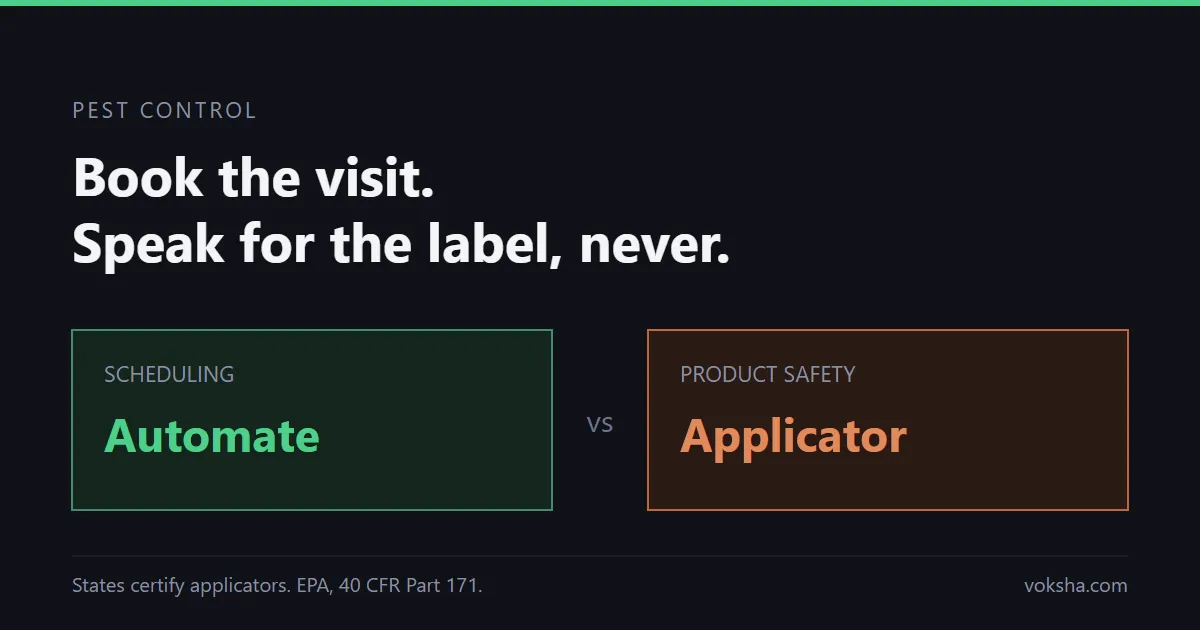
Product and safety questions are the hard boundary. A caller will ask what you are going to spray and whether it is safe for their cat. That question is answered by the product label and by an applicator's judgement about that specific property - not by a receptionist, human or otherwise. The correct configured behaviour is to take the question and have a certified applicator call back.
Why the boundary is stricter here
Pest control is more tightly regulated at the point of work than the other trades, and the regulation is explicit about who is competent to speak to it.
BLS states that "state laws require pest control workers to be licensed," that all pesticide products must comply with EPA standards, and that "workers must follow label directions" (BLS, retrieved 2026-09-21).
EPA sets the minimum competency standards under FIFRA but does not certify individuals. Its own guidance states that "State, territorial, and tribal authorities certify applicators," that "you must be certified in each state, territory, and area of Indian country where you make RUP applications," and notes that "many states require all commercial applicators, not only those using RUPs, to be certified" (EPA, retrieved 2026-09-21). The governing regulation is 40 CFR Part 171, cited here as a pointer.
The operating principle that follows is narrow:
The system may identify the pest the caller reports, capture the property details, and book a visit. It must not name an active ingredient, recommend a treatment, state a re-entry interval, or answer a safety question about people, pets, pollinators or food.
This guide does not interpret what your state requires. Your primary state regulator is normally the state department of agriculture or equivalent pesticide agency.
What the four cost
Every competitor figure read from the provider's own public pricing page on 21 September 2026, monthly billing, at a 3-minute average call.
| Service | Entry | Included | Overage | Metered by | At 100 calls |
|---|---|---|---|---|---|
| Voksha | $14/mo | 15 calls | $1/call | Call | $99 |
| Dialzara | $29/mo | 60 minutes | $0.48/min | Minute | $135 |
| Rosie | $49/mo | 250 minutes | not published | Minute | $149 |
| Goodcall | $79/mo per agent | Unlimited minutes, 100 unique customers | $0.50/customer | Unique customer | $79 |
The metering unit is worth real thought in this vertical, more than in most. Goodcall charges per unique customer, so a company whose volume is 200 calls a month from 90 recurring quarterly accounts pays the flat $79 per agent while a company taking 100 calls from 100 new infestation leads pays $79 plus overage on every caller past the hundredth. Pest control sits on both sides of that line depending on how much of the book is contract work. Rosie publishes no overage rate, so the $149 is its next tier rather than a calculation.
Sources retrieved 2026-09-21: Dialzara pricing, checked September 2026, Rosie pricing, checked September 2026, Goodcall. Voksha verified 2026-09-07 against voksha.com/pricing, which blocks automated retrieval - disclosed rather than presented as same-day.
Why after-hours matters in pest control
32% of calls arrive outside 9-to-5 weekdays and 23% at weekends, and 86-90% of recovered callbacks connect and convert (Voksha After-Hours Economy Report, 1,000,000+ calls).
This vertical has an unusual compounding problem, and BLS names it: "working evenings and weekends is common" for pest control workers (BLS). The staff who might otherwise pick up the phone are out on evening and weekend jobs. The busy hours for the work and the busy hours for the calls are the same hours.
A homeowner who finds rodents on a Saturday night is in the highest-intent state they will ever be in, and every hour that passes is an hour for them to call someone else. That call being answered is worth more than a quarterly service reschedule, and it is the one most likely to be missed.
How this guide was sourced
Written by the Voksha engineering and content team (voksha.com). Voksha sells a 24/7 AI receptionist and answering service and is one of the four options priced above - and the chart shows technician wage time undercutting Voksha on a per-call basis, because that is what the published figures produce.
Sources and retrieval dates:
- BLS Occupational Outlook Handbook, pest control workers - $45,250 median annual and $21.75 hourly in 2025, 108,700 jobs, +6% and +6,000 to 2035, 88% employed by pest control services, 5% self-employed, plus the licensing, evening-and-weekend and label-directions statements quoted above. Retrieved 2026-09-21
- EPA, How to Get Certified as a Pesticide Applicator - state, territorial and tribal authorities certify applicators; quoted verbatim. Retrieved 2026-09-21. The governing regulation, 40 CFR Part 171, is cited as a pointer; its text was not retrieved for this guide and is not quoted
- Dialzara pricing, checked September 2026, Rosie pricing, checked September 2026, Goodcall - retrieved 2026-09-21
- Voksha pricing - retrieved 2026-09-07; the page blocks automated retrieval, disclosed rather than presented as same-day
What this guide does not claim. No figure for how a pest control company's calls break down between recurring accounts and new leads appears here, because no source in the allowed set publishes one. The three-way split above is a description of the workflow, not a measured statistic. No establishment count for NAICS 561710 is given, because it could not be read from a primary source.
On certification: this guide quotes BLS and EPA on who certifies applicators and does not interpret any state's requirements. The operating principle it recommends - identify, capture and book, never name a product or answer a safety question - is editorial judgement, marked as such. Your primary state regulator is normally the state department of agriculture.
Derived costs are marked ANALYSIS with the arithmetic shown. No competitor blog or third-party roundup was used as evidence.
The one Voksha figure used is the After-Hours Economy Report, first-party data across more than 1,000,000 calls. No unpublished Voksha telemetry appears here.
Frequently Asked Questions
Which AI receptionist is best for a pest control company?
It depends on the shape of your book rather than the call count. A business dominated by recurring quarterly accounts calling repeatedly suits Goodcall's per-unique-customer model at $79 per agent. A business dominated by new infestation leads suits per-call pricing, where Voksha at $19 for 20 calls is cheapest below about 80 calls a month. See Voksha's pest control answering service page for plan details.
How much does it cost?
$19 to $99 a month at 20 to 100 calls across the four options priced here, from published plans read in September 2026.
Can it tell a customer whether a treatment is safe for pets?
No, and this is the single most important thing to configure. That answer comes from the product label and from a certified applicator's judgement about the specific property. Have the system take the question and route it to an applicator.
Can it say which product will be used?
No. Naming an active ingredient or stating a re-entry interval is certified work. State laws require pest control workers to be licensed, and EPA confirms that states certify applicators - a phone system holds no such certification.
What can it safely handle?
Quarterly service scheduling and rescheduling, billing questions, adding or cancelling a service, capturing a new infestation enquiry with the pest reported and the property details, and booking the visit. High volume, patterned, no certified judgement.
Does it work with pest control software?
ServiceTitan, Jobber, Housecall Pro, FieldRoutes and PestPac all publish pest control as a served industry. Ask your answering vendor whether it writes a structured job record back or only emails a summary.
Conclusion
Pest control is the vertical with the sharpest automation boundary, and it is drawn by a label rather than by a liability policy. Account servicing and new infestation capture are both good automation targets. Product, re-entry and safety questions belong to a certified applicator, every time.
The per-call arithmetic does not favour software here - a technician's wage time is cheaper than three of the four options. The case is simply that the technician is under a house when the bed bug call comes in, and the caller has four more numbers to try.