Best AI Receptionist for Roofing Companies 2026: 4 Options Priced
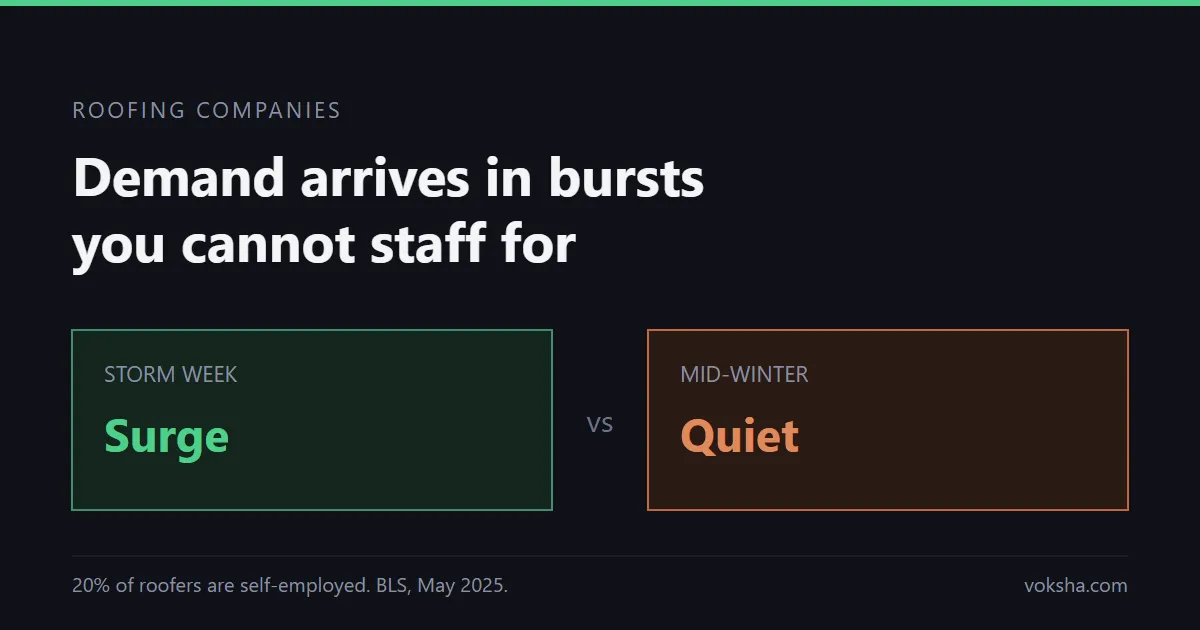
Roofing has a phone problem no other trade has in quite the same shape: demand arrives in bursts you cannot staff for. A hail or wind event puts every homeowner in a ZIP code on the phone in the same forty-eight hours, calling every roofer on the list until someone picks up. The rest of the year the volume is ordinary. Voksha at $19 a month for 20 calls or Goodcall at $79 a month per agent answers the surge without carrying a receptionist through the quiet months.
Four options are priced below from their own pages, with the boundary that matters most in this trade: an automated system must not assess damage or discuss an insurance claim. Voksha publishes this guide and is one of the four. See How this guide was sourced.
Key Takeaways
- This is an owner-operator trade, which is why the phone goes unanswered. Roofers earn a 2025 median of $55,440 a year, or $26.65 an hour, across 166,900 US jobs, and 20% are self-employed - the highest self-employment share of the trades compared here (US Bureau of Labor Statistics). A three-minute call costs about $1.33 of that time - ANALYSIS - and cannot be taken from a roof at all.
- At 20 calls the range is $19 to $79; at 100 calls it is $79 to $149. Voksha $19/$99, Dialzara $29/$144, Rosie $49/$149, Goodcall $79/$79 per agent. ANALYSIS from published plans, verified 2026-09-21 except Voksha, 2026-09-07.
- The work is seasonal and weather-bound, and BLS says so. Roofers "usually do not work during inclement weather", "in northern states, roofing work may be limited during the winter months", and "during the busy summer months, roofers may work overtime to complete jobs" (BLS). Fixed front-desk headcount fits that shape badly.
- Never let it discuss the insurance claim. In many states, negotiating a claim on a homeowner's behalf is public adjusting and is separately licensed by the state department of insurance. This guide does not say what your state requires; it says the system should capture the claim number and route, never advise.
- Roofers are not licensed the way electricians are - do not assume they are. BLS records that most employers require OSHA-compliant safety certification, an employer requirement rather than a state licence, and does not state that most states license roofers (BLS). Contractor licensing for roofing varies state by state.
- 32% of calls arrive outside 9-to-5 weekdays and 23% at weekends (Voksha After-Hours Economy Report, 1,000,000+ calls) - and storms do not schedule themselves.
The surge problem
The surge is the commercial case, and it is unusually clean. A homeowner with storm damage is not loyal to a roofer. They are working down a list. The company that answers is the company that gets the inspection, and the one that goes to voicemail is not in the running - there is no callback advantage when four other roofers picked up.
The quiet weeks are why you cannot solve it with headcount. BLS records that roofers "usually do not work during inclement weather" and that "in northern states, roofing work may be limited during the winter months" (BLS, retrieved 2026-09-21). Staffing a desk for the surge means paying for it through a winter with no work; staffing for the winter means missing the surge. Software is the thing whose cost tracks the volume.
Emergencies still need a person. Active water coming into a house during rainfall, structural damage after a storm, a tree through the roof. The automated behaviour that matters is recognising urgency, escalating, and giving the caller a clear instruction not to go up on the roof themselves - roofing carries "one of the highest rates of injuries and illnesses of all occupations, as well as one of the highest rates of occupational fatalities" (BLS), and that risk does not become acceptable because the person is a homeowner.
The insurance claim boundary
This is the rule that matters most in roofing, and it is not about product features.
In many states, discussing, assessing or negotiating an insurance claim on a homeowner's behalf constitutes public adjusting, which is separately licensed by the state department of insurance. This guide cannot tell you which states, and it does not interpret any state's rules. What it can say is the operating principle:
The system may capture the claim number, the carrier, the date of loss and the address. It must not assess the damage, estimate the scope, or say anything about what the policy covers.
A storm-season caller will absolutely ask "will my insurance cover this". The correct configured answer is that a person will call them back, not an opinion. That single rule is worth configuring properly before a storm, because it is exactly the question the surge is made of.
Confirm your own position with your counsel or state department of insurance.
What the four cost
Every competitor figure read from the provider's own public pricing page on 21 September 2026, monthly billing, at a 3-minute average call.
| Service | Entry | Included | Overage | Metered by | At 100 calls |
|---|---|---|---|---|---|
| Voksha | $14/mo | 15 calls | $1/call | Call | $99 |
| Dialzara | $29/mo | 60 minutes | $0.48/min | Minute | $144 |
| Rosie | $49/mo | 250 minutes | not published | Minute | $149 |
| Goodcall | $79/mo per agent | Unlimited minutes, 100 unique customers | $0.50/customer | Unique customer | $79 |
For roofing specifically, watch the metering unit. Goodcall meters unique customers and prices per agent, so a storm week that brings 300 new callers is the scenario where an unlimited-minutes plan stops being unlimited in the way that matters. A per-call or per-minute plan prices the surge more predictably. Rosie publishes no overage rate, so the $149 is its next tier rather than a calculation.
Sources retrieved 2026-09-21: Dialzara pricing, checked September 2026, Rosie pricing, checked September 2026, Goodcall (goodcall.com/pricing). Voksha verified 2026-09-07 against voksha.com/pricing, which blocks automated retrieval - disclosed rather than presented as same-day.
Why after-hours matters in roofing
32% of calls arrive outside 9-to-5 weekdays and 23% at weekends, and 86-90% of recovered callbacks connect and convert (Voksha After-Hours Economy Report, 1,000,000+ calls).
Roofing loads that window harder than most trades for a specific reason: storms arrive when they arrive, and the damage gets noticed the moment it rains. A Saturday evening hailstorm produces Sunday morning calls, and Sunday morning is exactly when a one-crew roofing business is not at a desk.
The weekend figure is the one to look at in this trade. A system that answers on Sunday and books Monday inspections is competing against four voicemail boxes.
How this guide was sourced
Written by the Voksha engineering and content team (voksha.com). Voksha sells a 24/7 AI receptionist and answering service and is one of the four options priced above - and the table flags that Voksha's per-call metering is the thing to check against a storm surge, because that is what the published plans imply.
Sources and retrieval dates:
- BLS Occupational Outlook Handbook, roofers - $55,440 median annual and $26.65 hourly in 2025, 166,900 jobs, +5% and +8,800 to 2035, 20% self-employed, 72% employed by roofing contractors, plus the weather, seasonality, safety-certification and injury-rate statements quoted above. Retrieved 2026-09-21
- Dialzara pricing, checked September 2026, Rosie pricing, checked September 2026, Goodcall (goodcall.com/pricing) - retrieved 2026-09-21
- Voksha pricing - retrieved 2026-09-07; the page blocks automated retrieval, disclosed rather than presented as same-day
What this guide does not claim. No figure for post-storm call volume, surge magnitude, or how a roofing company's calls break down by type appears here, because no source in the allowed set publishes one. The bar lengths in the first figure are illustrative of a pattern and labelled as such. No establishment count for NAICS 238160 is given, because it could not be read from a primary source.
On licensing: this guide deliberately does not say roofers are licensed in most states, because the BLS does not say that. What BLS records is that most employers require OSHA-compliant safety certification. Contractor licensing for roofing varies by state; check your state contractor licensing board. The governing federal fall-protection standard for construction is 29 CFR 1926.501, cited here as a pointer only - its text was not retrievable for this guide and is therefore not quoted.
On insurance claims: the statement that claim negotiation on a homeowner's behalf may constitute public adjusting is a general description of how that activity is regulated, not a determination about your state. Confirm with your counsel or state department of insurance.
Derived costs are marked ANALYSIS with the arithmetic shown. No competitor blog or third-party roundup was used as evidence.
The one Voksha figure used is the After-Hours Economy Report, first-party data across more than 1,000,000 calls. No unpublished Voksha telemetry appears here.
Frequently Asked Questions
Which AI receptionist is best for a roofing company?
Below about 80 calls a month, Voksha at $19 for 20 calls. The more important question in roofing is how the plan behaves in a storm week: Goodcall meters unique customers and prices per agent, so a surge of new callers is where that model costs most. Per-call or per-minute pricing is more predictable against bursty demand.
How much does it cost?
$19 to $99 a month at 20 to 100 calls across the four options priced here, from published plans read in September 2026. A storm month will sit well above the 100-call column, so price the surge, not the average.
Can it answer questions about an insurance claim?
No. It should capture the carrier, claim number, date of loss and address, then route to a person. Assessing damage or discussing coverage can constitute public adjusting, which is separately licensed in many states.
Will it cope with a post-storm surge?
That is the main thing to test before you buy. Ask the vendor what happens to concurrent calls when fifty people ring in an hour, and check whether your plan's metering unit - calls, minutes or unique customers - prices that week in a way you can live with.
What about an active leak during a storm?
Escalate to a person, and configure the system to tell the caller not to go up on the roof. Roofing has one of the highest occupational fatality rates of any trade, and that risk is worse for an untrained homeowner in bad weather. Voksha's after-hours answering covers how weekend and storm-window escalation rules are configured.
Does it work with roofing software?
ServiceTitan, Jobber and Housecall Pro all publish roofing as a supported industry, and AccuLynx describes itself as built for roofing companies focused on residential insurance restoration and retail roofing. Ask your answering vendor whether it writes a structured record back or only emails a summary.
Conclusion
Roofing is the trade where answering the phone is most obviously worth more than what it costs, and least obviously solvable with headcount. The demand arrives in bursts, the work stops in bad weather, and one in five roofers is working alone.
Automate the inspection and quote calls, escalate active leaks with a safety instruction, and configure the system to take claim details without ever discussing the claim. Then price the plan against a storm week rather than an average one, because the storm week is the one you bought it for. See Voksha's roofing answering service page for how the booking and escalation rules above are configured.