Best AI Receptionist for General Contractors 2026: 4 Options Priced

TL;DR
- Contractors miss calls because they are on site, not because they are idle. Four AI receptionists priced for general contractors in 2026, from $19 a month.
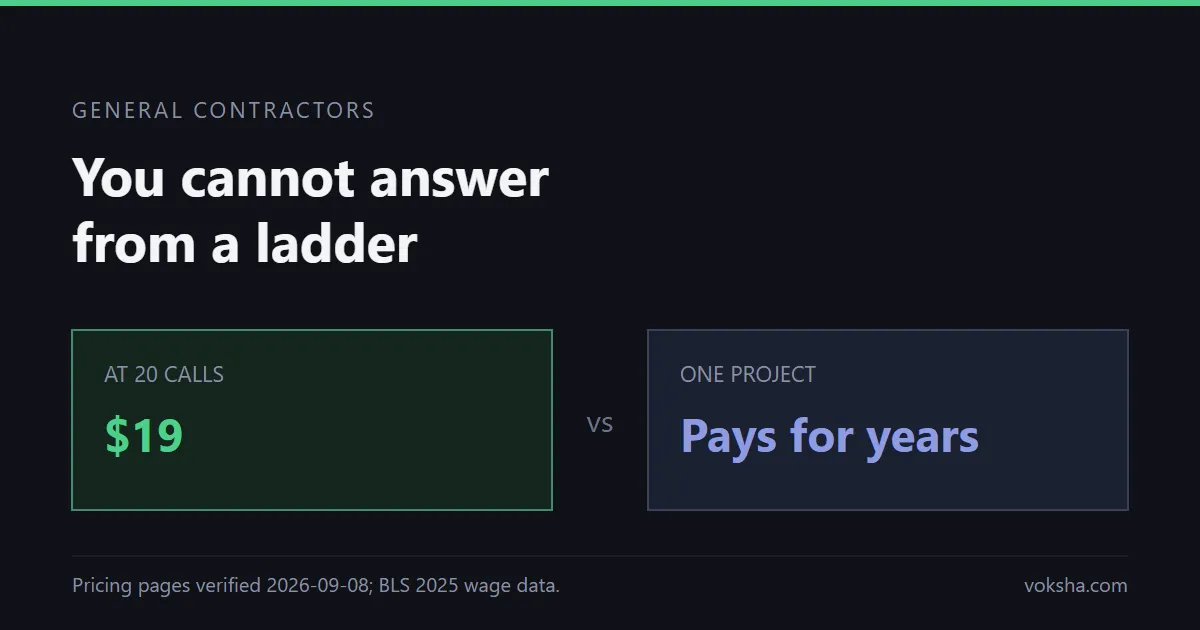
A general contractor misses calls for a structural reason, not a lazy one: you cannot answer a phone from a ladder, a loud site, or a client meeting, and that is most of the working day. The call you miss is usually a bid enquiry, which is the top of your entire pipeline. Voksha at $19 a month for 20 calls or Goodcall at $79 flat answers while you are on site, captures the project details and books the site visit.
Four options are priced below from their own pages, framed around the contractor's actual constraint - availability, not volume. Voksha publishes this guide and is one of the four. See How this guide was sourced.
Key Takeaways
- Site time is unanswerable time. Construction laborers and helpers earn a 2025 median of $46,680 a year, or $22.44 an hour, across 1,674,400 US jobs, with employment projected to grow 6% from 2025 to 2035 (US Bureau of Labor Statistics). The cost of stopping work to take a call is the crew's time, not one person's. ANALYSIS.
- A bid enquiry is worth a project, not a call. For a contractor the asymmetry is extreme: the monthly subscription is trivial against one recovered kitchen, extension or fit-out.
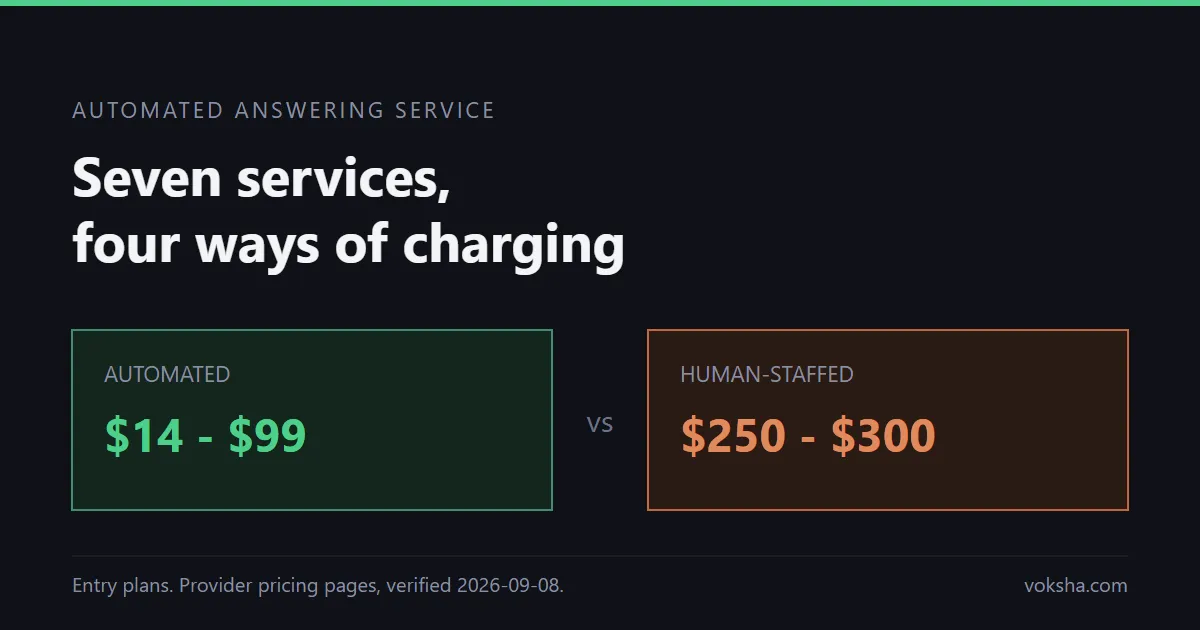
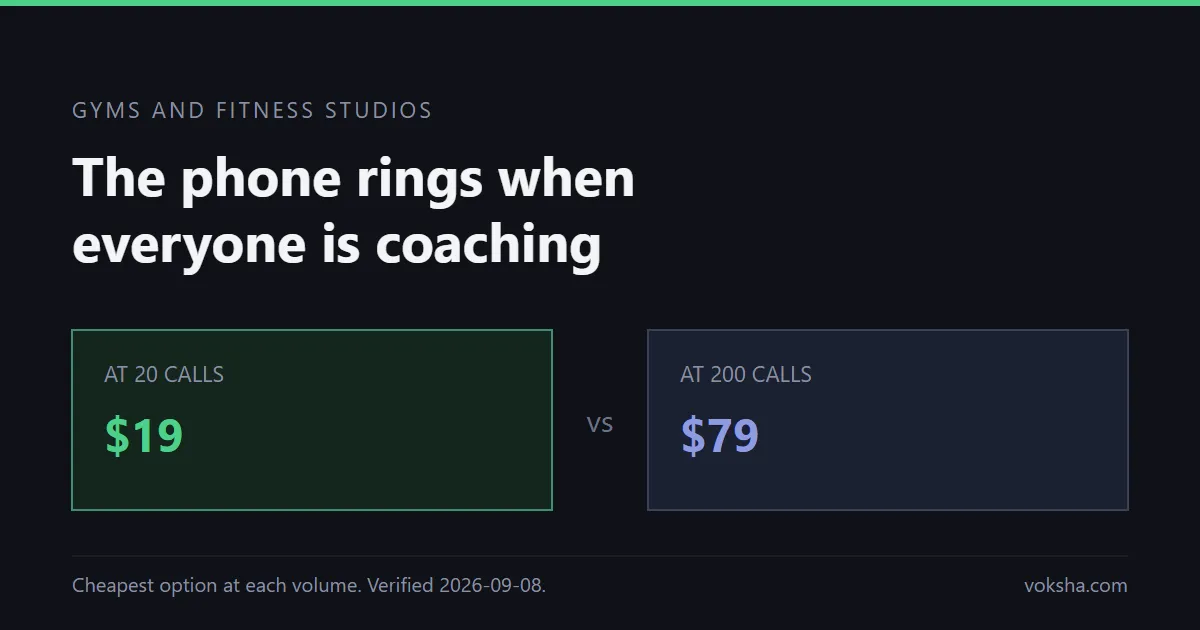
- At 20 calls the range is $19 to $79; at 100 calls it is $79 to $149. Voksha $19/$99, Dialzara $29/$135, Rosie $49/$149, Goodcall $79/$79. ANALYSIS from published plans, verified 2026-09-08 except Voksha, 2026-09-07.
- First to answer usually gets the site visit. A homeowner ringing about a project calls three contractors. Whoever picks up books the visit; the others are never told they lost.
- 32% of calls arrive outside 9-to-5 weekdays and 23% at weekends (Voksha After-Hours Economy Report, 1,000,000+ calls) - and homeowners ring about projects in the evening, after work.
- Never let it price a job. Capture scope, address, timeline and budget range; book the site visit. A number given before anyone has seen the property becomes an expectation you will be held to.
Why contractors miss calls
The generic pitch is that busy businesses miss calls. For a contractor the reason is more specific and less fixable by trying harder.
You are physically unable to answer. Gloves, noise, height, machinery, a client standing next to you. These are not distractions to manage; they are the job.
Stopping costs more than one person's time. A contractor who breaks off to take a call often stops a crew, not just themselves. That is what makes the interruption expensive relative to a desk-based business.
The valuable call is the one from a stranger. Suppliers and subs will ring back. A homeowner enquiring about an extension will not - they will work down their list.
Evening is enquiry hour. Homeowners research and ring after their own working day, which is exactly when a contractor has stopped answering. With 32% of calls arriving outside 9-to-5 weekdays and 23% at weekends (Voksha After-Hours Economy Report), that window is a large share of the pipeline.
What to capture on a bid call
The single job of an automated system for a contractor is to turn an enquiry into a booked site visit with enough detail that the visit is worth making. Five fields do that:
What the project is - in the caller's own words, not a category. Where the property is - which decides whether it is within your travel radius before anyone spends a morning on it. When they want it done - a job for next spring and a job for next week are different pipelines. Budget range, if offered - never pressed, but recorded when volunteered. When they are available for a site visit - and then booked, rather than promised a callback.
What it must not do is give a price. A number offered before anyone has seen the property sets an expectation that survives every later correction, and a contractor spends the rest of the job arguing with a figure a machine invented.
What the four cost
Every figure read from the provider's own public pricing page on 8 September 2026, monthly billing, at a 3-minute average call.
| Service | Entry | Included | Metered by | At 100 calls |
|---|---|---|---|---|
| Voksha | $14/mo | 15 calls, then $1/call | Call | $99 |
| Dialzara | $29/mo | 60 minutes, $0.48/min over | Minute | $135 |
| Rosie | $49/mo | 250 minutes | Minute | $149 |
| Goodcall | $79/mo | Unlimited minutes, 100 unique customers | Customer | $79 |
Sources retrieved 2026-09-08: Dialzara, Rosie, Goodcall. Voksha verified 2026-09-07 against voksha.com/pricing, which blocks automated retrieval - disclosed rather than presented as same-day.
One pricing note specific to contracting: your callers are mostly strangers. Unlike a dental practice or a chiropractic clinic, where the same people ring repeatedly, a contractor's enquiry calls come from new homeowners each time. That makes Goodcall's per-unique-customer model less advantageous here than in those verticals - its 100 included customers are consumed by 100 different enquirers rather than absorbing repeat calls. Per-call pricing tends to hold its advantage further up the volume curve for a contractor than for a clinic.
What to transfer to a person
Anything urgent on an active site. A sub or a client ringing about a problem on a live job needs you, not a message. Route by caller ID where you can.
Site incidents and safety calls. Immediate transfer, any hour, no exceptions in the configuration.
Existing clients mid-project. A client whose kitchen is half finished should not meet a script. Route them straight through.
Anything about money on a live job. Variations, invoices and payment disputes are conversations, and automating them costs more goodwill than the time it saves.
That leaves the enquiry calls - strangers with projects - as the automation target, which happens to be the category with the highest value and the worst answer rate. The boundary applies to Voksha exactly as to the others named here.
How this guide was sourced
Written by the Voksha engineering and content team (voksha.com). Voksha sells a 24/7 AI receptionist and answering service and is one of the four options priced above. The pricing note explaining why Goodcall's model suits contractors less well than clinics is stated because the arithmetic says so, not because it favours us.
Sources and retrieval dates:
- BLS Occupational Outlook Handbook, construction laborers and helpers - median $46,680 a year and $22.44 an hour in 2025, 1,674,400 jobs, projected +6% to 2035
- Dialzara, Rosie, Goodcall - retrieved 2026-09-08
- Voksha pricing - retrieved 2026-09-07
The working-day figure is explicitly labelled illustrative rather than measured: no dataset this guide could verify breaks a contractor's day into answerable and unanswerable hours. The shape of the argument does not depend on the exact hours, and inventing a statistic to support it would have been easy and wrong.
Derived costs are marked ANALYSIS with arithmetic shown. No competitor blog or third-party roundup was used as evidence. The one Voksha figure used is the After-Hours Economy Report, first-party data across more than 1,000,000 calls. No unpublished Voksha telemetry appears here.
Frequently Asked Questions
Which AI receptionist is best for a general contractor?
Voksha at $19 for 20 calls at low volume, and it holds its advantage further up the curve than in other trades because contractor callers are mostly new enquirers rather than repeat customers. Goodcall's $79 flat plan is cheapest around 100 calls a month.
How much does it cost a contractor?
$19 to $99 a month at 20 to 100 calls across the four options priced here, from published plans read in September 2026. Against one recovered project, the subscription is not a material number.
Can it quote a job over the phone?
No, and it should be configured not to try. A price given before anyone has seen the property becomes an expectation that follows you through the whole job. Capture scope, address, timeline and budget range, and book the site visit.
Can it book a site visit?
That is the outcome worth paying for. A booked visit with the project details recorded is a qualified lead; a voicemail is a callback you may or may not get to before the homeowner rings someone else.
What about clients on a live job?
Route them straight to a person, ideally by caller ID. A client mid-project and a stranger enquiring are completely different calls, and only the second one should meet an automated system.
Is answering in the evening worth it?
That is when homeowners ring, after their own working day. It overlaps almost exactly with the window when contractors have stopped picking up, which is why the evening enquiry is the most commonly lost call in the trade.
Conclusion
Contractors do not miss calls through carelessness. They miss them because the working day is spent in places a phone cannot be answered, and because the enquiry window falls in the evening when the day is finally over.
Automate the stranger enquiry - scope, address, timeline, site visit booked - and route live-job calls and anything about money to a person. Never let it name a price. One recovered project pays for a decade of the subscription, which makes this the rare purchase where the monthly cost is genuinely not the deciding factor.