Best AI Receptionist for Insurance Agencies 2026: 4 Options Priced

TL;DR
- Insurance calls split three ways - quotes, service and claims - and only two should be automated. Four AI receptionists priced for agencies in 2026, from $19 a month.
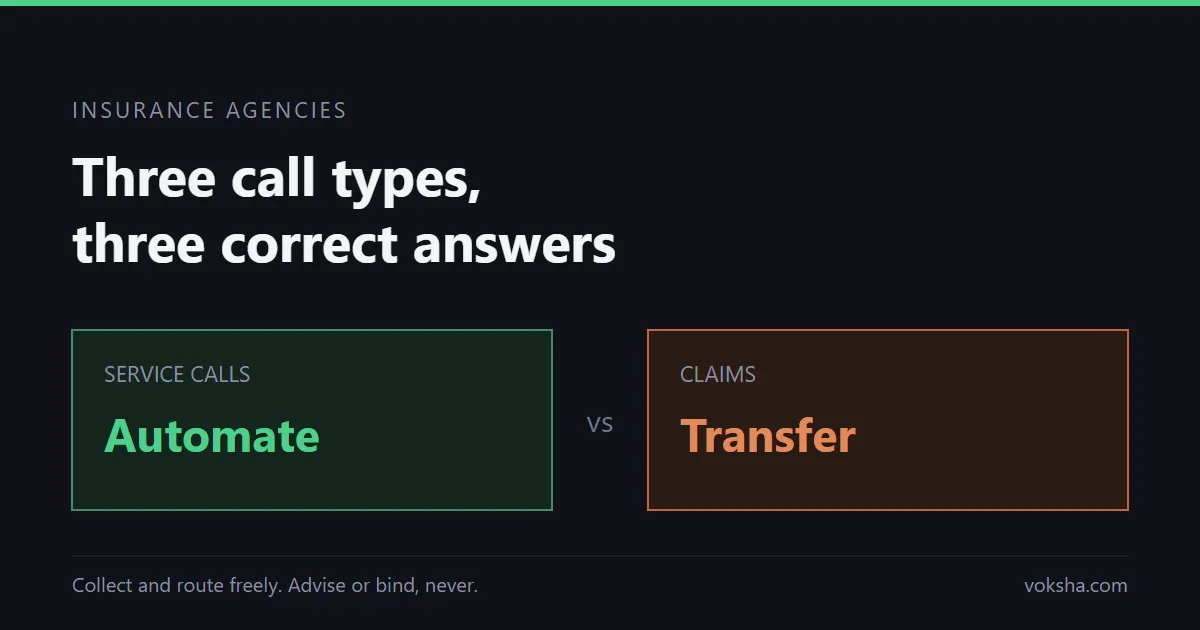
An insurance agency's calls divide into three types with three different correct answers. Quote enquiries should be captured completely and routed fast - they are the revenue. Service calls - address changes, ID cards, billing questions, renewal dates - are patterned and are the right automation target. Claims should reach a person, because someone ringing after a crash is not a workflow. Voksha at $19 a month for 20 calls or Goodcall at $79 flat handles the middle category so licensed staff spend their time on the other two.
Four options are priced below from their own pages, with the boundary that matters most in this vertical: an automated system must not advise on coverage or bind anything. Voksha publishes this guide and is one of the four. See How this guide was sourced.
Key Takeaways
- Licensed agent time is the expensive input. Insurance sales agents earn a 2025 median of $62,280 a year, or $29.94 an hour, across 572,600 US jobs, with employment projected to grow 3% from 2025 to 2035 (US Bureau of Labor Statistics). A three-minute service call costs about $1.50 of that time - ANALYSIS - against $0.66 to $0.93 for software.
- Automate service, capture quotes, transfer claims. That three-way split is the entire design, and getting it wrong in either direction is costly: automating claims damages clients, automating nothing wastes licensed time on ID card requests.
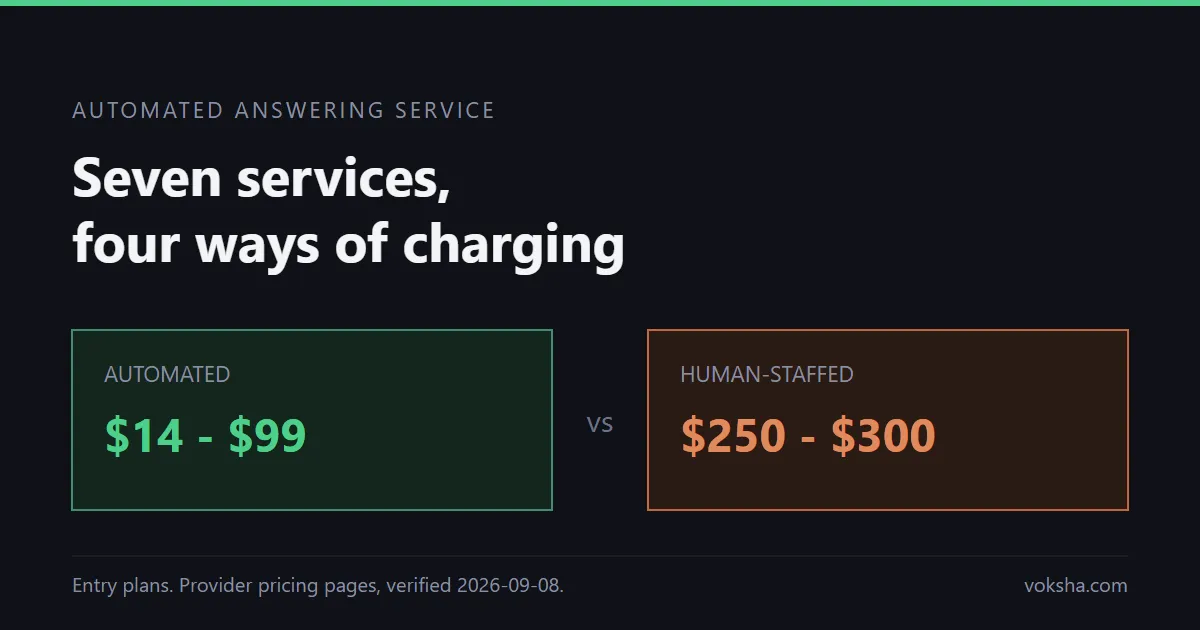
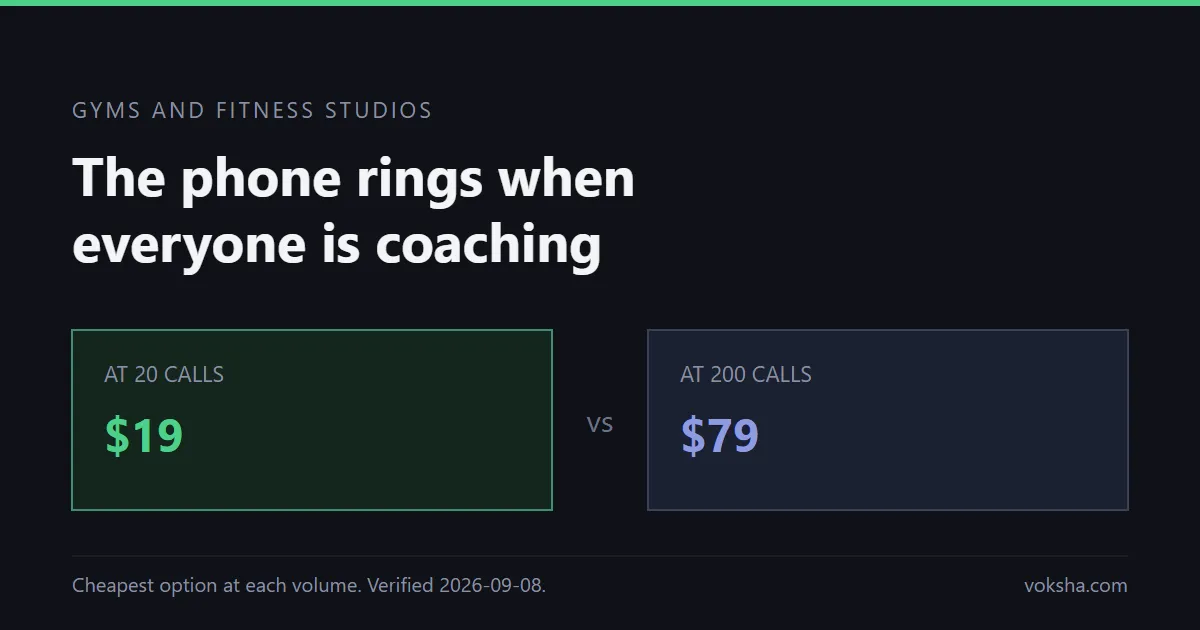
- At 20 calls the range is $19 to $79; at 100 calls it is $79 to $149. Voksha $19/$99, Dialzara $29/$135, Rosie $49/$149, Goodcall $79/$79. ANALYSIS from published plans, verified 2026-09-08 except Voksha, 2026-09-07.
- Speed decides quote conversion. A prospect ringing for a quote is ringing several agencies. Capturing the details and booking the callback while they are still on the phone is the difference between a lead and a missed one.
- 32% of calls arrive outside 9-to-5 weekdays and 23% at weekends (Voksha After-Hours Economy Report, 1,000,000+ calls) - and accidents in particular do not observe business hours.
- Never let it advise on coverage or bind anything. Producer licensing is state-regulated. This guide does not interpret those rules; it says only that an automated system should collect information and route, never advise.
The three call types
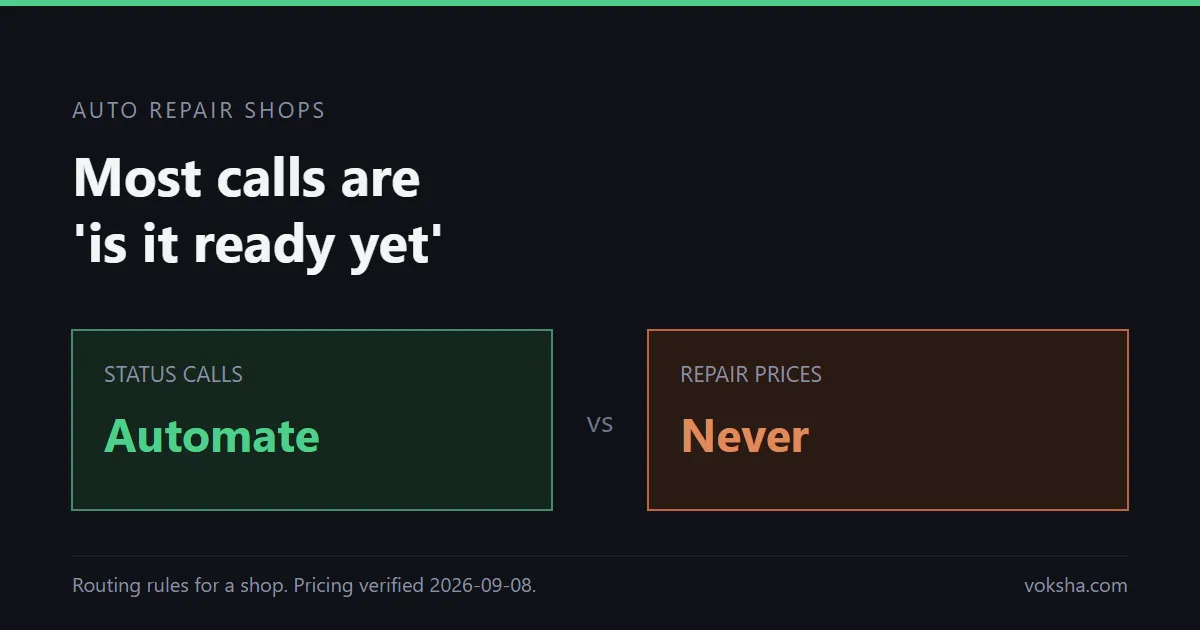
Service calls are the automation target. They are the highest-volume category, they follow patterns, and none of them require a licensed judgement. Every one handled automatically is licensed time returned to quoting and claims.
Quote calls are the revenue, and the constraint is speed. A prospect shopping for cover is calling several agencies. The system's job is to capture the details in full - who, what risk, when they can talk - and get a licensed agent onto it quickly. Its job is emphatically not to indicate a price or suggest what cover suits them.
Claims are the human category. Someone reporting an accident is upset, possibly at the roadside, and needs a person. This is the clearest transfer rule in the vertical, and it should be configured before go-live rather than after the first complaint.
The boundary that matters in this vertical
Insurance is a licensed profession, and producer licensing is regulated at state level. This guide does not interpret those rules and cannot tell you what your state requires. What it can say plainly is the operating principle that keeps an automated system on the right side of the line:
It may collect. It may route. It may confirm facts already on file. It must not advise, quote, or bind.
Practically, that means an automated system should never say whether a policy covers a given event, never indicate a premium, never recommend a level of cover, and never confirm that something is now insured. Those are licensed acts or commitments. A system that "helpfully" answers "yes, you're covered for that" has created an exposure that no efficiency gain offsets.
Confirm your own obligations with your compliance officer or state department of insurance before putting any answering service, human or automated, in front of policyholders.
What the four cost
Every figure read from the provider's own public pricing page on 8 September 2026, monthly billing, at a 3-minute average call.
| Service | Entry | Included | Metered by | At 100 calls |
|---|---|---|---|---|
| Voksha | $14/mo | 15 calls, then $1/call | Call | $99 |
| Dialzara | $29/mo | 60 minutes, $0.48/min over | Minute | $135 |
| Rosie | $49/mo | 250 minutes | Minute | $149 |
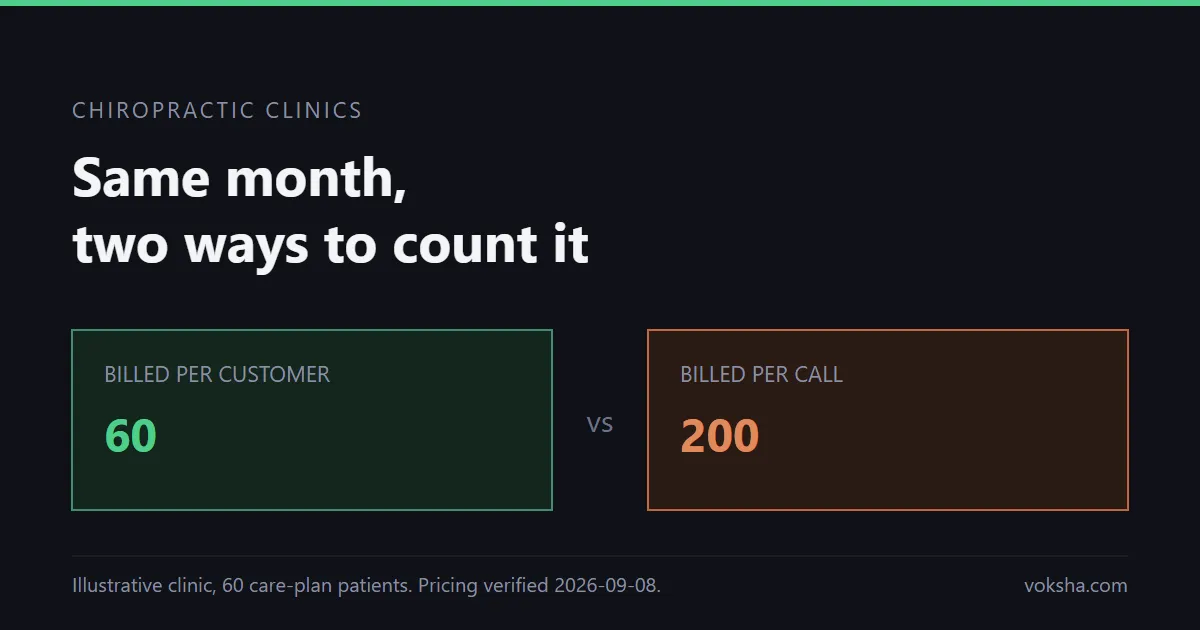
| Goodcall | $79/mo | Unlimited minutes, 100 unique customers | Customer | $79 |
Sources retrieved 2026-09-08: Dialzara, Rosie, Goodcall. Voksha verified 2026-09-07 against voksha.com/pricing, which blocks automated retrieval - disclosed rather than presented as same-day.
Why after-hours matters here
Two categories arrive outside business hours for different reasons. Accidents happen at any hour, and a policyholder ringing at 10pm needs to reach a person - which is a routing configuration, not an automation opportunity. Quote shoppers ring in the evening because that is when they have time to compare, and those calls are pure pipeline.
With 32% of calls arriving outside 9-to-5 weekdays and 23% at weekends, and 86-90% of recovered callbacks connecting and converting (Voksha After-Hours Economy Report, 1,000,000+ calls), an agency that only answers 9 to 5 is handing a meaningful share of both categories to whoever does.
How this guide was sourced
Written by the Voksha engineering and content team (voksha.com). Voksha sells a 24/7 AI receptionist and answering service and is one of the four options priced above - and the table names Goodcall as cheaper at 100 calls, because that is what the published plans produce.
Sources and retrieval dates:
- BLS Occupational Outlook Handbook, insurance sales agents - median $62,280 a year and $29.94 an hour in 2025, 572,600 jobs, projected +3% to 2035
- Dialzara, Rosie, Goodcall - retrieved 2026-09-08
- Voksha pricing - retrieved 2026-09-07
On licensing: this guide states that insurance producer licensing is regulated at state level and does not interpret any state's rules. The operating principle it recommends - collect and route, never advise or bind - is editorial judgement, not a legal opinion, and is marked as such. Confirm your obligations with your compliance officer or state department of insurance.
Claims about call composition in agencies are described as operational patterns rather than measured statistics, because no figure this guide could verify quantifies them. Derived costs are marked ANALYSIS with arithmetic shown. No competitor blog or third-party roundup was used as evidence.
The one Voksha figure used is the After-Hours Economy Report, first-party data across more than 1,000,000 calls. No unpublished Voksha telemetry appears here.
Frequently Asked Questions
Which AI receptionist is best for an insurance agency?
Below about 80 calls a month, Voksha at $19 for 20 calls. Above that, Goodcall's $79 flat plan usually wins, particularly for an agency whose service calls come from the same policyholders repeatedly.
How much does it cost an agency?
$19 to $99 a month at 20 to 100 calls across the four options priced here, from published plans read in September 2026.
Can it quote a policy or advise on coverage?
No, and it should be configured not to attempt either. Producer licensing is state-regulated, and a system that indicates a premium or confirms cover has made a commitment on your agency's behalf. Capture the details and route to a licensed agent.
Should it handle claims calls?
Transfer them to a person immediately, by explicit rule, at any hour. A caller reporting an accident or a loss needs a human, and this is the clearest transfer rule in the vertical.
What can it safely handle?
Service calls: address changes, ID card requests, billing questions, renewal dates, office hours. High volume, fully patterned, and none of them require licensed judgement.
Does answering faster actually win quotes?
A prospect shopping for cover is calling several agencies, so capturing their details and booking a callback while they are still on the line is the difference between a lead and a missed one - especially in the evening, when much of that shopping happens.
Conclusion
Insurance is the vertical where the automation boundary is sharpest. Service calls should be automated, quote calls captured and routed at speed, and claims answered by a person - and the system should never advise on coverage or bind anything.
Get those three rules configured before go-live, and the return is not the $1.50 a call. It is licensed capacity spent on quoting and claims rather than on sending out ID cards.