Best AI Receptionist for Auto Repair Shops 2026: 4 Options Priced

TL;DR
- Most calls to a repair shop are status checks worth nothing; the estimate call is worth a job. Four AI receptionists priced for shops in 2026, from $19 a month.
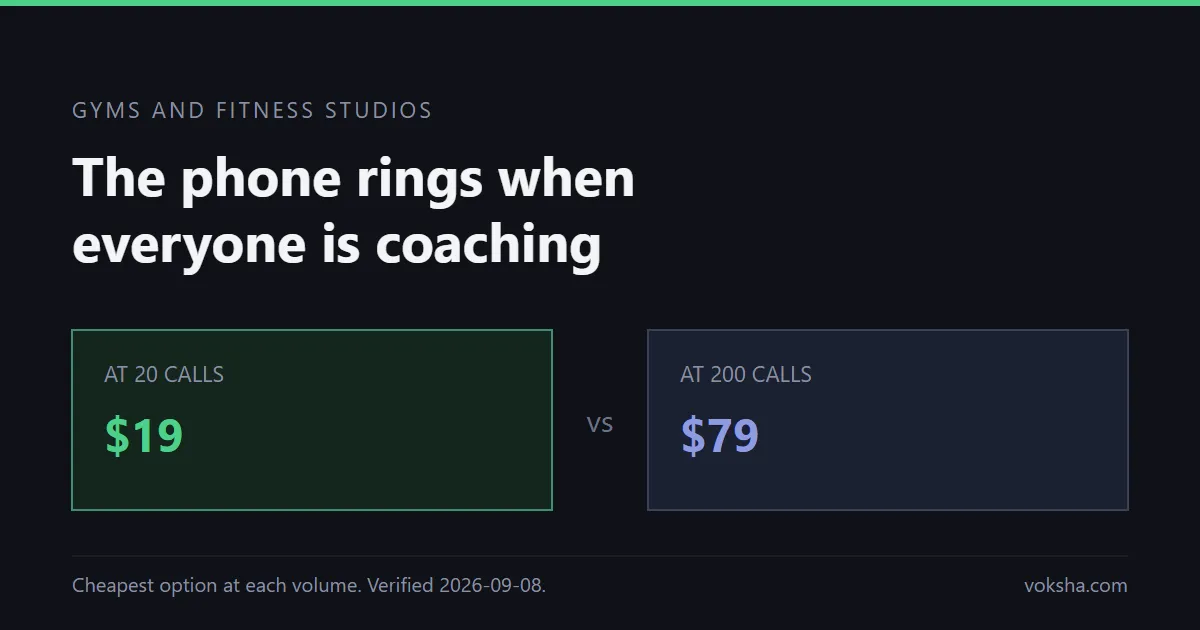
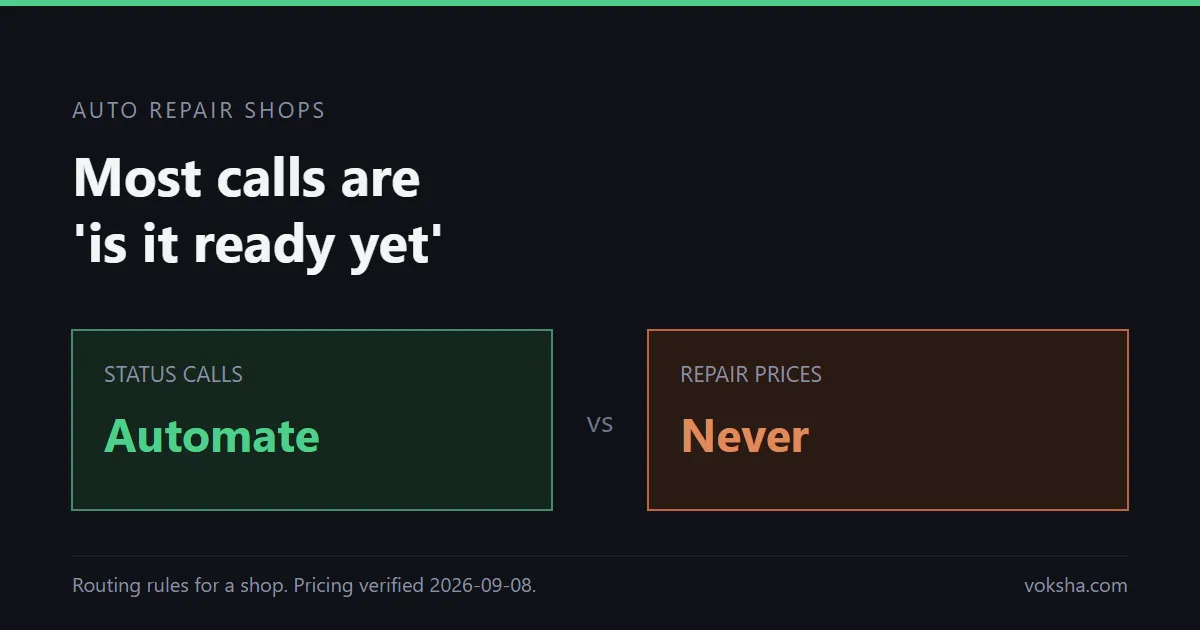
A repair shop's phone problem is not volume, it is composition. Most calls are "is my car ready yet" - zero revenue, high frequency, and they land on the one person who is also writing estimates and handing over keys. The call that pays, "can you look at my car this week", arrives on the same line and competes with them. Voksha at $19 a month for 20 calls or Goodcall at $79 flat answers the first category so your advisor is free for the second.
Four options are priced below from their own pages, along with the routing rules that make automation useful in a shop rather than annoying. Voksha publishes this guide and is one of the four. See How this guide was sourced.
Key Takeaways
- Every phone interruption stops billable work. Automotive service technicians earn a 2025 median of $50,620 a year, or $24.34 an hour, across 825,800 US jobs, with employment projected to grow 5% from 2025 to 2035 (US Bureau of Labor Statistics). A three-minute call costs about $1.22 in wage - ANALYSIS - against $0.66 to $0.93 for software.
- Status calls are the automation target. They are patterned, repetitive and worth nothing individually, and they are the reason your advisor cannot get to the estimate call.
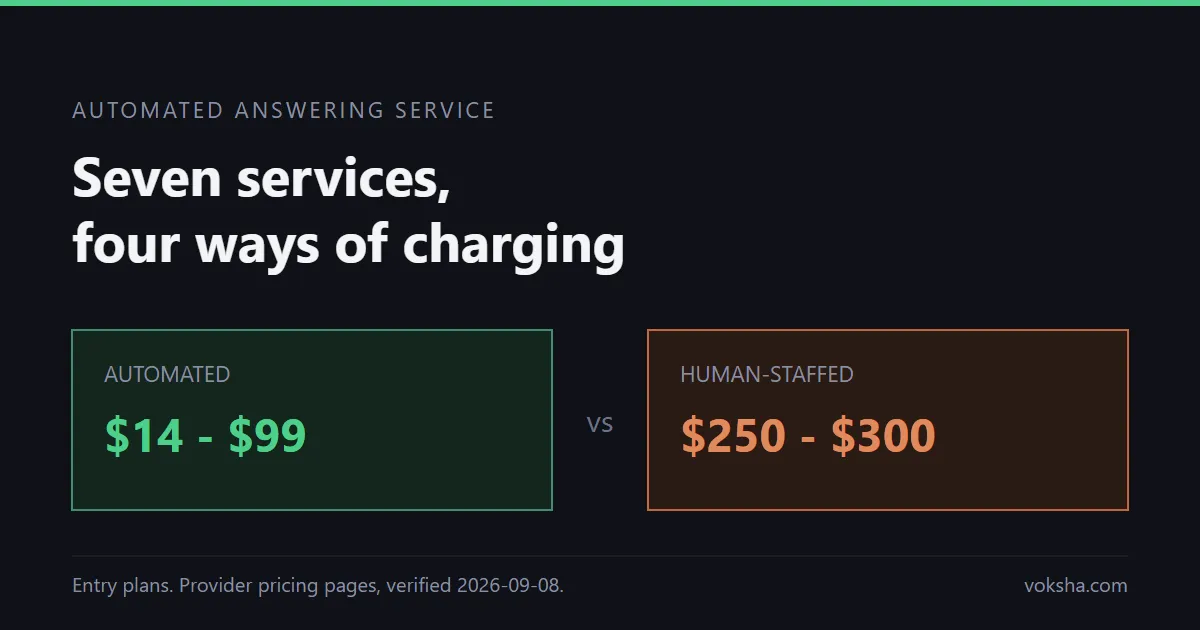
- At 20 calls the range is $19 to $79; at 100 calls it is $79 to $149. Voksha $19/$99, Dialzara $29/$135, Rosie $49/$149, Goodcall $79/$79. ANALYSIS from published plans, verified 2026-09-08 except Voksha, 2026-09-07.
- Whoever answers first usually gets the job. For a driver whose car is undriveable, the shop that picks up is the shop that books it. That is the whole argument for answering out of hours - and 32% of calls arrive outside 9-to-5 weekdays with 23% at weekends (Voksha After-Hours Economy Report, 1,000,000+ calls).
- Never let it quote a repair price. A number said on the phone becomes a promise. Capture symptoms, book the diagnostic, let a human quote.
- Breakdowns and roadside calls go to a person immediately - a driver stranded on a hard shoulder is not a scheduling request.
The composition problem
Shops rarely lose money because nobody answers. They lose it because the person answering is the same person doing the work that makes money.
The service advisor is a single point of contention. They write estimates, order parts, hand over keys, explain invoices and answer the phone. Every ringing line pulls them off one of the other five.
Status calls dominate the volume. A car in the shop for two days generates status calls, sometimes several. They are entirely mechanical - the answer is a state in your system - and they interrupt exactly the same person as a new booking would.
The estimate call is time-sensitive. A driver with a car making a noise rings three shops. The one that answers and books gets the job. The other two get nothing, and never know the call happened.
Technicians cannot answer. Hands in an engine bay, gloves on, lift running. Anything that reaches a technician has already cost twice - once for the interruption, once for the work stopped.
Which calls to automate, and which to route
The rule that keeps this safe is simple: automation may inform, it may book a diagnostic, and it may not price a repair. A caller told "that will be about $400" has been given a number they will hold you to, and no configuration makes that safe when the car has not been looked at.
What the four cost
Every figure read from the provider's own public pricing page on 8 September 2026, monthly billing, at a 3-minute average call.
| Service | Entry | Included | Metered by | At 100 calls |
|---|---|---|---|---|
| Voksha | $14/mo | 15 calls, then $1/call | Call | $99 |
| Dialzara | $29/mo | 60 minutes, $0.48/min over | Minute | $135 |
| Rosie | $49/mo | 250 minutes | Minute | $149 |
| Goodcall | $79/mo | Unlimited minutes, 100 unique customers | Customer | $79 |
Sources retrieved 2026-09-08: Dialzara, Rosie, Goodcall. Voksha verified 2026-09-07 against voksha.com/pricing, which blocks automated retrieval - disclosed rather than presented as same-day.
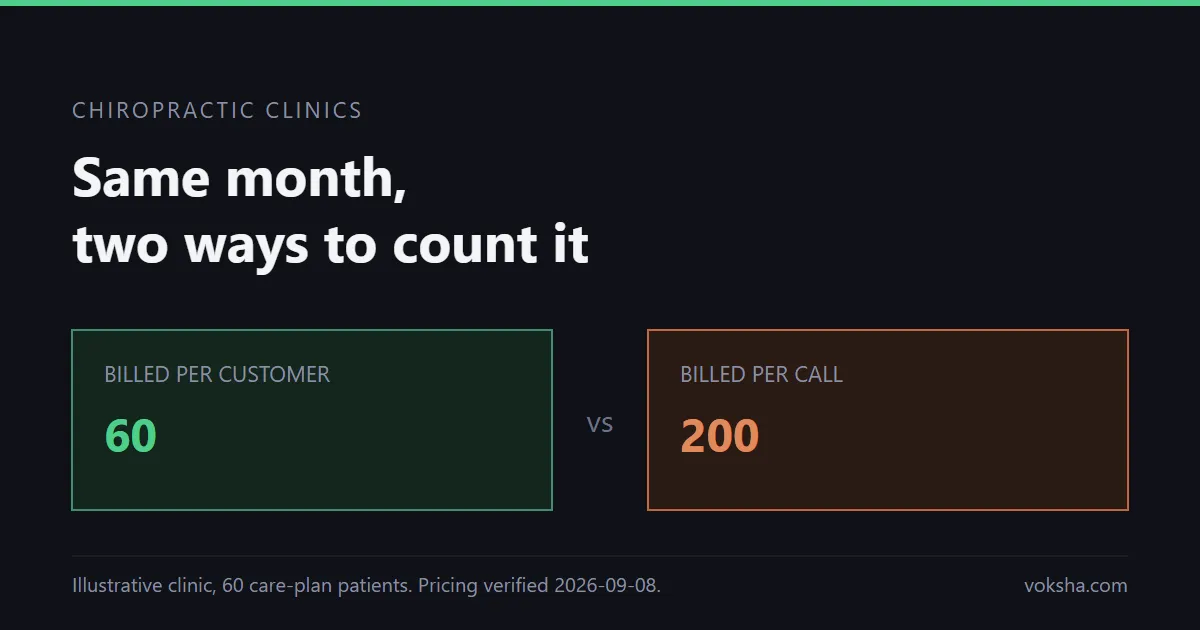
One wrinkle specific to shops: status calls inflate call counts without inflating customer counts. A customer whose car is in for three days may ring four times. On a per-call plan that is four billable events; on Goodcall's per-customer model it is one. If your shop keeps cars for multi-day jobs, count unique customers before comparing plans - the two numbers diverge more here than in most trades.
The after-hours case, which is a booking case
Cars break outside business hours, and a driver whose car will not start on Sunday evening is looking for whoever answers on Monday morning - or before. With 32% of calls arriving outside 9-to-5 weekdays and 23% at weekends, and 86-90% of recovered callbacks connecting and converting (Voksha After-Hours Economy Report, 1,000,000+ calls), the out-of-hours enquiry is not a marginal category for a shop.
The right behaviour out of hours is narrow and useful: confirm the shop can look at the vehicle, record the symptoms and the registration, book the diagnostic slot, and say plainly that a price comes after someone has seen it. That converts the call without creating a commitment nobody has authorised.
How this guide was sourced
Written by the Voksha engineering and content team (voksha.com). Voksha sells a 24/7 AI receptionist and answering service and is one of the four options priced above - and the table names Goodcall as cheaper at 100 calls, which is what the published plans produce for a shop with multi-day jobs.
Sources and retrieval dates:
- BLS Occupational Outlook Handbook, automotive service technicians and mechanics - median $50,620 a year and $24.34 an hour in 2025, 825,800 jobs, projected +5% to 2035
- Dialzara, Rosie, Goodcall - retrieved 2026-09-08
- Voksha pricing - retrieved 2026-09-07
Claims about call composition in repair shops - that status calls dominate volume, that the service advisor is a contention point - are described as operational patterns rather than measured statistics, because no figure this guide could verify quantifies them. Derived costs are marked ANALYSIS with arithmetic shown.
No competitor blog or third-party roundup was used as evidence. The one Voksha figure used is the After-Hours Economy Report, first-party data across more than 1,000,000 calls. No unpublished Voksha telemetry appears here.
Frequently Asked Questions
Which AI receptionist is best for an auto repair shop?
Below about 80 calls a month, Voksha at $19 for 20 calls. Above that - and particularly if you keep cars for multi-day jobs that generate repeat status calls - Goodcall's $79 flat plan is usually cheaper, because it bills per unique customer.
How much does it cost a shop?
$19 to $99 a month at 20 to 100 calls across the four options priced here, from published plans read in September 2026.
Can it answer "is my car ready"?
That is the single highest-value thing to automate in a shop, provided it can read the job status from your system. It is the most frequent call, it is worth nothing individually, and it interrupts the person writing estimates.
Can it quote a repair price?
No, and it should be configured not to try. A price said on the phone becomes a commitment before anyone has looked at the vehicle. Capture the symptoms, book the diagnostic, let a human quote.
What about a breakdown call?
Transfer to a person immediately by explicit rule. A stranded driver is not a scheduling request, and it is the clearest example of a call that should never sit in an automated flow.
Is answering out of hours worth it for a shop?
It is where the booked jobs come from. Cars fail in the evening and at weekends, and the shop that answers is generally the shop that gets the vehicle.
Conclusion
A repair shop does not need every call answered by a person - it needs the status calls taken off the advisor so the estimate calls get through. That is a composition problem, and it is what automation is genuinely good at.
Automate the status checks and the hours questions, capture estimate enquiries with symptoms and a booked diagnostic, and transfer breakdowns and any question about price. The line is simple: inform freely, commit never.