Best AI Receptionist for Gyms and Fitness Studios 2026: 4 Options

TL;DR
- Gym phones ring hardest when staff are on the floor coaching. Four AI receptionists priced for studios in 2026, from $19 to $149 a month, and what each handles.
A gym's phone rings hardest at exactly the moment nobody can answer it: peak class times, when every member of staff is on the floor coaching. Voksha at $19 a month covers 20 calls, Goodcall's $79 flat plan covers unlimited minutes, and both answer the enquiry that would otherwise go to voicemail while your instructor is mid-session. The four options below are priced from their own pages.
Fitness is a specific case on the phone: the highest-value call is a prospective member asking about joining, the highest-volume call is an existing member asking about a class or a cancellation, and the staff qualified to answer either are usually holding a stopwatch. Voksha publishes this guide and is one of the four priced. See How this guide was sourced.
Key Takeaways
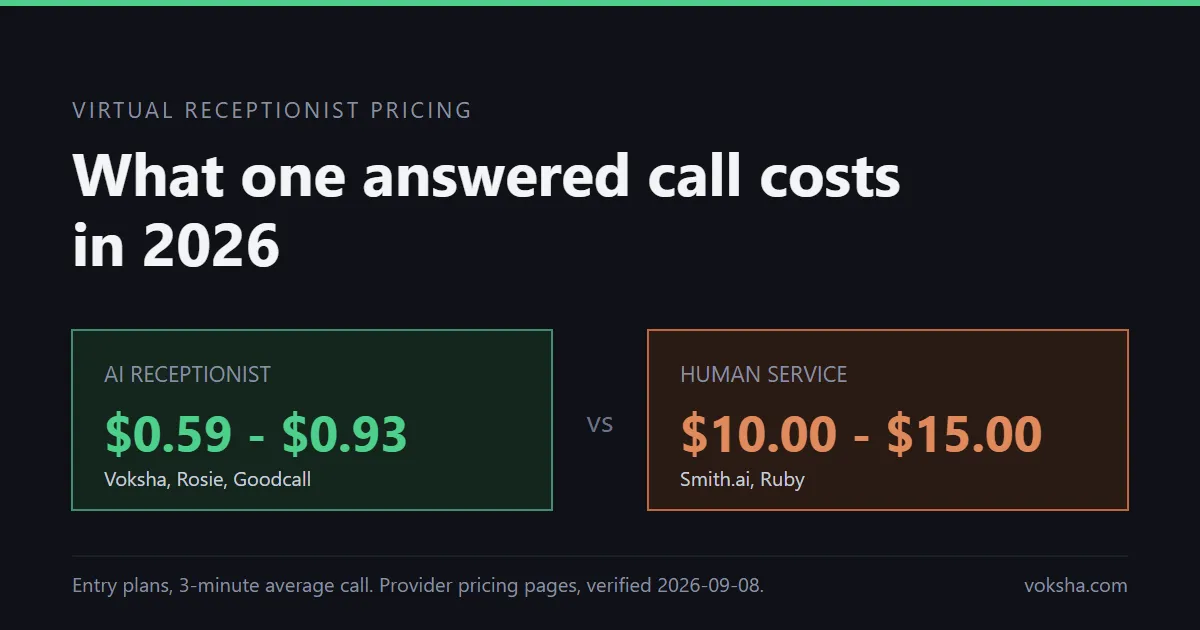
- Your coaching staff are the most expensive people to put on reception. Fitness trainers and instructors earn a 2025 median of $47,160 a year, or $22.67 an hour, across 388,400 US jobs, with employment projected to grow 7% from 2025 to 2035 (US Bureau of Labor Statistics). Three minutes on the phone costs about $1.13 in wage - ANALYSIS - plus a class that is now being taught by someone facing away from it.
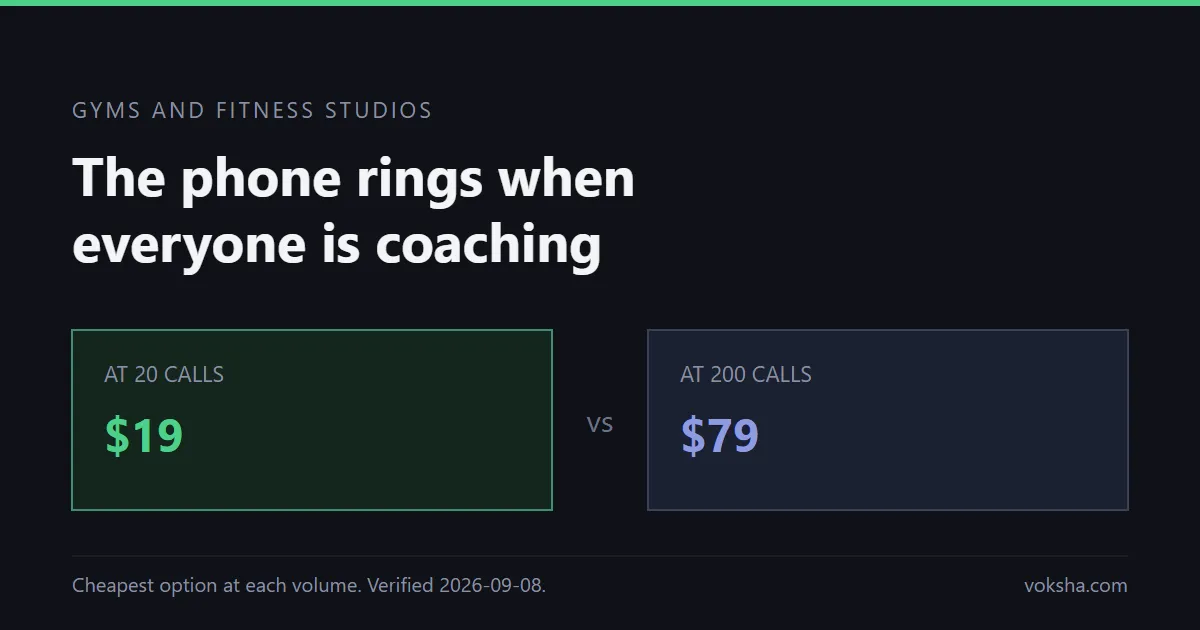
- At 20 calls the range is $19 to $79; at 200 calls it is $79 to $299. Voksha $19 to $99, Dialzara $29 to $299, Rosie $49 to $299, Goodcall $79 flat to 100 unique customers. ANALYSIS from published plans, verified 2026-09-08 except Voksha, 2026-09-07.
- Unlimited concurrency matters more here than price. Every human option answers one call at a time. When a class ends and four people ring at once, software answers all four. That is the property gyms are actually buying.
- A joining enquiry is worth a membership, not a call. The subscription is trivial against one recovered member, which reframes the decision away from the monthly cost entirely.
- 32% of calls arrive outside 9-to-5 weekdays and 23% at weekends (Voksha After-Hours Economy Report, 1,000,000+ calls) - which for a gym is when members are actually free to ring.
- Do not automate the cancellation conversation if retention is the goal. A member ringing to cancel is a retention opportunity, and the honest position is that a person handles that better than a script does.
The gym phone problem, specifically
The peak is the problem. Calls cluster around class times and early evening - the same window when every staff member is coaching, spotting or running a floor. The phone is loudest precisely when the building is busiest.
Concurrency, not speed. When a class finishes, several people ring within a few minutes. One human answers one of them. Software answers all of them at once, and for a studio that is the single biggest operational difference between the options here.
Two call types with wildly different values. A prospective member asking about membership is a revenue event. An existing member asking what time the 6am spin class starts is a cost. Both ring the same phone, and only the first one justifies interrupting a session.
Seasonality is real and lumpy. New-year demand, post-summer returns and the start of term all produce enquiry surges. A plan that meters calls tightly can become expensive in exactly the month you most want every enquiry answered - which is an argument for checking the overage rate before January rather than during it.
What the four cost, across the volumes a studio actually sees
Every figure read from the provider's own public pricing page on 8 September 2026, monthly billing, at a 3-minute average call.
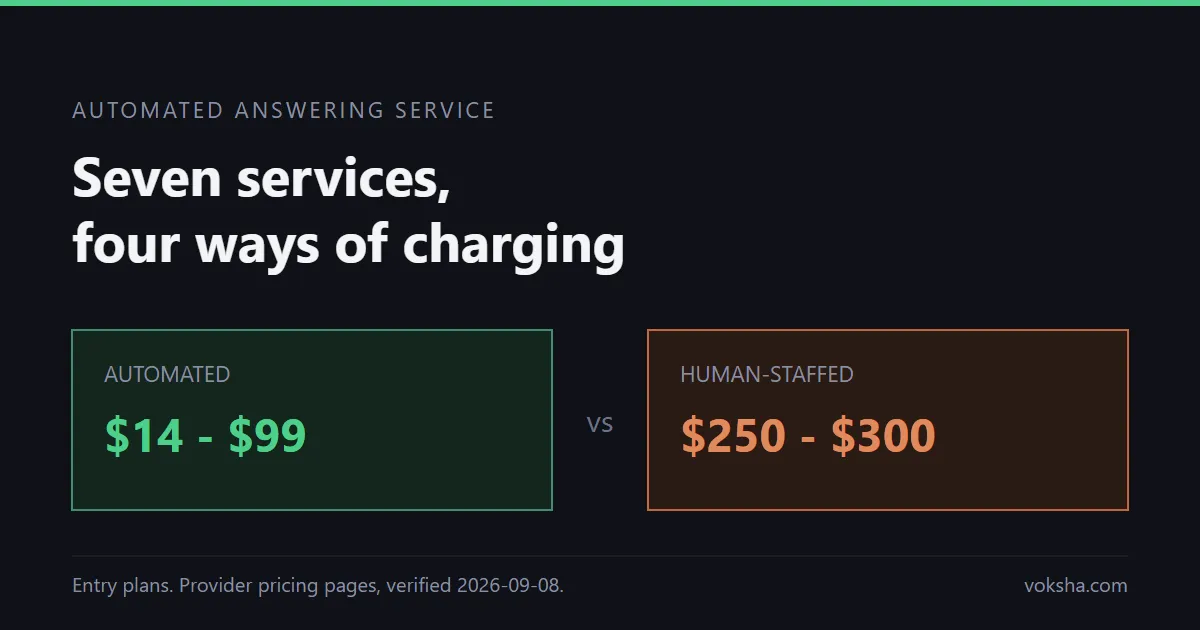
| Service | Entry | Included | Metered by |
|---|---|---|---|
| Voksha | $14/mo | 15 calls, then $1/call | Call |
| Dialzara | $29/mo | 60 minutes, $0.48/min over | Minute |
| Rosie | $49/mo | 250 minutes | Minute |
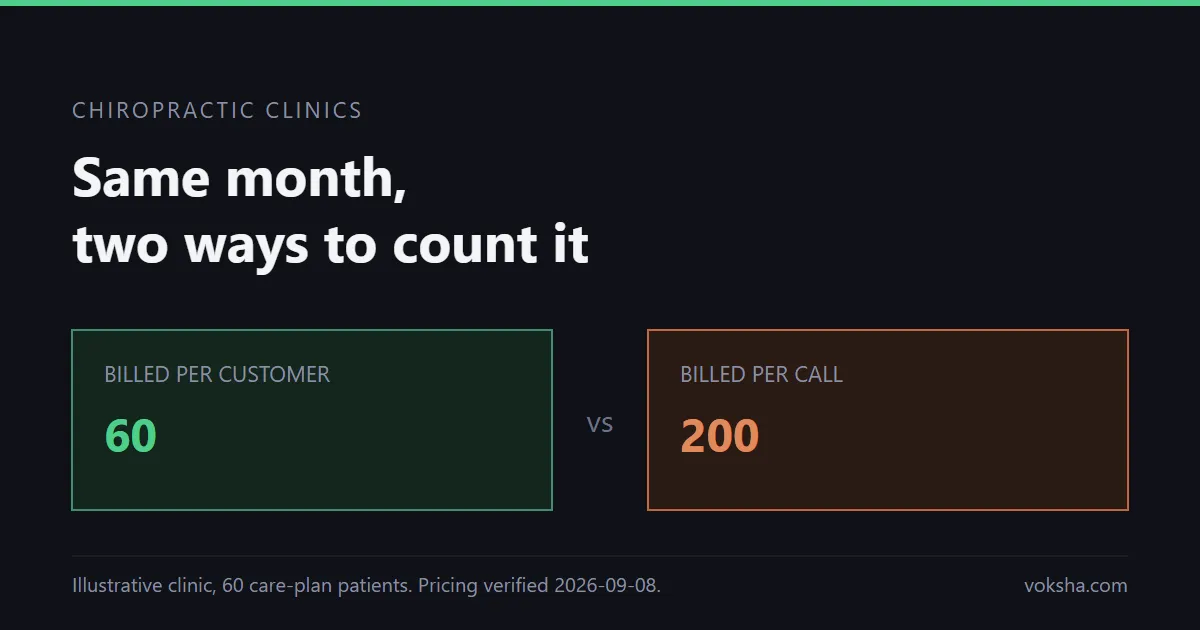
| Goodcall | $79/mo | Unlimited minutes, 100 unique customers | Customer |
Sources retrieved 2026-09-08: Dialzara, Rosie, Goodcall. Voksha verified 2026-09-07 against voksha.com/pricing, which blocks automated retrieval - disclosed rather than presented as same-day.
What to automate in a studio
Class times, timetable and location questions. The highest-volume, lowest-value calls in the building. Fully patterned, and the ones that most often interrupt coaching.
Class bookings and waitlists. Where your booking system exposes them, this is the call that completes rather than just informs.
Membership enquiries, captured and routed. An AI can capture who called, what they want and when they can visit, and book the tour. Whether it should attempt to sell the membership is a judgement call, and most studios do better having a human close.
Opening hours and access questions out of hours. Members ring in the evening because that is when they are free - and 32% of calls arrive outside 9-to-5 weekdays with 23% at weekends (Voksha After-Hours Economy Report).
What not to automate
The cancellation call. A member ringing to cancel is the one conversation where a person changes the outcome - a freeze, a plan change, or simply being heard. Automating it makes cancelling frictionless, which is efficient and expensive. Route it to a human by explicit rule.
Injury and incident calls. Anything involving a member hurt in the building goes to a manager immediately, not into a queue.
Complaints. A frustrated member wants a person. A script that handles the complaint smoothly still leaves them feeling processed.
That is the honest boundary on our own product too: Voksha handles the patterned calls - timetable, bookings, enquiry capture, after-hours - and should be configured to transfer the three categories above rather than to handle them well.
How this guide was sourced
Written by the Voksha engineering and content team (voksha.com). Voksha sells a 24/7 AI receptionist and answering service and is one of the four options priced above. The comparison names Dialzara as cheapest in the middle of the range and Goodcall as cheapest at high volume, because that is what the published plans produce.
Sources and retrieval dates:
- BLS Occupational Outlook Handbook, fitness trainers and instructors - median $47,160 a year and $22.67 an hour in 2025, 388,400 jobs, projected +7% to 2035
- Dialzara, Rosie, Goodcall - retrieved 2026-09-08
- Voksha pricing - retrieved 2026-09-07
Seasonal demand patterns are described qualitatively because no figure this guide could verify covers them. Where a number would have been convenient, it is left out rather than estimated. Derived costs are marked ANALYSIS with the arithmetic shown.
No competitor blog or third-party roundup was used as evidence. The one Voksha figure used is the After-Hours Economy Report, first-party data across more than 1,000,000 calls. No unpublished Voksha telemetry appears here.
Frequently Asked Questions
Which AI receptionist is best for a gym?
It changes with volume. Voksha at $19 is cheapest for a small studio at 20 calls a month, Dialzara at $29 covers the middle, and Goodcall's $79 flat plan wins at higher volume where members call repeatedly.
How much does it cost a fitness studio?
$19 to $79 a month at 20 calls, and $79 to $299 at 200 calls, across the four options priced here from published plans read in September 2026.
Can it take class bookings?
Where your booking system exposes them, yes - and booking during the call rather than taking a message is the difference worth paying for. Confirm which booking platforms a vendor writes to before buying.
What happens when several members call at once?
Software answers all of them simultaneously. Any human option - your staff or an outsourced service - answers one and sends the rest to voicemail, which is the specific failure a gym experiences at peak times.
Should it handle cancellations?
Route them to a person if retention matters. Making cancellation frictionless is efficient in the wrong direction, and it is the one call where a human genuinely changes the outcome.
What about the new-year enquiry surge?
Check the overage rate before you need it. A plan that meters calls tightly gets expensive in exactly the month when every missed enquiry is a lost annual membership.
Conclusion
A gym does not have a missed-call problem so much as a simultaneity problem: the phone rings four times at once, at the hour when every member of staff is coaching. That is the property software solves and humans structurally cannot.
Automate the timetable questions and the enquiry capture, route cancellations and incidents to a person, and check the overage rate before your busiest month rather than during it.