AI Receptionist ROI: What $14 a Month Actually Buys
TL;DR
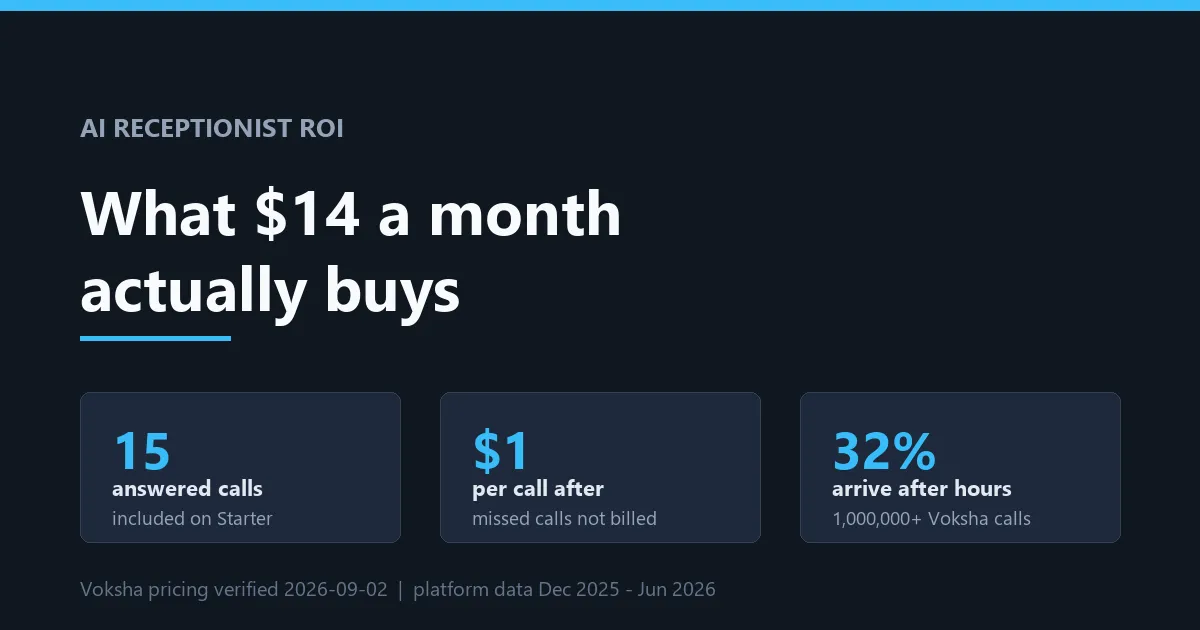
- Voksha Starter is $14 a month including 15 answered calls, then $1 per call; Premium is $99 for 150. Missed and failed calls are not billed. Break-even is one recovered booking per 200 answered calls. Across 1,000,000+ Voksha calls, 32% arrive outside 9-5 weekday hours and 23% at weekends.
An AI receptionist on Voksha's Starter plan costs $14 a month for 15 answered calls, then $1 per call after that. A business taking 30 calls a month pays about $29. The comparison that matters is not $14 against a $45,000 salary, it is $1 per answered call against the value of the call you would otherwise have missed. On Voksha platform data covering more than 1,000,000 calls, 32% of them arrive outside 9-to-5 weekday hours.
Key Takeaways
- Voksha Starter is $14/month including 15 answered calls, then $1 per call. Premium is $99/month including 150 calls. Missed and failed calls are not counted or billed (Voksha pricing and docs, verified 2026-09-02).
- Across 1,000,000+ Voksha calls, 32% arrive outside 9-to-5 weekday hours and 23% at weekends (After-Hours Economy Report, 2026). Those are the hours a front desk is not staffed.
- Of the callbacks Voksha recovers, 86-90% connect and convert - first-party platform data, not an industry estimate.
- Voksha's own call corpus shows 32% of calls arrive outside 9-to-5 and 23% land at weekends - the hours a front desk is not staffed.
- Payback is a division problem, not a leap of faith: divide your per-call cost by the gross profit of one booked job.
What does $14 a month actually include?
Fifteen answered calls, then $1 for each additional answered call. That is the whole mechanic, and it is the part most pricing articles get wrong.
| Plan | Monthly price | Answered calls included | After that | Phone number |
|---|---|---|---|---|
| Starter | $14 | 15 | $1 per call | 1 local |
| Premium | $99 | 150 | $1 per call | Toll-free |
| Enterprise | $990+ | Custom | Custom | Multiple |
Two details change the arithmetic. An answered call is one your agent picked up - missed and failed calls are not counted and not billed. And nothing stops working when you pass your allowance; the agent keeps answering and the extra calls appear on the invoice, with alerts at 75%, 90% and 100% of your included volume.
So the honest per-call cost at Starter is between $0.93 and $1.00, depending on whether you use your allowance. That is the number to run an ROI calculation against.
How big is the missed-call problem, really?
Big enough that per-call price is rarely the deciding number - but the industry figures usually quoted here do not survive checking, so this section uses first-party data instead.
What Voksha can actually evidence, from its own platform across more than 1,000,000 calls between December 2025 and June 2026 (After-Hours Economy Report, retrieved 2026-09-03):
- 32% of calls arrive outside standard 9-to-5 weekday hours, and 23% at weekends. Pressure concentrates in early morning and the first two hours after 5pm.
- 86-90% of recovered callbacks connect and convert.
A note on the numbers you will see elsewhere. Two statistics dominate writing on this topic: "62% of small business calls go unanswered" and "$126,000 a year lost to missed calls." Both are weaker than they look. The 62% figure traces to a single January 2016 study of 85 businesses by 411 Locals, an SEO lead-generation company rather than a research firm, and is frequently redated to 2023 or 2024 by pages that repeat it. No published methodology could be located for the $126,000 figure at all. This article does not rely on either.
What is solidly established is the market context. 19.8% of US businesses reported using AI in a business function, and adoption falls below 20% for firms with fewer than 20 employees (US Census Bureau, Business Trends and Outlook Survey, published May 2026). The Federal Reserve's 2026 Small Business Credit Survey (n=6,525) found 46% of small firms use AI in some capacity, but only 7% have fully integrated it (Federal Reserve, published March 2026).
That gap between broad experimentation and shallow integration is the honest framing: most small businesses have tried AI somewhere, very few have wired it into the phone.
When do the calls you are missing actually arrive?
Outside the hours a front desk is staffed, mostly. This is the part general industry research cannot tell you, because it needs platform data rather than a survey.
Across more than 1,000,000 calls handled between December 2025 and June 2026, Voksha's own corpus shows 32% arriving outside standard 9-to-5 weekday hours and 23% landing at weekends (these are overlapping lenses, reported separately). Pressure concentrates in early morning and in the first two hours after 5pm (After-Hours Economy Report, retrieved 2026-09-02).
How do you calculate your own payback?
Divide your per-call cost by the gross profit of one booked job. That gives you the number of recovered calls you need before the service pays for itself.
At Starter, an answered call costs about $1. If one booked appointment is worth $200 in gross profit, a single recovered call covers roughly 200 answered calls. The honest framing is not "it pays for itself" as a slogan, but this: the break-even is one recovered booking per 200 answered calls.
Two variables move that answer more than price does:
- Your gross profit per booking, not your revenue. A dental practice quoting $1,200-$1,500 for a new patient's first year is running different arithmetic from a salon booking a $60 cut.
- Your recovery rate. Not every answered call is a saved job. In Voksha's corpus, 86-90% of recovered callbacks connect and convert, but that measures callbacks specifically, not every inbound call.
Where does the arithmetic stop working?
At high volume, and in conversations that need judgment rather than intake.
On volume: past roughly 85 answered calls a month, Starter plus overage costs more than Premium's flat $99 for 150 calls. Running a busy practice on Starter is the most common way to overpay.
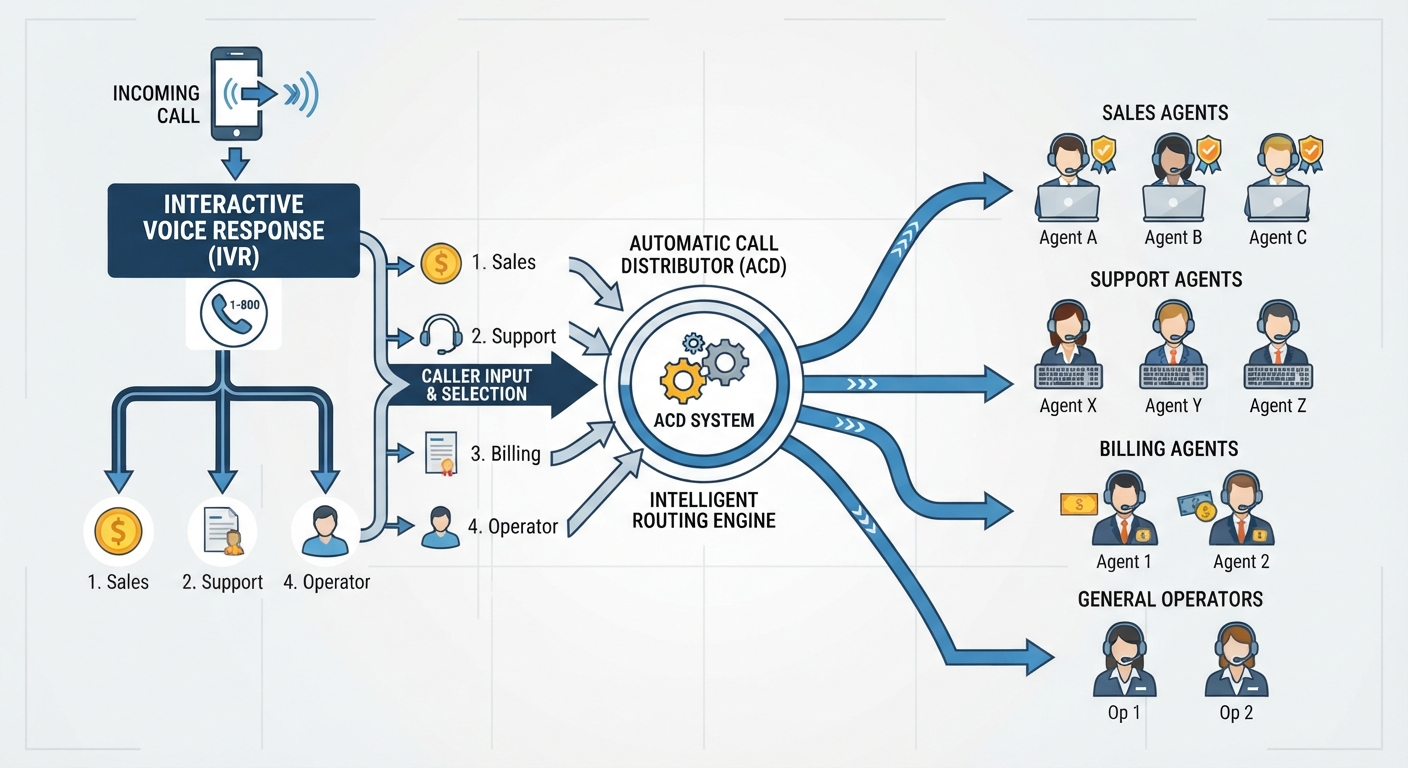
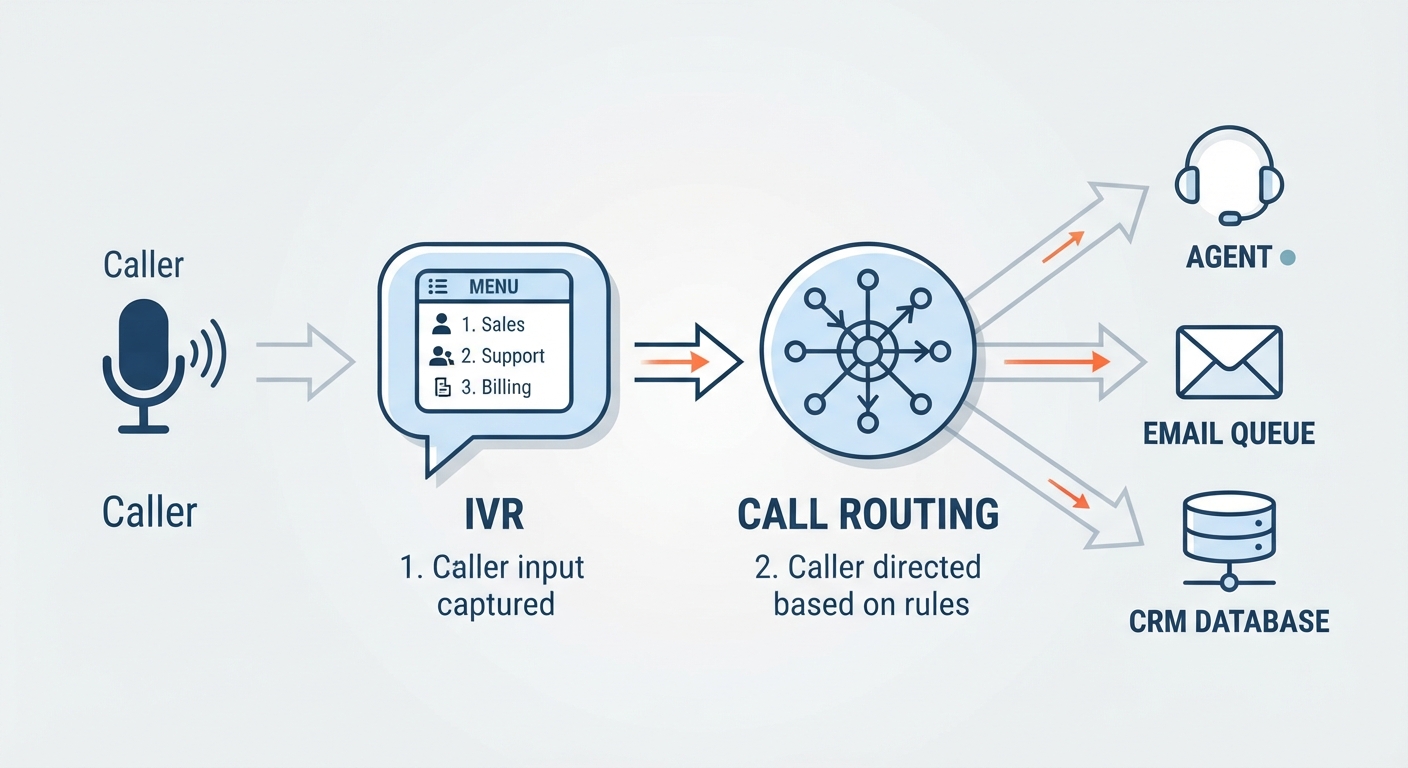
On call type: intake, scheduling, hours-and-availability questions and lead qualification are well-matched to an agent. High-emotion disputes, complex billing, and sensitive clinical or legal conversations are not. The escalation rules are where that judgment gets encoded, and a deployment without them will disappoint on exactly the calls that matter most.
On setup: the agent follows the business logic you give it. If your intake process is undefined, the agent will reproduce that ambiguity at scale. Two free browser test calls come with every new agent, which is the cheapest way to find out before committing.
What the comparison to a salary gets wrong
Most ROI articles on this topic, including the earlier version of this one, open by putting $14 a month next to a $45,000 salary. The ratio is dramatic and the comparison is weak, for two reasons.
A receptionist does work an agent does not: greeting walk-ins, handling the room, absorbing the awkward exception. And the agent does work a receptionist cannot: answering at 2am, taking six calls at once, never having a worse day on Friday than on Monday.
The defensible comparison is narrower and more useful. For the specific job of answering an inbound call that would otherwise have gone to voicemail, the cost is about $1. Whether that is worth paying depends entirely on what one booking is worth to you, which is why the calculation in this article is a division rather than a verdict.
Frequently Asked Questions
Is the $14/month price all-inclusive, or are there per-call fees?
It is not unlimited, and the distinction matters. **Starter is $14 a month including 15 answered calls, then $1 for each additional answered call.** Premium is $99 including 150 calls on the same overage terms. Missed and failed calls are not counted or billed, and alerts fire at 75%, 90% and 100% of your allowance so a busy month is visible while it is happening rather than on the invoice (Voksha pricing and billing docs, verified 2026-09-02).How many calls do I need to recover before it pays for itself?
Divide the per-call cost by the gross profit of one booked job. At about $1 per answered call, one booking worth $200 in gross profit covers roughly 200 answered calls. The variable that moves this most is not price but your gross profit per booking.At what volume should I move from Starter to Premium?
Around 85 answered calls a month. Below that, Starter plus overage is cheaper. Above it, Premium's 150-call allowance costs less than paying $1 per call on top of Starter.What happens when the agent cannot handle a call?
It escalates according to rules you define, either routing to a named person or capturing details for follow-up. Every route ends with a notification, so no call ends in silence. Defining those rules is setup work, not a default.Does an AI receptionist sound robotic?
Voice quality has improved substantially, but this is a claim worth testing rather than reading. Every new agent includes two free browser test calls before any plan is chosen, which is a better answer than any percentage figure in an article.How This Guide Was Sourced
Pricing and plan mechanics were read from Voksha's own pricing page and product documentation on 2026-09-02: Starter $14 with 15 included calls, Premium $99 with 150, overage at $1 per answered call, missed and failed calls not billed.
Call-timing and callback-conversion figures are Voksha platform data from the After-Hours Economy Report, covering more than 1,000,000 calls between December 2025 and June 2026. Market adoption figures are from the US Census Bureau BTOS (May 2026) and the Federal Reserve Small Business Credit Survey (n=6,525, March 2026).
Two widely-quoted industry statistics were removed from this article on 2026-09-03 after source-tracing: the "62% of calls go unanswered" figure resolves to a January 2016 study of 85 businesses by an SEO lead-generation company, and no methodology could be located for the "$126,000 lost per year" figure. Neither met the evidence bar in HOUSE-STYLE.md §1.2.
Disclosure: Voksha sells the AI receptionist described here. The per-call framing in this article is deliberately less flattering than the salary comparison it replaces, because the salary comparison does not survive contact with how the product is actually billed.