How Much Do Answering Services Cost in 2026? A Transparent Price Comparison

TL;DR
- ✓ Learn the current market rates for AI, hybrid, and human answering services in 2026.
- ✓ Understand why the outdated per-minute billing model is being replaced by flat-fee subscriptions.
- ✓ Compare AI receptionist costs versus traditional human staffing for small business needs.
- ✓ Discover how to choose the right call-handling model to maximize your lead conversion.
In 2026, the question isn’t whether you can afford an answering service. It’s whether you can afford the cost of silence.
If you’re still letting calls go to a generic voicemail or—heaven forbid—a busy signal, you’re bleeding money. Every time that phone rings and nobody answers, a lead is walking out the door. According to research on the true cost of missed business calls, small businesses are flushing over $126,000 down the drain annually just by failing to pick up.
The old-school "per-minute" billing model? It’s a dinosaur. It was designed to punish you for being successful. Thankfully, the market has finally shifted. We’re moving toward capability-based pricing—models that prioritize outcomes, CRM integration, and 24/7 availability.
The 2026 Price Comparison Table: AI vs. Hybrid vs. Human
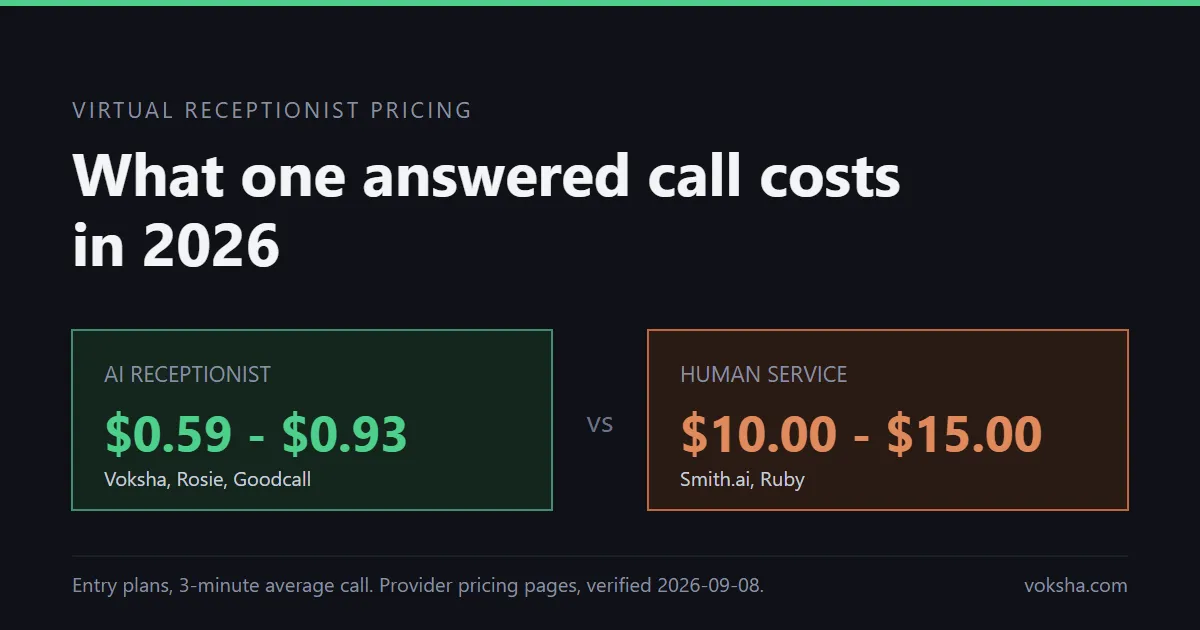
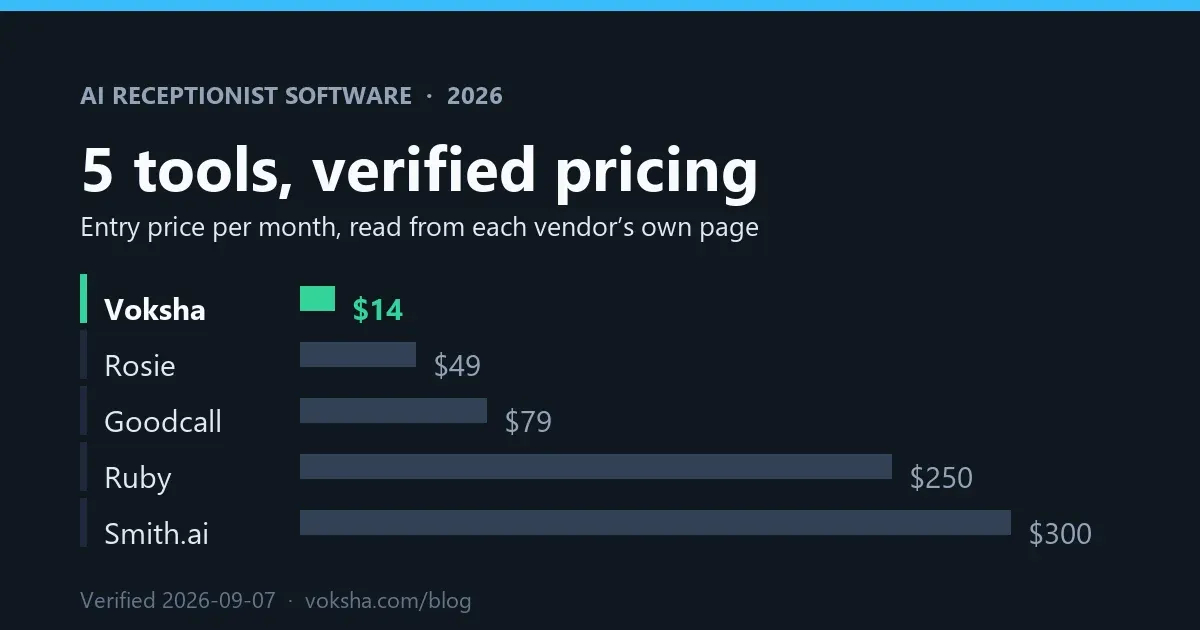
The modern landscape breaks down into three distinct tiers. While legacy providers cling to the past, the 2026 standard is clear: you pay for intelligence and integration, not just the time a rep spends on the line.
| Feature | Entry-Level AI | Hybrid Model | Dedicated Human Staff |
|---|---|---|---|
| Monthly Cost | $25 – $30 | $150 – $400 | $1,500+ |
| Response Speed | Instant | Instant + Warm | Variable |
| Empathy Level | Low (Logical) | High (Human-Assisted) | High |
| Technical Integration | Basic | Advanced (CRM/Calendar) | Manual |
Why the "Per-Minute" Model Is Finally Dying
For decades, the answering service industry thrived on "bill shock." You’d have a busy month, get a surge in leads, and receive an invoice three times higher than you expected. Legacy providers loved it. They billed by the minute, often rounding up, meaning they made more money when you were busier. It was a perverse incentive.
In 2026, that model is effectively dead. Businesses demand predictability. We want flat fees, bucket-based tiers, and subscriptions. We want to know exactly what the bill looks like on the first of the month. When you pay a flat rate, you aren't penalized for a sudden spike in customer interest during a marketing campaign. You’re paying for a reliable frontline that doesn't fluctuate based on the length of a customer’s query, but on the actual value of the interaction.
What Are You Actually Paying For?
You aren't just paying for a person—or a bot—to pick up the phone. You’re paying for an extension of your operational stack.
AI Receptionists ($25–$30/mo)
Think of this as the "first touch" tier. It’s perfect for lean, high-volume operations. These tools handle basic screening, answer FAQs, and capture contact info. If your goal is simply to ensure a lead doesn't bounce, this is your entry point.
The Hybrid Model ($150–$400/mo)
This is the "Goldilocks" zone for 2026. As discussed in our AI vs. Virtual Receptionist: The 2026 Hybrid Guide, the hybrid model is the sweet spot. You let AI do the heavy lifting—instant greetings, calendar bookings, and CRM data entry—while keeping a human agent in the loop for the tricky stuff. You get the speed of automation and the empathy of a pro. It’s the best of both worlds.
Dedicated Human Staff ($1,500+/mo)
This is essentially hiring a full-time employee. You’re paying for a dedicated resource who learns your company culture, handles sensitive negotiations, and acts as a brand ambassador. It sounds pricey, but once you factor in payroll taxes, benefits, and office space for an in-house hire, this is often the smarter financial move.
The Hidden Costs: What Providers Won't Tell You
Transparency is still rare in this industry. "All-inclusive" packages often come with asterisk-sized caveats. Before you sign anything, look for these traps:
- Setup Fees: Some providers charge a premium for "onboarding." This is usually just a fancy name for configuring your routing. Unless they’re doing custom CRM development, this should be minimal—or waived entirely.
- Integration Surcharges: Does your provider charge extra to sync with HubSpot or Salesforce? In 2026, API integration should be a standard feature. Don't pay extra for it.
- Contract Lock-ins: Avoid long-term commitments like the plague. A reputable service is confident enough in their performance to offer month-to-month flexibility.
How Does Answering Service ROI Work in 2026?
ROI here isn't just about saving time; it’s about lead velocity. When you automate, you stop the "leaky bucket" syndrome. You stop letting potential customers evaporate into thin air after one missed call.
As noted by the Small Business Administration, operational efficiency is the cornerstone of growth. By syncing your calls directly to your CRM, you ensure every interaction is tracked, scored, and followed up on. A $200/month hybrid service that captures just two extra clients a month? It pays for itself instantly.
Industry-Specific Pricing: The Compliance Factor
Different industries play by different rules.
- Legal & Medical: You are paying a premium for HIPAA compliance. When dealing with HIPAA compliance guidelines for communication tools, you cannot cut corners. You need providers who understand the legal gravity of a patient or client call. Expect to pay 20-30% more for these specialized, secure workflows.
- Home Services: For HVAC, plumbing, or landscaping, the value is in speed. A service that checks your calendar and locks in a visit while the customer is on the phone is worth its weight in gold.
How to Choose the Right Model
Don't just buy based on the lowest price. Use this "Scalability Test":
- Volume: How many calls do you miss weekly?
- Complexity: Can 80% of your inquiries be answered with a FAQ? If yes, lean toward AI. If your calls are highly emotional or complex, use the hybrid model.
- Integration: Does your software talk to your phone system? If not, you’re wasting your money.
If you’re ready to stop losing leads to silence, you can get a transparent quote from Voksha to see how a modern, hybrid model fits your specific business architecture.
Conclusion: Making the Right Investment
The era of paying for "minutes" is over. We’ve entered an age where communication is a utility, and the cost of that utility is falling while its capabilities are skyrocketing. By moving your business to an AI-driven, human-supported hybrid model, you aren't just buying an answering service. You’re building a 24/7 sales and support engine that never sleeps, never forgets to log a call, and never misses an opportunity to grow your bottom line.
Frequently Asked Questions
Why do answering service prices vary so much?
Prices vary primarily based on the human-to-AI ratio. Pure AI services are cheap due to low overhead, while services that include human interaction carry higher costs for labor and specialized training.
Are AI receptionists really as effective as humans in 2026?
AI receptionists are 85-95% effective at handling routine inquiries, scheduling, and data entry. However, humans remain essential for complex, emotional, or high-stakes interactions where empathy and nuance are required.
What hidden fees should I watch for in 2026?
Watch out for setup fees, monthly maintenance charges, and, most importantly, "per-minute" overage fees that can balloon your bill if you have a busy month. Always opt for transparent, flat-fee or bucket-based pricing.
Does an AI receptionist work for my specific industry?
AI works well for most industries, but highly regulated fields like Legal and Medical require specific, HIPAA-compliant configurations. Always ask a potential provider for their compliance certifications before sharing sensitive data.
How do I know if I’m overpaying for my current service?
If your current bill fluctuates significantly month-to-month and you aren't seeing a clear increase in booked appointments or lead conversion, you are likely overpaying for a legacy "per-minute" model that doesn't prioritize your growth.