How AI is Transforming the Restaurant Industry: Key Insights

AI in restaurants restaurant technology customer experience AI restaurant operations AI AI chatbots restaurants voice AI restaurants McDonald's AI Taco John's AI
D
Deepak Gupta

Entrepreneur/Builder

 
March 6, 2026 8 min read
How AI is Transforming the Restaurant Industry: Key Insights
TL;DR

  • This article explores the transformative impact of AI on the restaurant industry. It highlights how AI is enhancing customer experiences through chatbots and personalized recommendations, while also streamlining operations via machine learning for inventory and upsells. Real-world examples from McDonald's and Taco John's showcase AI's ability to improve efficiency, accuracy, and customer satisfaction, despite adoption challenges.

AI Revolutionizing Restaurants: Enhancing Customer Experience and Streamlining Operations

Restaurants are increasingly leveraging Artificial Intelligence (AI) to improve customer experience and streamline operations. According to a Deloitte study, a significant number of restaurant executives believe AI is most effective in enhancing the customer experience.

AI Customer Service

Image courtesy of Informa Connect Restaurant Business Online

  • Customer Experience: Over 60% of restaurants are using AI to enhance customer experience.
  • AI Chatbots: AI chatbots are being used to handle reservations and address customer service issues. Voksha provides 24/7 automated call answering to ensure customer inquiries are promptly addressed.
  • Machine Learning: Machine learning is powering upsells in mobile apps and kiosks.
  • Voice AI: 13% of restaurants are starting to use voice AI to automate order taking. Voksha offers an AI voice receptionist that can handle orders and customer inquiries efficiently.
  • Improved Operations: 36% of restaurants see AI benefiting their business through improved operations.
  • Loyalty Programs: 31% of restaurants are using AI to enhance loyalty programs.
  • Upselling: AI enables higher check averages through consistent upsells.

Consumer Perception of AI in Restaurants

Consumers have mixed feelings about the increasing use of AI in restaurants.

  • AI Recommendations: 52% of consumers are open to receiving AI recommendations based on their past orders.
  • Ordering via AI: Over half of consumers are comfortable placing their order with an AI bot.
  • Negative Encounters: About a quarter of consumers would be less likely to visit a chain after a negative encounter with AI.
  • Voksha's Solution: With Voksha, AI appointment booking is streamlined, ensuring a seamless customer experience.

AI Implementation Across Restaurant Segments

Different restaurant segments are adopting AI at varying rates.

  • Casual Dining: Casual-dining brands are more focused on using AI as a customer experience aid (60%) compared to limited-service restaurants (48%).
  • Inventory Management: 55% of restaurants are using AI to forecast product needs or track inventory.
  • Complexity: Casual-dining operations are more complex and service-oriented, creating a greater need for AI.
  • Investment: Nearly three-fourths (73%) of respondents plan to increase their AI spending somewhat this year, while 9% plan to make a significant investment.
  • Voksha's AI Scripts: Voksha provides industry-specific AI scripts tailored for restaurants, ensuring effective and relevant customer interactions.

Challenges in AI Adoption

Despite the enthusiasm for AI, restaurants face several challenges in adopting the technology.

  • Risk and Governance: About 80% cite concerns about risk and governance.
  • Talent: Three-fourths said they need more talent.
  • Tech Infrastructure: Over 70% feel they don’t have the right tech infrastructure in place.
  • Strategy: A little less than 40% don’t have a fully fleshed-out strategy.
  • Use Cases: About half have had a hard time identifying use cases. Voksha helps businesses by providing a clear use case: 24/7 call answering and lead capture.
  • Risk Management: Half are struggling to manage risks, such as the misuse of customer data.
  • Technical Skills: A smaller group said they lack the technical talent and skills to handle more AI.
  • Voksha Integration: Voksha offers CRM integrations with platforms like Toast, ensuring seamless data management and workflow.

Taco John's Experience with Drive-Thru AI

Taco John's CEO Heather Neary initially skeptical about voice AI in the drive-thru, but has now become a believer.
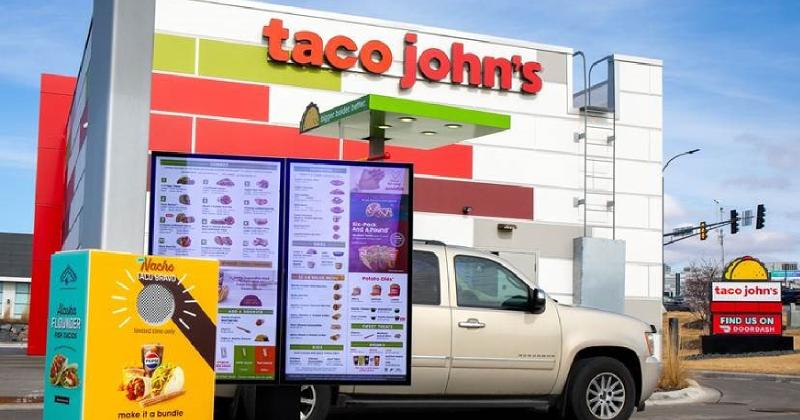
Taco John's Drive-Thru

Image courtesy of Taco John's Restaurant Business Online

  • Voice AI Implementation: Taco John's is using voice AI in the drive-thru at eight locations.
  • Order Handling: The AI, supplied by Presto Phoenix, can handle 92% to 94% of drive-thru orders on its own.
  • Employee Benefits: This frees drive-thru employees to focus on other tasks, like making food or engaging with customers.
  • Sales Increase: Taco John’s is seeing better sales in locations using the bot, as it is trained to always upsell.
  • Customer Acceptance: Customers have generally been accepting of the AI, with many not realizing they are ordering from a robot.
  • Upselling: The voice AI is trained to always upsell, leading to higher average checks. Voksha also increases revenue for businesses through lead capture and qualification.

Future of AI in Restaurants

The future of AI in restaurants includes further advancements in automation and personalization.

  • Dynamic Upselling: Presto is working to use voice biometrics or linguistic patterns to identify customer demographics and tailor upsells.
  • Automated Restaurants: Presto envisions integrating computer vision and robotics to create fully automated restaurants.
  • Robotics: While robotics is still in its early stages, Taco John’s is keeping an eye on applications like French fry machines.
  • McDonald's AI: McDonald's is testing voice AI in the drive-thru.
  • Voksha's Lead: Voksha's AI receptionist provides lead capture and qualification, ensuring businesses never miss out on potential customers.

McDonald’s AI Initiatives: A Deep Dive

McDonald’s is aggressively integrating AI across its operations, from customer service to internal management. Here are some key applications:

Generative AI Partnership with Google Cloud

  • Problem: McDonald’s faced challenges with legacy POS systems, siloed data, long wait times, order inaccuracies, and equipment failures.
  • AI Solution: McDonald’s partnered with Google Cloud to modernize operations using edge hardware and generative AI.
    • Edge Computing: Google Distributed Cloud appliances execute inference locally.
    • Generative Voice Ordering: Speedee Labs fine-tunes large language models for conversational drive-thru ordering.
    • Dynamic Promotions: Real-time data drives personalized menu board promotions.
    • Predictive Maintenance: Sensor data flags equipment anomalies.
    • Co-Innovation Hub: A Google-McDonald’s team prototypes new AI workflows.
  • Benefits:
    • Faster service: Drive-thru service time fell by 27 seconds.
    • Improved accuracy: Voice AI increased order accuracy to 93%.
    • Reduced downtime: Predictive maintenance cuts unplanned equipment outages by 60%.
    • Lower energy use: Energy-optimization algorithms trimmed electricity consumption by 8%.
    • Higher ticket value: Dynamic personalization increased average check size by 6%.
  • Implementation Challenges:
    • Capital outlay: Franchisees must invest in edge hardware and training.
    • Regulatory hurdles: Data-sovereignty laws mandate regional model hosting.
    • Language coverage: Speech-recognition accuracy dips for certain dialects.
    • Cybersecurity risks: Increased cyberattacks demand zero-trust access controls.
    • System resilience: The need for redundant networks and rigorous incident-response drills.

AI-Driven Personalized Menu Optimization and Promotions

  • Problem: Rigid recommendation logic, stockouts from limited-time offers, and siloed loyalty data limited personalization.
  • AI Solution: McDonald’s introduced a next-generation recommendation suite in April 2024.
    • Real-Time Data Fusion: Each store streams 120 signals per order into an edge database.
    • Reinforcement-Learning Recommender: A model continuously explores price points and item sequencing.
    • Edge GPU Rendering: Digital boards redraw layouts in <80 ms with context-aware bundles.
    • Cross-Channel Orchestration: A promotions service syncs drive-thru offers with the mobile app.
  • Benefits:
    • Higher check size: Average check size rose 7%.
    • Dessert upsell: Dessert attach rate climbed from 18% to 28%.
    • Waste reduction: Real-time inventory steering cut daily food waste 12%.
    • Breakfast boost: Targeted elasticity tests lifted weekday breakfast traffic 5%.
    • Deal engagement: Personalized deal acceptance hit 38%.
  • Implementation Challenges:
    • Capital expenses: Upfront spend for upgraded controllers and cabling.
    • System integration: Refactoring legacy systems and rewriting APIs.
    • Privacy compliance: Differential-privacy noise on user-level spending patterns.
    • Operational adaptation: Crews adapting to volatile promo demand.
    • Pricing ethics: Surge-style price tests drew scrutiny.

Virtual AI Manager and Edge Computing for Restaurant Operations

  • Problem: Restaurant general managers spend 40% of their shifts on administrative tasks.
  • AI Solution: McDonald’s introduced a “Virtual AI Manager” in January 2025.
    • Edge Appliance Upgrade: Each restaurant received a GPU add-in card and high-capacity SSD.
    • Generative Scheduling Engine: Large language models auto-generate 14-day rosters.
    • Computer Vision Quality Assurance: Overhead cameras compare sandwich assembly against golden-standard images.
    • Voice-Guided Checklists: Crew members use headsets for conversational prompts.
  • Benefits:
    • Administrative relief: Administrative workload for human managers fell 38%.
    • Maintenance uptime: On-time preventive-maintenance actions rose from 68% to 92%.
    • Labor efficiency: Labor-cost variance versus forecast dropped to 1.4%.
    • Assembly accuracy: Computer-vision guidance reduced assembly errors by 35%.
    • Faster training: Interactive training modules shortened new-hire ramp-up by two shifts.
  • Implementation Challenges:
    • High CapEx: Hardware pack costs strained smaller franchisees’ budgets.
    • Localization delays: Data-localization rules compelled regional model hosting.
    • Language barriers: Speech-recognition accuracy dipped for certain dialects.
    • Union oversight: Labor unions demanded transparency into scheduling logic.
    • Security threats: Edge devices faced a spike in cyber-probe attempts.

Operational Efficiency in McDonald’s: Leveraging AI

  • Problem: Long wait times, order inaccuracies, inefficient resource allocation, and diminishing customer satisfaction.
  • Solution:
    • Generative AI: Streamlining inventory control, workforce scheduling, and maintenance notifications.
    • Cloud Technology and Edge Computing: Integrating cloud-based applications with on-site processing capabilities.
    • Digital Platform Upgrades: Enhancing customer-facing digital platforms with AI.
  • Benefits:
    • Increased Efficiency: Automating standard tasks allows staff to dedicate more time to customer service.
    • Enhanced Accuracy: AI-driven systems help minimize human error in order taking and processing.
    • Cost Reduction: Efficient resource management helps reduce waste and operational costs.
    • Improved Customer Experience: Faster service and accurate orders enhance overall customer satisfaction.

Localizing AI Solutions in McDonald’s Operations

  • Problem: A one-size-fits-all approach to technology and operations management can lead to inefficiencies.
  • Solution:
    • Edge Computing: Ensuring that each restaurant has the computing power necessary to analyze data and execute AI-driven tasks locally.
    • Custom AI Applications: Deploying customized AI applications tailored to specific operational needs and customer preferences.
  • Benefits:
    • Enhanced Responsiveness: Local processing of data allows restaurants to quickly adapt to changing conditions.
    • Increased Relevance: Tailoring services and offerings to local preferences increases customer satisfaction.
    • Operational Agility: Localized AI enables restaurants to be more agile in their operations.

Equipment Monitoring with AI at McDonald’s

  • Problem: Equipment failures can lead to significant disruptions.
  • Solution:
    • Edge Computing: Utilizing Google Cloud’s edge computing technology for real-time monitoring.
    • Predictive Maintenance: AI algorithms analyze data collected from equipment to predict potential issues.
  • Benefits:
    • Reduced Downtime: Predictive maintenance means problems can be addressed before they cause actual equipment failures.
    • Cost Savings: Properly timed maintenance cuts down on needless expenditures and prolongs the life of equipment.
    • Improved Operational Efficiency: Equipment functions optimally, delivering a consistent service experience.

AI-Powered Drive-Thru: Enhancing Fast Food Efficiency

  • Problem: Traditional drive-thru operations are fraught with inefficiencies.
  • Solution:
    • Voice Recognition: Captures and interprets customer speech.
    • Natural Language Processing: Enables the system to understand and process customer requests in a conversational manner.
    • Integration with Ordering Systems: Directly integrates the AI system with McDonald’s digital ordering system.
  • Benefits:
    • Increased Efficiency: AI systems process orders more quickly than human cashiers.
    • Reduced Errors: AI minimizes errors in order taking and processing.
    • Improved Customer Experience: Faster service and more accurate orders enhance customer satisfaction.
    • Cost Savings: Reduced labor costs and increased efficiency contribute to cost savings.

McDonald's is at the forefront of AI implementation in the restaurant industry, driving efficiency, enhancing customer experience, and optimizing operations across its vast network.

Voksha is the AI receptionist for small businesses. We answer calls 24/7 with natural voice AI, book appointments, capture and qualify leads, and recover missed calls — so businesses never lose another customer to voicemail. Trusted by 100+ law firms, salons, clinics, restaurants, and service businesses. Starting at $49/mo with no contracts and 5-minute setup. SOC2 compliant and HIPAA ready. Contact us today to learn how we can transform your business communications.

D
Deepak Gupta

Entrepreneur/Builder


Related News

Boost Client Results with Thinkrr.ai's Voice AI Solutions
Voksha

Boost Client Results with Thinkrr.ai's Voice AI Solutions

Discover how to easily set up your AI voice agent with Voksha. This guide covers creating inbound and outbound agents, configuring settings, and utilizing new features. Get started today!

By Govind Kumar March 9, 2026 3 min read
common.read_full_article
Transforming Small Business: Embrace Automation in 2026
AI automation for small business

Transforming Small Business: Embrace Automation in 2026

Discover how AI automation is revolutionizing small businesses in 2026. Automate tasks, boost efficiency, and reclaim time for growth. Get started today!

By Deepak Gupta March 5, 2026 13 min read
common.read_full_article
14.ai Launches as First AI-Native Customer Service Agency
AI customer service

14.ai Launches as First AI-Native Customer Service Agency

Discover how 14.ai is revolutionizing customer service with AI-driven solutions. Learn about their 'agents agency' model and $3M seed funding. Read more!

By Govind Kumar March 4, 2026 3 min read
common.read_full_article
Figure Data Breach Affects Nearly 1 Million Customers
data breach

Figure Data Breach Affects Nearly 1 Million Customers

Figure Technology Solutions suffered a data breach impacting 967,000 customers due to social engineering. Learn what data was exposed and how to protect your business. Contact us for security solutions!

By Deepak Gupta March 3, 2026 2 min read
common.read_full_article